


Share this Pokémon
Characteristics
- Height:
- 0.40
- Weight:
- 1.20
Base stats
Total: 310Combat strengths and weaknesses
Damage multiplier taken by Swablu depending on the attacking move's type. ×2 and ×4 are the attacks to avoid.




Your Pokédex, in cards
Every card of every Pokémon, what you already have and what you're missing.
Evolutions


Additional information
Pokémon Cards (25)
Showing the latest 12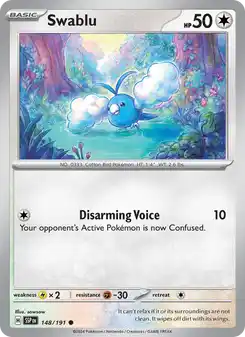








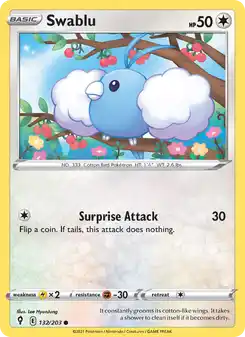

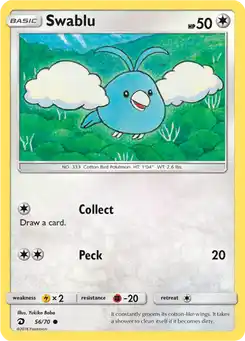
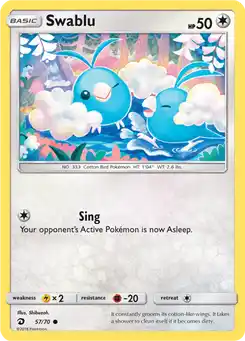


Official artwork

Base sprites


Pokémon Home


Dream World

Showdown


Detailed information
Overview of Tylton
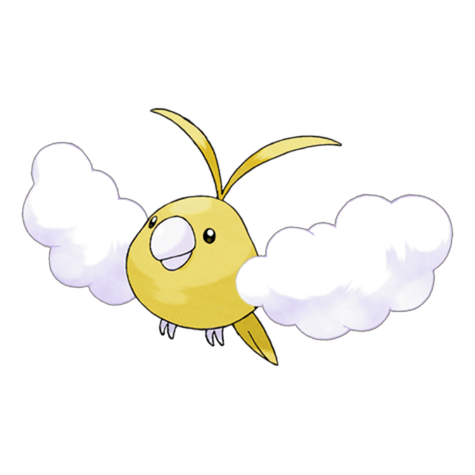
Tylton is a Normal and Flying type Pokémon introduced in the third generation. Its English name is Swablu and its Japanese name is チルット. This Pokémon is easily recognizable thanks to its fluffy wings that resemble cotton clouds. Tylton is often considered a calm and peaceful Pokémon, which is reflected in its rather defensive and utility-oriented playstyle.
In the Pokédex, Tylton holds national number 333. It is small in size and light in weight, which directly influences certain moves and battle mechanics. It is primarily encountered in the wild in mountainous or temperate areas, often in tall grass or near specific routes depending on the game.
Type, weaknesses, and resistances
Tylton's Normal and Flying typing grants it interesting resistances but also notable weaknesses. It is immune to Ground type moves and resists Grass and Bug type moves. However, it is vulnerable to Electric, Ice, and Rock type moves, which limits its options in direct combat without preparation.
Strategically, Tylton is not used to absorb heavy damage but rather to use support moves or prepare for its evolution. Its base Defense and HP remain modest, which calls for caution during battles.
Base stats and nature
Tylton's base stats are generally low, making it an early-game or transitional Pokémon. Its Attack and Special Attack are limited, while its Defense and Special Defense are adequate for its level. Speed is average, which sometimes allows it to move before certain opponents early in the game.
Nature can influence Tylton's effectiveness. A nature boosting Special Defense or Speed is often preferred to improve its survivability or positioning in battle. Players aiming for an efficient evolution take care to choose a specimen with good values from the moment of capture.
Moves and key abilities
Tylton has a movelist primarily oriented toward the Flying type and Normal type. It learns Peck fairly early, a simple but reliable move in the early game. It can also learn support moves such as Safeguard, useful in strategic and team battles.
With TMs and HMs, Tylton can access a variety of moves such as Growl or more powerful Flying type moves as it levels up. These moves remain limited by its offensive stats, however, which pushes players to quickly plan its evolution.
Evolution and value in-game
Tylton evolves into Altaria at a certain level, gaining the Dragon type in addition to Flying. This evolution radically changes its role in battle, with much more balanced stats and significantly greater strategic potential. In-game, Tylton is therefore primarily used as a necessary step toward Altaria.
In more recent games, Altaria even gains a Mega Evolution, further reinforcing the value of catching a good Tylton from the start. Attentive players take its IVs and level into account before evolving it.
Tylton in the trading card game
In the Pokémon Trading Card Game, Tylton generally appears as a basic card with simple attacks. These cards are often used as the evolution base toward Altaria, with effects focused on defense or support.
Collectors particularly appreciate illustrations highlighting its fluffy appearance and aerial style. Certain promotional or set-specific cards are sought after for their aesthetic rather than for their competitive gameplay strength.