


Share this Pokémon
Characteristics
- Height:
- 1.30
- Weight:
- 77.40
- Gender differences:
- Yes
Base stats
Total: 475Combat strengths and weaknesses
Damage multiplier taken by Cacturne depending on the attacking move's type. ×2 and ×4 are the attacks to avoid.


Resistances - weak attacks


Immunities - no damage taken

Your Pokédex, in cards
Every card of every Pokémon, what you already have and what you're missing.
Evolutions

Additional information
Pokémon Cards (13)
Showing the latest 12






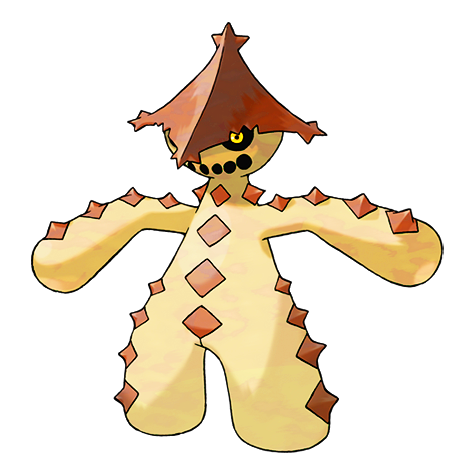
Official artwork
Base sprites


Pokémon Home


Dream World
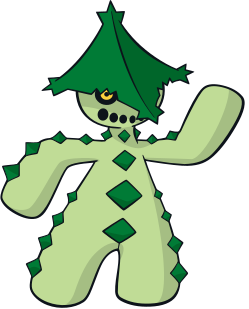
Showdown


Detailed information
Overview of Cacturne
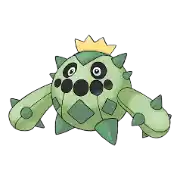
Cacturne is a Grass and Dark type Pokémon introduced in the third generation. Its English name is Cacturne and its Japanese name is ノクタス. It is the direct evolution of Cacnea, obtained at a certain level, making it an accessible Pokémon with a strong offensive potential for players looking for an aggressive profile.
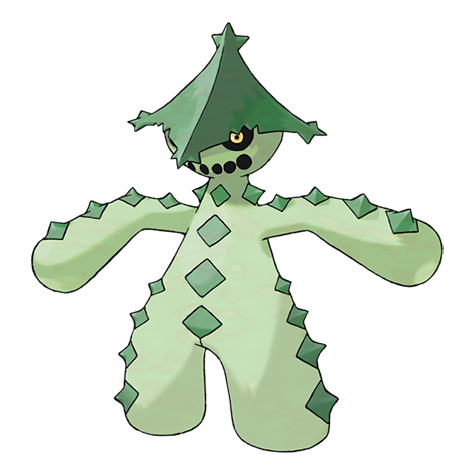
Cacturne stands out for its appearance inspired by a humanoid cactus, often associated with desert environments. In the Pokédex, it is described as a Pokémon primarily active at night, taking advantage of sandstorms to move discreetly. These lore elements have an indirect impact on its strategic identity, particularly in sand-oriented teams.
Type and role in battle
Cacturne's dual Grass and Dark typing offers interesting offensive coverage, but also several significant weaknesses. It is vulnerable to Fire, Ice, Fighting, Bug, Flying, and Fairy type moves. In return, it resists Water, Ground, Grass, Ghost, and Dark type moves, allowing it to switch in against certain defensive profiles.
In battle, Cacturne is primarily used as a physical or special attacker depending on the generation and format. Its base stats strongly favor Attack, while its Defense and HP remain limited. This makes it an effective Pokémon for dealing heavy damage quickly, but one that requires good anticipation to avoid being directly countered.
Offensive moves
Cacturne has a wide selection of Grass and Dark moves suited to strategic battles. It can exploit high-impact moves to surprise opponents, particularly in formats where frequent switches are common. Its average Speed, however, requires team support such as forced switches or safe pivoting.
Abilities and synergies
Cacturne's abilities reinforce its offensive orientation and its connection to hostile environments. Some abilities improve its effectiveness in sandstorms, making it particularly interesting in teams built around that weather condition. Other abilities provide opportunities to pressure opponents by punishing positioning errors.
These abilities directly influence the way Cacturne is played. Depending on the format, it can be used as a late-game cleaner or as a mid-game threat, capable of forcing switches and creating openings for the rest of the team.
Evolution and place in the Pokédex
Cacturne evolves from Cacnea at a specific level, allowing players to easily plan its integration into a team. In the Pokédex, it occupies a representative position among desert Pokémon, often associated with the Hoenn region. Its Pokédex number and classification reflect its role as a nocturnal predator.
Its height and weight are consistent with its slender appearance, which has no direct impact in battle but contributes to its overall identity in the Pokémon universe. These elements are also referenced on certain trading cards.
Cacturne in the trading card game
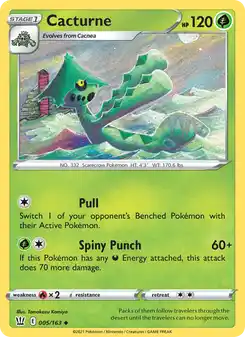
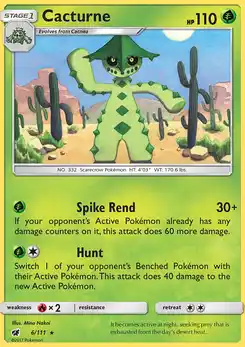
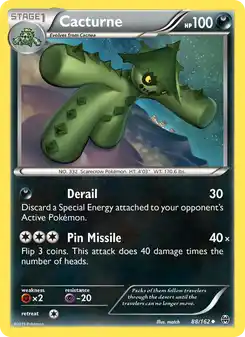
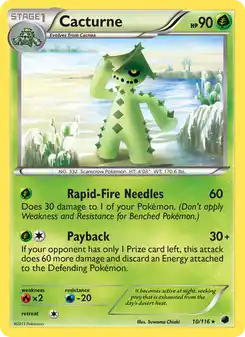
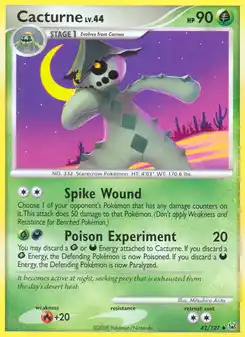
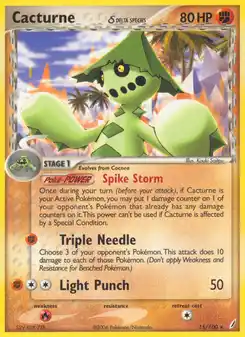
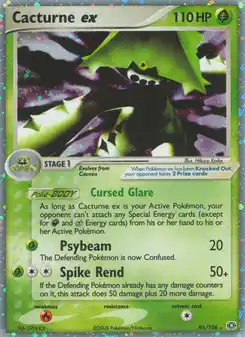
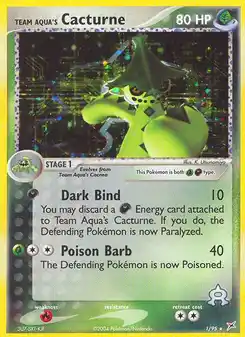
In the Pokémon Trading Card Game, Cacturne appears regularly in various forms, with illustrations highlighting its menacing and solitary appearance. Cacturne cards are often oriented toward direct damage or disruption mechanics, in keeping with its Dark type.
Depending on the set, certain cards may become sought after by collectors, particularly when Cacturne features alternative artwork or specific mechanics. For players and collectors alike, Cacturne remains a recognizable and appreciated Pokémon for its unique style and offensive potential.