



N°0019 · Generation 1
Rattata
It can gnaw on anything with its two front teeth. If you see one, there are probably 40 more in the area.
Share this Pokémon
Characteristics
- Height:
- 0.30
- Weight:
- 3.50
- Gender differences:
- Yes
Base stats
Total: 253Combat strengths and weaknesses
Damage multiplier taken by Rattata depending on the attacking move's type. ×2 and ×4 are the attacks to avoid.
Weaknesses - dangerous attacks

Immunities - no damage taken

The complete Pokédex, in your pocket
Detailed pages, types, stats and your favourite Pokémon - on the app.
Evolutions


Forms
Forms available in your language are clickable. The others show their stats below.
Additional information
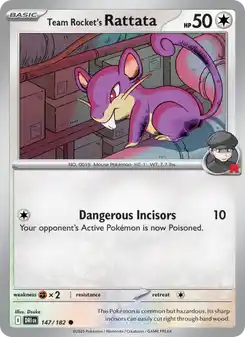
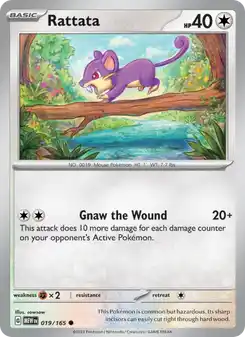
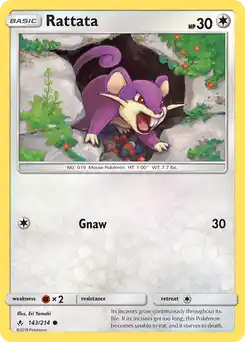
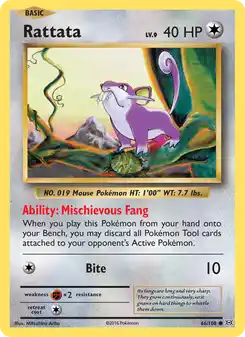
Pokémon Cards (18)
Showing the latest 12







Official artwork

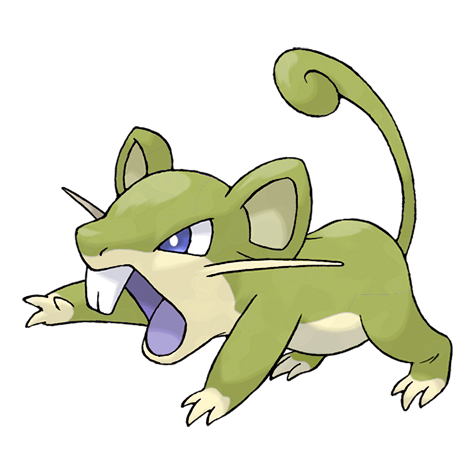
Base sprites


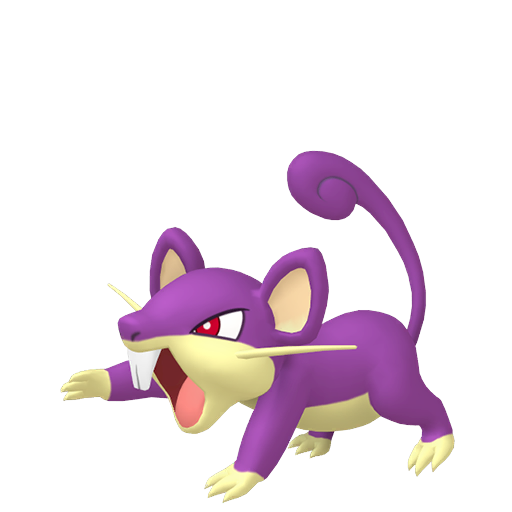
Pokémon Home

Dream World

Showdown


Detailed information
Overview of Rattata
Rattata is a Normal-type Pokémon, well known to players as one of the first wild Pokémon encountered in tall grass right at the start of the adventure. This small rat-inspired creature is present across many generations and regions, making it an iconic and very common Pokémon in the Pokédex. Its recurring presence in the Red, Blue, and Yellow versions, but also in Diamond, Pearl, Black, White, Sun, Moon, and even Pokémon GO, makes it a familiar companion for the majority of Trainers.
Despite its simple appearance, Rattata has remarkable Speed for its low level, which often lets it attack first. Early in the game, this Pokémon can surprise players with the power of some of its physical bite-based attacks, such as Bite or Super Fang, especially if its nature and individual values are well chosen. Although it is not considered a final-stage or high-level strategic Pokémon, it remains very useful for understanding the basic mechanics of battle, stats, EVs, and moves.
This Rattata entry aims to compile all the important information in one detailed overview: description, type, moves, evolution, catch rate, breeding, abilities, alternative forms like the Alolan form, battle role, and tips for training it to level 20 and beyond. Whether you are playing on a classic cartridge, on Pokémon GO, or simply filling your Pokédex, this guide will help you make better use of this very common Pokémon.
Description and origins of Rattata
General description
Rattata is a small quadrupedal Pokémon resembling a rat. It has a body that is mainly purple or green depending on the game and the variant, with a white belly, large incisors, and a long tail curling upward. Its large ears and red eyes give it an alert, constantly watchful appearance. This sharp sight, combined with its Speed, allows it to quickly spot threats and food.
In Pokédex descriptions, Rattata is often portrayed as a very cautious Pokémon that lives near human settlements and slips through tall grass, fields, or tunnels. It can settle almost anywhere, which explains why it is considered a common species with a high encounter rate. It is often seen breaking the rhythm at the start of the game, appearing again and again in the grass at every turn, to the point of becoming almost a symbol of random encounters.
Origins of the name Rattata and foreign versions
The French name Rattata comes simply from the word "rat," combined with a rapid-sounding suffix that reflects its Speed and its ability to move in the blink of an eye. In English, the Pokémon's name is also Rattata, which makes the correspondence between the French and English versions easy. In Japanese, it is known as Koratta, a play on words that similarly refers to the rat and its small size. These different names all reflect the straightforward but effective concept behind the Pokémon: a small rodent that is omnipresent, agile, and resilient.
Its design is heavily inspired by the rats and mice found in cities and the countryside. It is a Normal-type Pokémon, without any particular element like Fire, Water, or Psychic, making it neutral in many battles. This simplicity of type and form makes it an excellent example for explaining the basics of the Normal type, physical attacks, and damage interactions in the first battles of the game.
General characteristics in the Pokédex
Number and generation
Rattata appears from the first generation onward. In the National Pokédex, it has a relatively low number, making it one of the first Normal-type Pokémon encountered. Its number makes it easy to find in Pokédex charts, on Pokémon cards, and in lists of Pokémon by region or generation. Its constant presence — from Kanto to Alola, passing through Johto and Sinnoh — reinforces its status as a very widespread foundational Pokémon.
Height and weight
Rattata is a small Pokémon in terms of height, which is reflected in how it is depicted in battle and on its Pokémon card. It weighs only a few kilograms, consistent with its fragile but very mobile appearance. Its small size and curled tail give it a silhouette that is easily recognizable in profile or from the front. This light build partly explains its high Speed and relative fragility in terms of HP and Defense.
Form, colors, and nature
The classic form of Rattata is that of a rat with purple coloring and a white belly. In some versions, it can be encountered in its shiny form, sometimes in greener or different shades, giving it an even rarer and more sought-after look. Its thin, curled tail and large fangs are essential elements of its visual identity. A Rattata's nature plays an important role in its battle power: a nature that boosts Speed or Attack at the expense of, for example, Special Defense or Defense, is often preferred by Trainers.
A Careful nature can be used if one wants to bolster its Special Defense a little while maintaining a playstyle based on Speed and mobility. However, to maximize damage output, natures favoring Attack or Speed generally remain more effective, as Rattata shines above all through its ability to strike fast and hard for its level.
Type, resistances, and weaknesses
Rattata is a Normal-type Pokémon. This type is characterized by great neutrality in battle: most Normal-type attacks hit a large number of opposing types without a particular bonus or penalty. The Normal type is not super effective against any specific type, but is completely ineffective against the Ghost type. This means that if Rattata uses a Normal-type move against a Ghost-type Pokémon, the attack will have no effect and damage will be zero.
In return, the Normal type has only one main weakness: the Fighting type. Fighting-type attacks deal double damage to Rattata, making them a significant threat in a duel. On the other hand, Rattata benefits from immunity to Ghost-type attacks, which have no effect on it whatsoever. In practice, this sometimes allows it to avoid damage in certain battles, even if its low Defense means it cannot stay on the field long against more powerful opponents.
This combination of neutrality and limited vulnerability makes the Normal type very interesting for new players. Rattata perfectly illustrates this concept and helps in understanding type interactions, damage values, and the notion of offensive coverage when building a balanced team.
Rattata's base stats and EVs
Base stat distribution
Rattata's base stats are designed to make it a fast and relatively offensive Pokémon for the start of the game. Its Attack and Speed are its best assets, even if they remain modest compared to higher-level Pokémon or final-stage evolutions. Its Defense and Special Defense are low, and its base HP is limited, making it fragile in extended battles. It is therefore better to rely on quick hits and priority attacks rather than drawn-out damage trades.
In summary, Rattata has a decent Speed base, sufficient Attack to deal notable damage at level 10 or level 20, but low Defense values. It is not designed to tank hits, but rather to strike first and exploit its Speed advantage. With the right items and training, it can reach a noteworthy maximum Speed for its category, especially if EVs are well distributed.
EVs gained and optimization
When defeated, Rattata typically yields Speed EVs, reflecting its dominant stat. For a Trainer who wants to raise a fast Pokémon, battling hordes of Rattata can be a simple solution for accumulating Speed EVs. From an optimization standpoint, a Rattata well trained in Attack EVs and Speed EVs can surprise in early-game encounters, especially in low-level challenge formats or certain specific battle modes.
To maximize Rattata's effectiveness, EVs should be prioritized between Attack and Speed. Even if its raw power remains limited, this optimization allows it to reach an interesting maximum Speed to take the initiative every turn. The exact EV values can vary depending on the chosen set, but the general principle stays the same: take full advantage of its ability to strike fast.
Rattata's moves and abilities
Moves learned by level-up
Rattata learns several useful moves by leveling up. Very early, it gets basic moves like Tackle, which introduces the mechanics of physical damage. It can then learn Bite, a Dark-type move that makes good use of its solid Attack stat and can deal decent damage while sometimes triggering a flinch effect.
As levels rise, Rattata can also learn moves based on its fangs, such as Super Fang or Ice Fang in certain generations, reinforcing its identity as a small biting Pokémon. Managing PP for these moves is important, as it does not have an unlimited supply. For a Trainer, it is therefore wise not to waste powerful moves on weak targets, especially when deep in a long tunnel or dungeon far from a Pokémon Center.
TMs, HMs, and other moves
In several versions, Rattata can learn moves via TMs and sometimes HMs, depending on the generation. It can for example learn Dig in certain games, which lets it attack while avoiding hits for one turn. This move can catch opponents off guard and provide Ground-type coverage — very useful against certain types like Electric.
TMs and HMs also give it access to various offensive or defensive options depending on the generation and game: more powerful Normal-type attacks, support moves, or attacks with a particular effect on the turn. The Trainer must then compose a fitting set, taking Rattata's nature, EVs, CP (combat points in Pokémon GO), and strategic goals into account. The values of Attack, Speed, and the choice of moves have a direct effect on its overall performance.
Useful moves in battle
In battle, Rattata's most useful moves are those that benefit from its Speed and Attack. A combination of Normal- and Dark-type attacks can form a simple but effective set. Tackle and Bite can be complemented by TM-learned moves such as Dig or other physical hits. Priority attacks in certain sets also allow the player to surprise an opponent by finishing off a weakened Pokémon before it can act.
Even if Rattata is not designed for very high-level battles, it can be interesting in fun formats, specific challenges, or themed teams. In certain games, it also appears in raids or specific turn-based battles, giving it a small place in the players' overall strategy.
Rattata evolving into Raticate
Rattata evolves into Raticate after reaching a certain level, generally early in the adventure. This evolution lets it gain in power, Attack, and Speed, while improving its defenses somewhat. For a Trainer, evolving Rattata is a logical choice if one wishes to keep using it beyond level 20 or in more serious battles.
Raticate retains the Normal type of Rattata in many versions, but benefits from a more imposing design, with larger fangs and a heavier weight in kg. The tail, overall shape, and color remain consistent with the base evolution. Some Trainers choose to keep an unevolved Rattata for specific challenges, but most players prefer to enjoy the power boost offered by Raticate.
In certain generations, such as Sun and Moon, Rattata has a regional form that evolves into an alternative form of Raticate with a dual type, which changes its battle role and weaknesses. These variants further enrich the possible sets and strategies around this Pokémon.
Rattata's Alolan form
In the Sun and Moon versions, as well as their sequels, Rattata has a regional variant called the Alolan form. This version of Rattata adopts a darker appearance, with black fur, a more prominent mustache, and the look of a nocturnal rat. Its type changes and becomes Normal/Dark, which strongly modifies its battle interactions.
The Alolan form of Rattata, and its evolution into Alolan Raticate, offer new moves and strategies. The dual Normal/Dark typing gives it new resistances and new weaknesses, particularly against Fighting- and Fairy-type attacks. This form is especially interesting to analyze in a type chart, as it clearly illustrates the effect of type combinations on damage, survivability in battle, and a Pokémon's role on a team.
Whether in its classic form or its Alolan form, Rattata remains an easily accessible Pokémon that can hide a few surprises when you dig into its moves, abilities, and type interactions.
Abilities, nature, and breeding
Rattata's abilities vary by generation, but effects that reinforce its ability to attack quickly or survive by the narrowest margin are common. Some abilities can boost its power when it has low HP, or improve its accuracy. These abilities have a direct impact on its battle role, especially in low-level duels where every hit counts.
A Rattata's nature is also important. A nature that boosts Attack or Speed at the expense of another stat is often ideal. A Careful nature is possible, but does not always exploit its offensive profile to the fullest. For breeding, Rattata is an easy Pokémon to raise: it can produce many Eggs, which lets players search for good IVs, the right nature, and potentially useful Egg moves to build a specific set.
In breeding, it is entirely possible to create a line of optimized Rattata — with well-distributed EVs and an appropriate nature — to obtain a perfectly calibrated Pokémon for the first battles or specific challenges. Trainers who love optimizing every detail can thus fully exploit the mechanics of breeding, individual values, and abilities.
Rattata across the different game versions
Red, Blue, Yellow, and the classic generations
In Pokémon Red, Blue, and Yellow, Rattata is one of the most common Pokémon. It is encountered very early, in the first grass areas around the starting towns. Its high encounter rate makes it a recurring opponent, almost unavoidable. In these versions, Rattata helps in understanding the mechanics of catching, the catch rate, and how to use Poké Balls. It is not unusual for a player's first capture to be a Rattata, given how prevalent it is.
Throughout later generations — Gold, Silver, Crystal, then Ruby, Sapphire, and Emerald — it remains an easy-to-find Pokémon, often cited as an example of a common Pokémon in Pokédex guides and summaries. Its presence in grass encounter tables clearly shows its status as a foundational Pokémon, useful for training and catching.
Diamond, Pearl, Black, White, and recent generations
In Diamond and Pearl, as well as in Black and White, Rattata continues to appear — sometimes on specific routes or through transfers. Its role remains similar: a simple Pokémon to encounter with a high catch rate, ideal for breeding strategic ideas or EV training. It is not always native to every version, but generally remains accessible via trade or cross-generation transfer systems.
In more recent generations, its Alolan variant and its presence in Sun and Moon renew interest in it somewhat, giving it a new type combination and a redesigned look. Even a Pokémon as simple as Rattata continues to evolve and adapt to new regions and new game mechanics.
Rattata in Pokémon GO
In Pokémon GO, Rattata is also very common. It appears in many urban and rural areas, making it a frequent encounter in daily play. Its base CP is low, but it is very useful for gaining Trainer experience, obtaining Candy, and understanding the mechanics of catching, transferring, and evolving into Raticate.
In certain events, Rattata may appear with an increased encounter rate, sometimes in its shiny form. It can also appear in some low-level raids, allowing new players to test raid battles without much difficulty. Even if it is not a competitive choice in the higher leagues, it remains a symbol of the first hours of gameplay and the most common encounters.
Pokémon cards and merchandise
Rattata also appears in the Pokémon Trading Card Game. Several editions feature a card at its image, with simple moves like Tackle or Bite, reflecting its base capabilities. These cards are generally common, easy to obtain, making them frequent inclusions in beginner-oriented packs.
The damage values of its attacks on the card are modest but consistent with its role as a small starter Pokémon. The effects of these attacks may vary by edition, sometimes featuring secondary effects like the ability to push the opponent back or discard cards. Rattata also appears in various merchandise, such as figures, plushies, and artwork, further reinforcing its place in the Pokémon universe.
Catching, encounter, and training tips
Catching a Rattata is very straightforward. Its catch rate is high and it is frequently encountered in tall grass around the first towns. A standard Poké Ball is usually enough, especially if it has been slightly weakened by a move like Tackle. The chance of catching it is therefore very good, even for a beginner Trainer at level 5 or 6.
In training, it is recommended to level it up quickly to access its best moves. Reaching level 20 already provides a relatively fast Pokémon with some useful attacks. Although Rattata is not meant to stay on the team until the major endgame battles, it can serve as a first attacker, a support Pokémon for catching other Pokémon, or a training tool for understanding EVs, natures, and abilities.
When building a set, prioritize physical moves that benefit from its solid Attack and Speed. More experienced Trainers can even try original sets combining support moves and priority attacks to surprise the opponent in certain combat turns.
Summary and strategic profile
In summary, Rattata is a very common Normal-type Pokémon, easy to encounter, catch, and train. Its raw power remains limited, but its Speed and access to fang-based moves make it useful in the early adventure. Its evolution into Raticate, as well as its Alolan variant, offer more possibilities for players who want to keep it on the team longer.
This profile compiles the essential information: type, moves, evolution, stats, EVs, abilities, nature, catch rate, breeding, presence across the different generations, and its role in Pokémon GO and the card game. Whether you are a new player discovering Rattata for the first time, or an experienced Trainer completing a full Pokédex, this Pokémon remains a cornerstone of the Pokémon universe.
Whether it is a simple Rattata encountered on a random route or a carefully raised specimen with an optimal nature and a strategic moveset, this Pokémon perfectly illustrates the depth of the Pokémon universe, where even the most common creatures have a story, an origin, and a precise role in each generation — from Red and Blue to Sun and Moon, all the way to modern games and apps like Pokémon GO.
