


N°0020 · Generation 1
Raticate
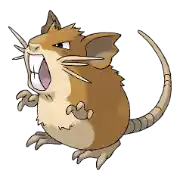
Its hind legs are webbed. This allows it to pursue prey into streams and rivers.
Share this Pokémon
Characteristics
- Height:
- 0.70
- Weight:
- 18.50
- Gender differences:
- Yes
Base stats
Total: 413Combat strengths and weaknesses
Damage multiplier taken by Raticate depending on the attacking move's type. ×2 and ×4 are the attacks to avoid.
Weaknesses - dangerous attacks

Immunities - no damage taken

The complete Pokédex, in your pocket
Detailed pages, types, stats and your favourite Pokémon - on the app.
Evolutions
Forms
Forms available in your language are clickable. The others show their stats below.
Additional information
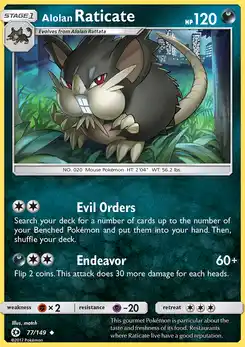
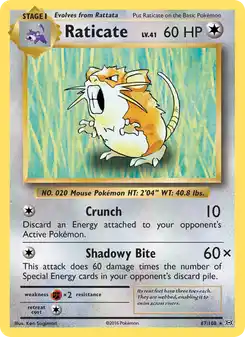
Pokémon Cards (21)
Showing the latest 12









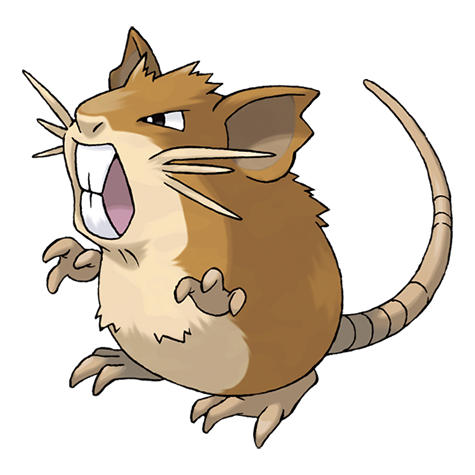
Official artwork
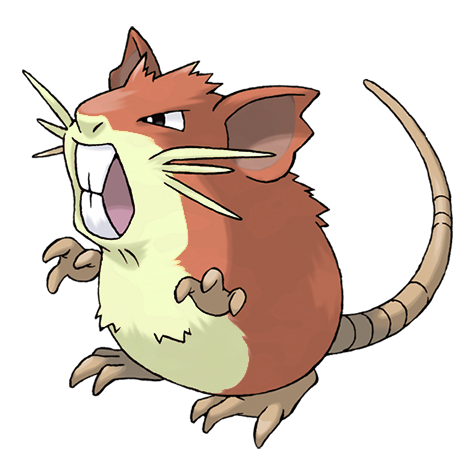
Base sprites


Pokémon Home

Dream World
Showdown


Detailed information
Overview of Raticate
Raticate is the direct evolution of Rattata, an iconic Normal-type Pokémon from the first generation. A truly aggressive rat with sharp eyes and fearsome fangs, it appears very early in the games of the Kanto region. In Red, Blue, and Yellow, this Pokémon is often one of the first serious opponents the Trainer faces, whether in tall grass, on a route, or in the hands of the rival. Refined across the generations, Raticate now exists in a classic form and an Alolan form, broadening its battle role and strategic possibilities.
With very solid Speed, good Attack stats, and enough HP for the early adventure, Raticate establishes itself as a basic offensive Pokémon that can deal serious damage if underestimated. It perfectly illustrates the concept of a "common but dangerous" Pokémon — capable of knocking out a carelessly positioned low-HP Pokémon through moves like Bite, Ice Fang, or Fire Fang depending on the game. This profile aims to provide a complete description of Raticate: its moves, EVs, evolution, appearances across various games and merchandise like Pokémon cards.
Whether you are looking for precise information on its base stats, type, abilities, level-up moves, or simply want to better understand the role of this aggressive rat in the Pokémon universe, this detailed overview will cover everything you need. Raticate may seem small compared to the great Pokémon of the late game, but well trained, it can earn a respectable place on your team, especially in the first hours of your adventure.
Description and origins of Raticate
General description
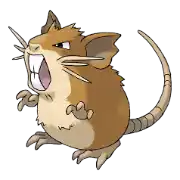
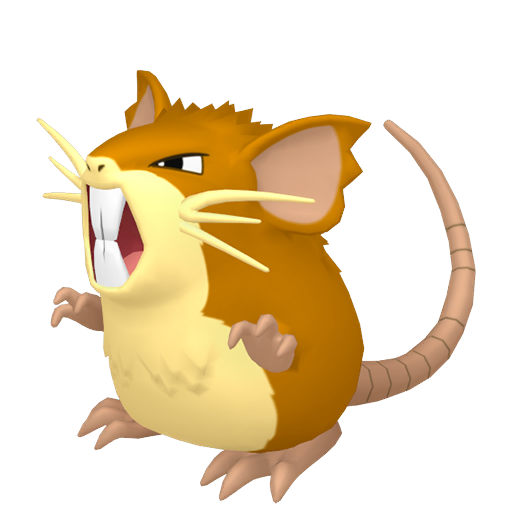
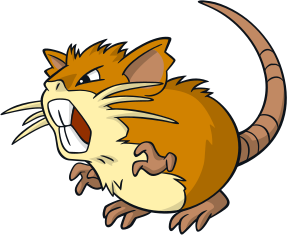
Raticate is a Pokémon resembling a large rat or giant mouse. Its stocky body, covered in brown fur sometimes tipping toward green depending on illustrations, rests on short powerful legs. Its belly is generally white, creating a marked contrast with its darker back. Its thick tail, long whiskers, and large teeth are the most characteristic elements of its silhouette, making it immediately recognizable in the Pokédex.
Its teeth — more precisely its large fangs — grow continuously. This is why Raticate tends to bite, gnaw, and test the hardness of everything around it, from boulders to tree trunks, and sometimes even products and goods found in homes and shops. Its appearance perfectly reflects this behavior: a rat that never stays still, always ready to fight, feed, or defend its territory.
Etymology and foreign-language versions
In French, the name Rattatac comes from "rat" and the sound "tac," evoking the aggressive snapping of its jaws. In English, it is known as Raticate, a blend of "rat" and "eradicate," underscoring its ability to devour everything. In Japanese, it is called ラッタ (Ratta), a short form that directly evokes the rat. These different names all stress the idea of a destructive, fast, and dangerous rodent.
In some guides and sites like Bulbapedia or other fan encyclopedias, mentions of Ratta as a name variant can be found, particularly when referring to the English or Japanese version. These various names attest to the Pokémon's popularity across multiple languages — French, English, and Japanese alike.
General characteristics in the Pokédex
Number, generation, and appearances
Raticate is part of the first generation, introduced in Pokémon Red, Blue, and Green in Japan, then Red and Blue in English. In the National Pokédex, it holds a relatively low number, making it one of the first evolutions a Trainer discovers in its pages. From there, Raticate has reappeared regularly in different generations: Kanto, Johto (Gold, Silver, Crystal), Hoenn (Ruby, Sapphire, Emerald via transfers or expansions), Sinnoh (Diamond, Pearl, Platinum), Unova (Black, White), and beyond thanks to transfer systems.
Its appearances are not limited to video games. Raticate is also present in the anime, sometimes alongside the Team Rocket, in the Pokémon manga, on many cards in the trading card game, and in various merchandise. This versatility makes it a very visible secondary Pokémon, often used to illustrate aggressive, fast Normal-type Pokémon.
Height, weight, and morphology
Raticate stands just over a meter tall in the games, and weighs several kilograms, making it a relatively large rodent compared to a real rat. Its height lets it be credible both as a small-scale predator and as a frequent target of larger Pokémon. Its weight remains light enough that it retains excellent Speed — one of its most important stats.
Raticate's body shape is stocky but muscular, with a thick torso, powerful hind legs, and a thick tail that contributes to its balance. Its whiskers are long and rigid, which according to some descriptions helps it maintain balance even in water or on unstable terrain. Its teeth are particularly highlighted in official descriptions, a reminder that it can gnaw through wood, walls, and even sturdier structures.
Type, base stats, and EVs
Type and compatibilities
In its classic form, Raticate is a Normal-type Pokémon. This type makes it neutral against most other types, but also vulnerable to the Fighting type. It has no particular resistances, except immunity to Ghost-type attacks — as all Normal-type Pokémon share. This immunity can be useful in battle, allowing it to block some very powerful attacks that will simply have zero effect on it.
In its Alolan form, however, Raticate becomes Normal/Dark. This dual type profoundly changes its profile: it gains additional resistances, but also new weaknesses. It becomes particularly vulnerable to Fighting- and Fairy-type attacks, but resists some Psychic- or Ghost-type moves better. Strategically, this opens up new team compositions, particularly in matchups aimed at countering certain defensive or offensive threats.
Base stats and battle role
Raticate's base stats are oriented toward Attack and Speed. Its Attack stat allows it to fully exploit its fang-based moves, while its Speed — though slightly lower than some fast Pokémon — remains sufficient to outpace many opponents in the early and mid-game. Its HP and defenses remain modest, however, which calls for an offensive rather than defensive playstyle.
In terms of EVs, Raticate typically yields Speed EVs when defeated, making it a solid target for training Pokémon that want to maximize that stat. As a Trainer, if you decide to raise a Raticate, it makes sense to distribute its EVs between Attack and Speed, in order to make it a finisher capable of knocking out already weakened opponents.
Raticate's moves and abilities
Moves learned by level-up
Raticate learns many physical moves by leveling up, which reinforces its identity as an offensive Pokémon. Among the most iconic moves: Bite, Ice Fang, Fire Fang, Thunder Fang depending on the generation, but also Normal-type moves such as Quick Attack or Night Slash in certain games. These moves directly benefit from its solid base Attack and Speed.
Early in the adventure, a Rattata that evolves into Raticate immediately gains a power boost on the same moves. At the level where it just evolved, the difference in damage dealt to wild Pokémon or Trainers' Pokémon on the route is clearly felt. Raticate benefits well from moves with high critical hit rates or those that strengthen its presence on the field.
TMs, HMs, and additional moves
In several games, Raticate can learn many moves via TMs and sometimes HMs. Depending on the generation, it can access Dig, Facade, Return, Frustration, or even coverage moves like Ice Punch or Thunder Punch in certain expansions. This large movepool allows it to tailor its attacks to the team's needs — whether to surprise a specific type or to reinforce its role as a sweeper.
HMs in older generations can also let it learn useful overworld moves like Cut or Surf in very specific cases. However, it is not always advisable to use Raticate as an HM carrier if you want to maximize its offensive potential. A moveset focused on power and Speed generally makes better use of its base stats.
Signature moves and battle style
One of Raticate's strengths lies in its Normal-type attacks amplified by abilities or held items. With an ability that boosts the power of low-HP attacks, or an item like a Life Orb, it can inflict very respectable damage for a Pokémon of its size. Moves like Bite or the various Fang attacks also play on secondary effects — such as flinching or burn — which can turn a battle in your favor.
Strategically, Raticate is rarely a central pillar of a team, but it can slot into some fun or thematic teams, particularly ones inspired by Team Rocket, alongside Meowth, Pikachu, or other iconic first-season anime Pokémon. It can also serve as a support Pokémon in solo challenges, Nuzlocke runs, or playthroughs where one wants to play with Pokémon often considered "small" but endearing.
Abilities, nature, and breeding
Possible abilities
Raticate's abilities vary slightly depending on the generation and form (classic or Alolan). Some abilities boost its power when weakened, while others may improve its mobility or change how it takes certain types of damage. These abilities, combined with its moves and stats, determine the most effective way to use it in battle.
Choosing a good ability is crucial for optimizing Raticate. An ability that reinforces its physical attacks or capitalizes on its Speed can transform this already aggressive rat into a genuine threat on the field, especially against Pokémon that underestimate its attack power.
Recommended nature and EV distribution
To fully exploit Raticate's potential, a nature that boosts Attack or Speed — such as Jolly or Adamant — is recommended, paired with a reduction in a less useful stat like Special Attack. A neutral nature can work if a highly optimized strategy is not the goal, but in most cases, boosting Speed or Attack remains the best choice.
In terms of EVs, the classic distribution involves investing heavily in Attack and Speed, with potentially a few points in HP to survive an extra hit. This configuration lets Raticate strike first and exploit its best moves to quickly knock out opposing Pokémon. In a more competitive context, precise EV management can make the difference between a win and a loss, especially against better-equipped teams.
Breeding and move inheritance
Raticate can be bred easily with compatible Pokémon in the same Egg Group. This breeding allows for Rattata offspring with better base stats, interesting IVs, and sometimes inherited moves. Over the generations, it has become common for Trainers to use breeding to create a Rattata and then a perfectly optimized Raticate.
By breeding multiple generations of Rattata, it is possible to obtain individuals with ideal stats, a desired ability, a precise nature, and an adapted moveset. This breeding work, though time-consuming, produces a Raticate far more powerful than one simply caught in the tall grass of Kanto or elsewhere.
Raticate across the different game generations
Kanto, Johto, and Hoenn
In the games of Kanto (Red, Blue, Green, Yellow, and their later remakes), Raticate is often associated with the first Trainers you face. The rival sometimes uses a Rattata and then a Raticate, and many route Trainers carry one on their team. These early appearances are seared into players' memories, because a poorly anticipated Raticate can easily knock out an underprepared Pokémon.
In Gold, Silver, and Crystal, then in the HeartGold and SoulSilver remakes, Raticate returns as a common Pokémon in Kanto and Johto. It appears on various routes, caves, and in tall grass, making it a regular presence throughout the adventure. In Ruby, Sapphire, and Emerald, and their remakes, it can be obtained through transfers or expansion systems, allowing it to continue existing in the Pokédex across subsequent generations.
Sinnoh, Unova, and beyond
In Diamond, Pearl, and Platinum, Raticate is mainly accessible through transfers or special events, but retains its place in the National Pokédex. Similarly, in Black, White, and their sequels, as well as in more recent games, it can be obtained through the various transfer systems, letting Trainers keep their favorite Raticate from one generation to the next.
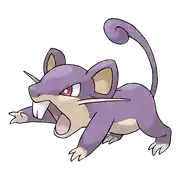
The Alolan form of Raticate, introduced in Pokémon Sun and Moon, and then in Ultra Sun and Ultra Moon, gives the Pokémon new momentum. Now Normal/Dark-type, with a different design — darker color, more imposing whiskers, and a heavier build — this Alolan Raticate plays an important role in the Alola region games. It is sometimes used by key characters, further strengthening its visibility in the series.
Raticate in Pokémon GO
In Pokémon GO, Rattata and Raticate are very common Pokémon, especially in urban areas. Rattata is often caught in large quantities for Candy, then evolved into Raticate. The latter can be used in early progression for certain Gym battles or low-level raids, even if at high level it will generally be replaced by more powerful Pokémon.
Raticate's CP depends heavily on its level and IVs. Even if it is not a frontline Pokémon in the higher battle leagues, it remains useful for players who are just starting out or who want to complete their Pokédex. When it appears in its shiny form, it takes on a different look that makes it highly sought after by collectors.
Pokémon cards, merchandise, and prices
Pokémon cards and expansions
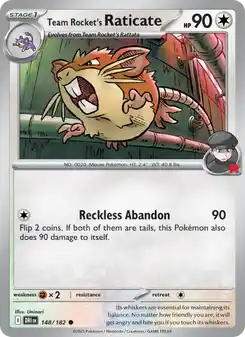
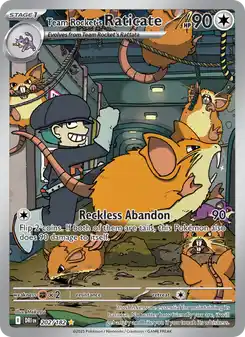
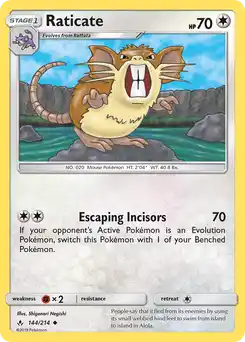
Raticate has been printed in many Pokémon cards over the years. It appears in the first Kanto-themed expansions, then in more recent expansions revisiting themes like Team Rocket, Alolan Pokémon, or special series centered on famous Trainers. Each Raticate Pokémon card features different attacks, often based on its fangs, Speed, or ability to deal swift damage.
The price of these cards varies depending on the expansion, rarity, card condition, and collector demand. Some versions may be very common and thus offered at a token price, while others — from rare or out-of-print expansions — can cost more. Collectors often consult dedicated pages to track price changes, card numbers, and detailed product information.
Merchandise and appearances
Outside of cards, Raticate sometimes appears in merchandise such as figures, plushies, stickers, or illustrated books. Even if it is not as iconic as Pikachu, its design as a fierce rat with large teeth gives it a particular charm. In some books or articles in French, English, or Japanese, Raticate is used as an example of an aggressive Normal-type Pokémon, often contrasted with cuter or more peaceful Pokémon.
Strategic tips and team role
Raticate early in the game
Early in the game, Raticate can be a valuable asset on your team. Its quick evolution from Rattata, its solid Attack and Speed stats, and its access to powerful physical moves make it a good choice for taking on the first Trainers and Gyms. A Trainer who invests time in raising Rattata and then Raticate can clear the first routes without much difficulty.
Its main weakness remains its fragility. Do not expect it to tank many hits. It will therefore often be more effective as an offensive Pokémon, switching in at the right moment to finish off an already weakened opponent — rather than as a tank or defensive pivot.
Raticate in mid- and late game
As the adventure progresses, Raticate will generally be outpaced by Pokémon with higher stats and more favorable typings. However, it can retain a secondary role on certain teams, particularly as a user of some utility moves, or as a Pokémon for personal challenges. In more casual formats, house-rule gameplay, or Kanto-focused playthroughs, it can maintain a respectable place.
In advanced strategy, Raticate is rarely a team cornerstone, but some players enjoy the challenge of building a team around Pokémon considered weak or secondary. In that context, Raticate becomes a symbol of creativity and loyalty rather than a powerhouse.
Summary
Raticate is a Normal-type Pokémon — sometimes Normal/Dark in its Alolan form — from the first generation and still present in modern games. With its large teeth, thick tail, imposing whiskers, and aggressive rat silhouette, it embodies the nervous, dangerous rodent that lurks in tall grass, cities, and routes in Kanto and beyond. Its base stats geared toward Attack and Speed, its many physical moves, and its suitable abilities make it an effective attacker in the early game.
This profile has covered Raticate's key information: type, stats, EVs, moves, abilities, breeding, appearances in video games, presence in Pokémon GO, Pokémon cards, expansions, merchandise, and its role on a team. Even if it is not destined to rival the greatest Pokémon of the late game, it remains a loyal companion for many Trainers, a recurring opponent on the first routes, and a familiar figure for all those who began their adventure with Red, Blue, Silver, Crystal, Ruby, Sapphire, Diamond, Pearl, Black, or other games in the series.
Whether you are filling your Pokédex, collecting a Raticate Pokémon card from an old expansion, reliving childhood memories, or building a Team Rocket-themed squad, Raticate will always be that fast rat, full of sharp determination, ready to surprise you with the power of its fangs and the ferocity of its gaze.
