



Share this Pokémon
Characteristics
- Height:
- 1.50
- Weight:
- 39.50
Base stats
Total: 479Combat strengths and weaknesses
Damage multiplier taken by Pidgeot depending on the attacking move's type. ×2 and ×4 are the attacks to avoid.




The complete Pokédex, in your pocket
Detailed pages, types, stats and your favourite Pokémon - on the app.
Evolutions



Forms
Forms available in your language are clickable. The others show their stats below.

Additional information
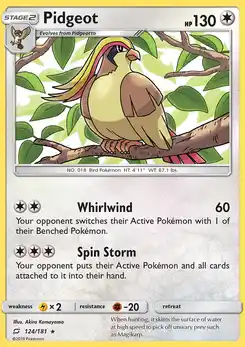
Pokémon Cards (22)
Showing the latest 12













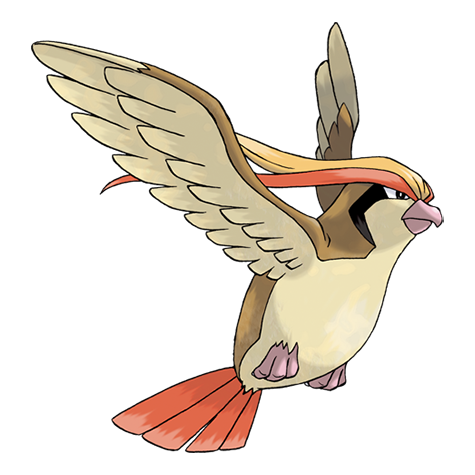
Official artwork
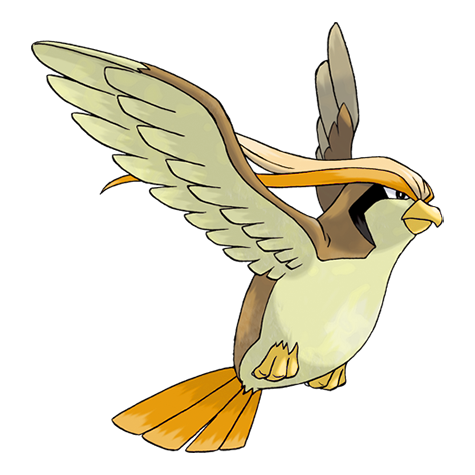
Base sprites


Pokémon Home


Dream World
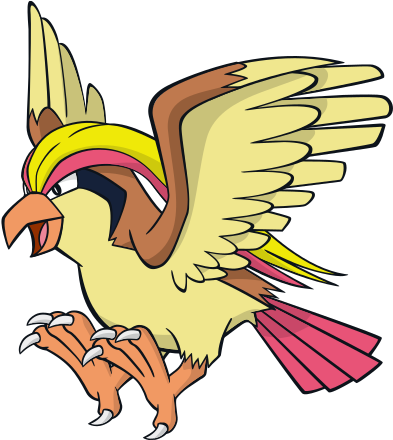
Showdown


Detailed information
General overview of Pidgeot
Pidgeot is the final evolution of the Pidgey and Pidgeotto family, known as Roucarnage in the French versions of the Pokémon games. This Normal/Flying-type bird Pokémon is iconic of the early generations, particularly the Red, Blue, and Yellow versions. For many Trainers, Pidgeot represents the first great powerful Flying Pokémon, capable of covering long distances and playing a central role on the team. Thanks to its high Speed, solid base stats, and elegant design, it holds a cherished place in the hearts of fans.
In the main Pokémon games, Pidgeot is usually obtained by evolving a small Pidgey caught very early in the adventure. This gradual evolution path — from timid little bird to confident large raptor — gives a deeply satisfying sense of progression. Trainers who take the time to raise Pidgey level by level are often rewarded with a Pidgeot that is fast, sturdy, and capable of delivering a decisive aerial strike at the right moment. Whether in first-generation games or in modern remakes, the impact of Pidgeot remains very strong.
Pidgeot's characteristics and typing
Type and Pokédex description
Pidgeot is a Normal/Flying-type Pokémon. This dual typing grants it complete immunity to Ground-type attacks, as well as resistance to Bug- and Grass-type moves. However, it is vulnerable to Rock, Ice, and Electric attacks. In Pokédex descriptions, Pidgeot is often described as a large, majestic bird capable of flying at high speeds for extended periods, using air currents to conserve energy. Its broad wings generate powerful gusts that can unbalance opponents.
Pidgeot's description also emphasizes its protective and territorial nature. It can survey a vast territory from the sky and dive at an impressive speed on prey or an enemy that approaches its nest too closely. Some Pokédex entries mention its ability to fly so fast that it can cover long distances in very little time, including over seas or islands. This reinforces the image of a Pokémon that is free, bound to wind and air — a symbol of travel in many games.
Base stats and combat impact
Pidgeot's stats are distinguished primarily by good Speed and solid physical Attack. Its HP, or PV, are sufficient to hold on for several turns against similarly leveled opponents, as long as its elemental weaknesses are not targeted. Its Defense and Special Defense are generally at an acceptable average, allowing it to withstand a few hits, but it should not be thought of as a defensive wall.
In terms of base stats, Pidgeot is not the most powerful Pokémon across all games, but its stats are well distributed and suited to its role as a light physical sweeper. Its Speed frequently gives it the initiative, which is crucial for landing the first hit, eliminating a weakened opponent, or finishing a battle without letting the enemy retaliate. This influence on the pace of battle is one of Pidgeot's main strengths in many Trainers' teams.
Pidgeot's evolution and origins
From little Pidgey to mighty Pidgeot
Pidgeot's story always begins with a small Pidgey, often caught right at the start of the adventure on the first routes of a region. Through battles, Pidgey evolves into Pidgeotto, then into Pidgeot. This evolution is a perfect example of a Pokémon that starts weak but determined and gradually becomes a trusted ally. In Red, Blue, and Yellow, as well as their remakes FireRed and LeafGreen, this gradual evolution is an almost unavoidable milestone.
Pidgeot's design draws inspiration from large birds of prey, blending elegance with power. Its feathers, crest, and wings give it a noble bearing, halfway between a falcon and a legendary raptor. In later generations — Ruby, Sapphire, Diamond, Pearl, Black, White, Silver, Sun, and Moon — Pidgeot retains this image of a respected, classic bird Pokémon, even as new Flying-type Pokémon appear. Its recurring presence in multiple Pokédexes underlines the importance of this Pokémon throughout the franchise's history.
Pidgeot across the different generations
Throughout the generations, Pidgeot has remained a familiar Pokémon. Whether it appears in Kanto, Johto, Sinnoh, or other regions, it keeps its role as a versatile bird that Trainers love to have on their team. In certain versions, it can even learn new moves via TMs and HMs introduced in more recent games, further enriching its arsenal.
In Sun and Moon, as well as their associated versions, Pidgeot can sometimes be found on certain islands, gliding through the sky or appearing as a high-level wild Pokémon. In Ruby, Sapphire, Black, White, or their remakes, it is sometimes accessible through transfers, events, or specific game versions. Consulting each Pokédex entry and game version is therefore useful to know when and where to catch or transfer a Pidgeot.
Pidgeot's moves and battle style
Main Flying and Normal-type moves
Pidgeot is primarily a specialist in Flying- and Normal-type attacks. Flying-type moves allow it to effectively target Bug-, Fighting-, and Grass-type Pokémon. Moves like Wing Attack, Aerial Ace, or Brave Bird are often associated with Pokémon like Pidgeot. Depending on the game and generation, it can also learn various aerodynamic attack variants via TM.
Normal-type moves, for their part, give it solid overall coverage. Even if they offer no type advantage, they can hit a wide range of Pokémon neutrally. This makes Pidgeot a reliable Pokémon for facing varied opponents without constantly having to switch team members. Its style therefore rests on a combination of fast Attack, reasonable power, and versatility.
TMs, HMs, and strategic role
The TMs and HMs available to Pidgeot vary from game to game, but it can generally learn several useful techniques for battle or exploration. For example, in certain generations, it can learn moves like Defog, Fly, or other support abilities. Fly in particular is one of the most iconic HMs associated with Pidgeot. Beyond being a powerful Flying-type move, it allows the Trainer to travel easily between cities in many games.
Strategically, Pidgeot is often used as a Pokémon capable of putting pressure on opponents from the very start of a battle, or finishing off an already weakened opponent. Its Speed lets it outpace many Pokémon of similar level, and its attacks, even if not the most powerful in the entire Pokémon universe, are more than sufficient in the vast majority of story-mode encounters. In some cases it can even be used in friendly competition, especially if its EV and IV values have been carefully optimized.
Pidgeot's stats, EVs, IVs, and nature
Understanding Pidgeot's stats
Pidgeot's stats revolve primarily around three important axes for battle: HP, Attack, and Speed. Its HP provides solid resilience, allowing it to stay on the field for several turns. Its physical Attack means every hit it lands is a genuine threat to the opponent. Finally, its Speed — often one of its best stats — ensures priority against many Pokémon of the same level.
Trainers who appreciate Pidgeot often look closely at its base stats to plan efficient training. Comparing its stats against other bird Pokémon or other Flying-type Pokémon quickly reveals that it does not necessarily rival certain Legendary Pokémon, but that it offers an excellent compromise for a standard team. Well used, it can have a significant impact on the course of a battle, especially when supported by good held items and a balanced team.
EVs, IVs, nature, and their influence on performance
EVs and IVs play a crucial role in Pidgeot's overall performance. EVs, or effort values, are gained by battling other Pokémon and can be allocated in a targeted manner. For Pidgeot, it is generally recommended to focus EVs on Attack and Speed, in order to optimize its strong points. Some Trainers also add a few HP EVs to slightly improve its ability to take hits.
IVs, or individual values, represent a Pokémon's genetic potential in each stat. A Pidgeot with high IVs in HP, Attack, and Speed will have a significant advantage over one with poor or poorly distributed IVs. Many dedicated sites offer stat, EV, and IV calculators to precisely evaluate a Pidgeot's power. These tools are invaluable for Trainers who want to go beyond basic training and fully optimize their teams.
Pidgeot's nature also influences its final stats. For example, a Modest nature increases Special Attack but reduces physical Attack, which is generally bad for a physically-oriented Pidgeot. Conversely, a nature that boosts Attack or Speed — such as Jolly or Adamant — is much more suitable. A Docile nature, on the other hand, modifies no stats at all, which is acceptable but not optimal. Choosing the right nature for Pidgeot is therefore important for getting the best out of its capabilities.
Pidgeot in the Pokémon card game
Cards, the Pidgeot card, and Pidgeot EX
Pidgeot is also very present in the Pokémon card game. The classic Pidgeot card often features the Pokémon mid-flight, wings spread and gaze determined. These cards exist in many sets, from the first editions through to modern expansions. Some cards simply display its stats and main attack, while others feature more detailed and artistic illustrations.
In certain sets, special versions can be found, such as Pidgeot EX. These cards generally offer higher stats, more powerful attacks, and sometimes special effects that enhance Pidgeot's impact on the game. Collectors particularly appreciate these versions for their rarity and refined visuals. The price of a Pidgeot card or Pidgeot EX card varies depending on the edition, condition, language, and market demand.
Prices, sites, and information for collectors
To find the price of a Pidgeot card, collectors often consult specialized sites that list cards, their editions, rarities, and recent sales. These sites provide an estimate of the average price for a card in good condition, as well as a way to check whether certain versions are particularly sought after. Information about Pidgeot in the card game is often accompanied by detailed descriptions and articles comparing the various editions.
Pidgeot cards sometimes reflect its in-game role, assigning it a Flying- or Normal-type attack with damage values consistent with its image as a large, fast bird. Players who use the Pokémon card game often appreciate Pidgeot for its ability to combine decent attack power with a reasonable energy cost. Even if it is not always the most competitive card, it remains a nice piece in a themed deck or in a Flying-type Pokémon collection.
Pidgeot in the Pokémon games
Presence in the main versions
Pidgeot appears in a large number of Pokémon games, from the first Red and Blue versions to more recent titles like Sun, Moon, Ruby, Sapphire, Black, White, Silver, Diamond, and Pearl. In each of these games, it embodies a reliable Flying Pokémon, often accessible through evolution from Pidgey or Pidgeotto. In certain versions, it can also be found at a higher level in the wild, particularly in tall-grass areas, advanced routes, or near certain islands.
Its role in Trainers' teams remains broadly the same: a fast, enjoyable Pokémon that offers solid type coverage and great flexibility in battle. Some players keep it from start to finish of the adventure, while others eventually replace it with more exotic or more powerful Pokémon. Despite this, Pidgeot remains a safe choice, particularly for Trainers who prefer classic first-generation Pokémon.
Practical use and Trainer impressions
Trainers often appreciate Pidgeot for its ease of use. It requires little complex management and quickly delivers solid results. Its decent HP, comfortable Speed, and respectable physical Attack make it a Pokémon that gives an impression of reliability and sturdiness. Even when facing slightly stronger opponents, it can sometimes turn the tide with a well-placed attack.
Used well, Pidgeot can serve as an offensive pivot, capable of switching in, landing a powerful attack, then retreating if the situation becomes unfavorable. For many players, the simple sight of Pidgeot on screen brings back fond memories of the first Pokémon games, the first Trainer battles, and the first major victories. This nostalgic dimension further reinforces its popularity across the generations.
Frequently asked questions about Pidgeot
Is Pidgeot a good Pokémon for the main adventure?
Yes, Pidgeot is generally considered a very good Pokémon for the main adventure. It is easy to obtain by catching a Pidgey and evolving it, its stats are well balanced, and it offers excellent Speed. For Trainers who want a Flying Pokémon capable of learning Fly and actively participating in battles, Pidgeot is often an ideal choice. Even if some rarer Pokémon have better stats, Pidgeot remains a very reliable companion.
Which natures are recommended for Pidgeot?
To optimize Pidgeot, natures that boost Attack or Speed are generally most recommended. A nature like Jolly or Adamant is far more useful than Modest, which increases Special Attack at the expense of physical Attack. A Docile nature modifies no stats and remains acceptable for casual use, but for a Trainer who wants to optimize their team, it is better to avoid natures that harm its main stats. A poorly chosen nature can give the impression that Pidgeot is weak, when in fact it can be very strong when properly configured.
How to manage Pidgeot's EVs and IVs?
Managing Pidgeot's EVs and IVs depends on the Trainer's goal. For solo adventure use, it is often enough to battle regularly with Pidgeot, which will naturally assign it EVs in Attack and Speed over time. For more competitive or optimized use, it is better to target EVs in Attack and Speed, avoiding spending them on less useful stats.
IVs can be assessed using a calculator available on various dedicated sites. Combining high IVs in Attack, Speed, and HP with an appropriate nature can make Pidgeot a very well-calibrated Pokémon. Even if it won't reach the heights of Legendary Pokémon, it will be perfectly capable of holding its own in many battles, especially in more relaxed formats.
Is Pidgeot still relevant in modern games?
Despite the arrival of many new species over the generations, Pidgeot remains a relevant Pokémon for players who appreciate the classics of the first generation. It offers a combination of simplicity, solid power, and accessibility that makes it still enjoyable to use. In modern games, it sometimes benefits from new moves, rebalancing, and mechanics that can enhance its viability.
Ultimately, Pidgeot may not be the strongest Pokémon in pure competitive terms, but it remains an excellent choice for living the adventure, completing a nostalgic team, or serving as a concrete example in articles, guides, or information sheets about Flying-type Pokémon. For many Trainers, the image of Pidgeot soaring above routes, towns, and islands remains inseparable from the Pokémon experience.
