


Share this Pokémon
Characteristics
- Height:
- 0.30
- Weight:
- 2.00
Base stats
Total: 262Combat strengths and weaknesses
Damage multiplier taken by Spearow depending on the attacking move's type. ×2 and ×4 are the attacks to avoid.




The complete Pokédex, in your pocket
Detailed pages, types, stats and your favourite Pokémon - on the app.
Evolutions
Additional information
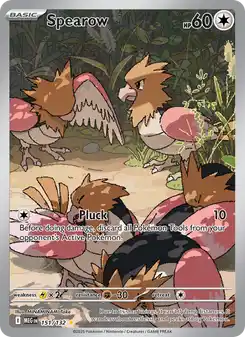
Pokémon Cards (15)
Showing the latest 12




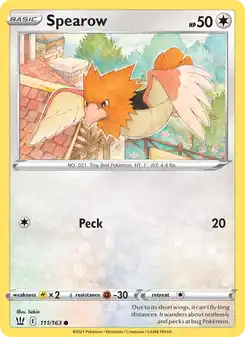
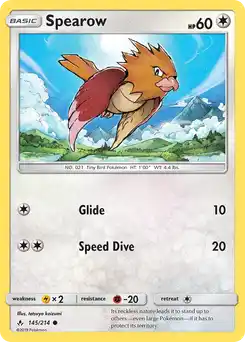


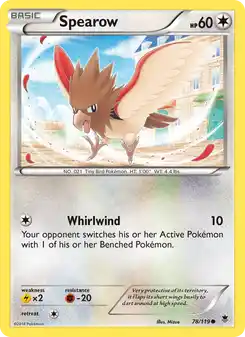
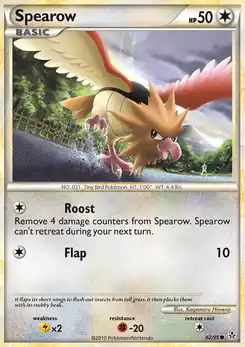
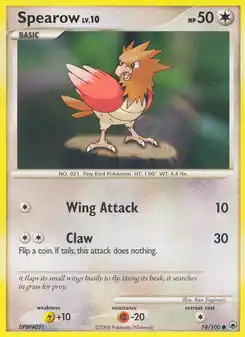
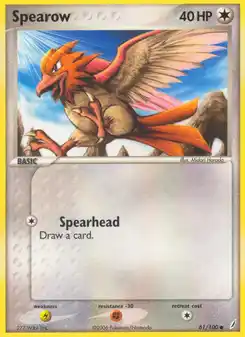
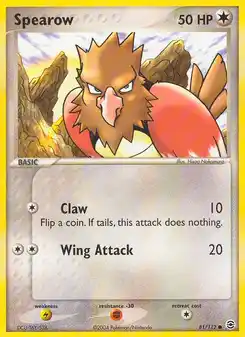
Official artwork
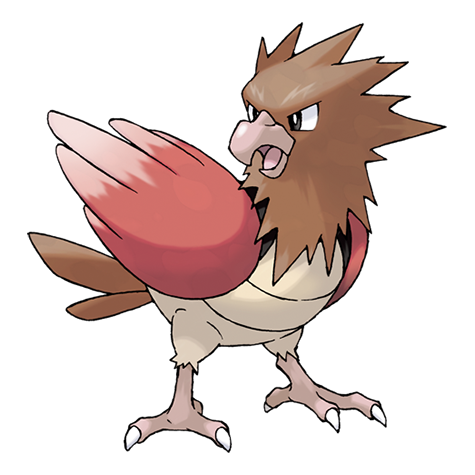
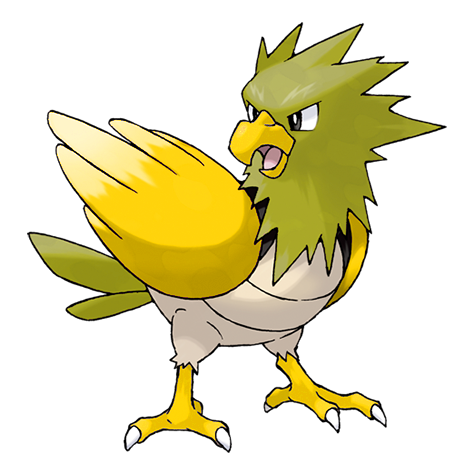
Base sprites


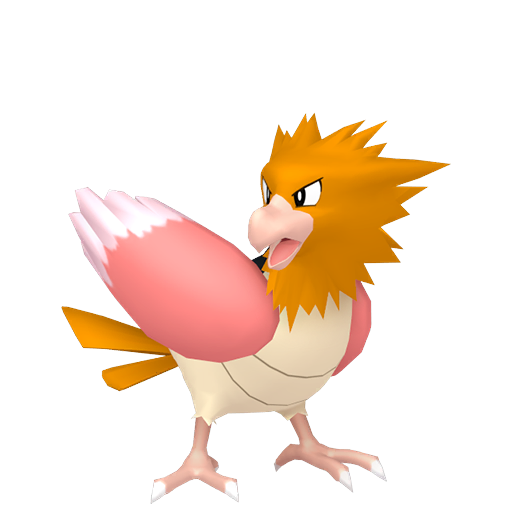
Pokémon Home

Dream World
Showdown


Detailed information
Introducing Spearow
Spearow is a small Pokémon of the Normal and Flying types from the first generation, known in Japanese as オニスズメ, sometimes romanized as onisuzume. Despite its small size and fragile appearance, this Pokémon is known for its aggressive temperament and its ability to charge at enemies at full speed, frantically beating its wings. From the very first routes in the game, it is one of the creatures encountered in tall grass and quickly becomes a reliable companion for trainers looking for a straightforward Flying-type Pokémon that is easy to catch and fast to train.
In the Pokédex, Spearow is generally described as a territorial bird that lets out shrill cries to communicate with its kind. It does not hesitate to attack Pokémon larger than itself when it feels threatened, using its sharp beak and fast wings to strike and retreat. This page aims to bring together as much information as possible about Spearow: base stats, moves, evolution level, approximate power, encounter locations, breeding and eggs, its evolution into Fearow, and its role across different games including Pokémon GO.
Whether you are completing a full list of Kanto Pokémon, preparing a strategic EV spreadsheet, or simply looking for a Flying-type to learn useful Flying-type moves, Spearow deserves a spot in your team at least early on in the adventure. Even if its max potential does not match that of the most powerful Pokémon, it remains an excellent example of a well-balanced basic Pokémon that is easy to master and enjoyable to play.
Description and Origins of Spearow
General Description
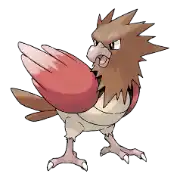
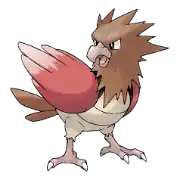
Spearow resembles a small, stocky bird with short but very lively wings. Its plumage is primarily brown and beige, with shades that can lean slightly toward red or sand depending on the game and the official artwork. Its beak is short, straight, and very pointed, designed for pecking and striking opponents. Its wings allow it to fly short distances, but they are mainly used for quick, sudden movements rather than long, graceful flights.
In battle, Spearow stands out with attacks based on its beak and speed. It is often depicted diving headfirst at the enemy, wings spread, beak ready to pierce the opponent's defenses. Even though it is not a large Pokémon in terms of weight or size, the combination of its power relative to its small frame and its high reactivity makes it an opponent not to be underestimated in the early levels.
Name Origin and Foreign Versions
The French name Piafabec comes from the contraction of "piaf," a familiar word for a small bird, and "bec" (beak), referring to its pointed beak used for attacking. The English name Spearow blends "spear" and "sparrow," emphasizing the Pokémon's offensive nature, its beak being compared to a miniature spear. In Japanese, its name is オニスズメ, often romanized as onisuzume, which can be interpreted as "demon sparrow" or "ogre sparrow," a way to convey that despite its small size, it has a very aggressive temperament.
Physical Characteristics in the Pokédex
Size, Weight, and Number
Spearow is a small Pokémon, generally only a few tens of centimeters tall. Its size makes it inconspicuous in tall grass, allowing it to surprise its targets or escape certain predators. On Pokédex entries, its size is always listed as modest, making it a Pokémon that can comfortably sit on a trainer's shoulder or on the arm of a larger Pokémon.
Its weight in kg remains very low, consistent with its lightweight body. This low weight makes it easy for it to move quickly through the air and change direction abruptly when the wind shifts or a battle breaks out. The Pokédex assigns it a relatively low number in the Kanto list, making it one of the first Flying-type Pokémon encountered in the main series. This low number also underlines its role as a starter Pokémon, designed to be easily caught and trained from the very first levels.
Wings, Beak, and Movement Style
Spearow's wings are not made for majestic long-distance flight, but rather for sudden, fast, and precise movements. It can fly at low altitude above routes, beaches, or islands, rising just high enough to spot prey or escape danger. In several Pokédex entries, it is described as a Pokémon that is constantly moving in search of food, using its wings to cover short distances between grass patches and trees.
Its beak is its primary weapon. Sharp and solid, it can pierce opponents' skin, crack open seeds, or fish out small Water-type Pokémon near water. Iconic moves such as Drill Peck or Flying-type strikes directly showcase the power of this beak. In trainers' imaginations, Spearow is often associated with a low-flying silhouette diving in a stoop, beak forward, striking before the opponent has time to react.
Type, Base Stats, and EVs
Dual Normal and Flying Type
Spearow is a Normal and Flying type Pokémon. This dual type is very common among small Kanto birds, but it remains extremely useful early in the adventure. The Flying type grants it an immunity to Ground-type attacks, which can prove valuable against opponents that rely on moves of that type. However, it remains vulnerable to Rock, Electric, and Ice-type attacks, requiring some care when choosing battles.
The Normal type, for its part, gives Spearow access to a variety of physical attacks. Even though it does not gain a particular resistance from this type, it remains very flexible and can learn a wide range of moves through level-up or via TMs, allowing it to adapt its set to the trainer's play style.
Base Stats, HP, and Defensive Values
At the stat level, Spearow is not designed to absorb heavy hits. Its HP, Defense, and Special Defense are relatively low, making it a fragile Pokémon that cannot endure long exchanges. Its best defense is its speed and ability to strike quickly before the enemy can respond. This fragility is typical of a pre-evolution Pokémon and reflects its place in the trainer's progression cycle.
Its Attack and Speed are decent for a Pokémon of its size. Without reaching extreme values or a max level comparable to final-stage Pokémon, Spearow can be surprisingly effective when EVs are well distributed and it is used at the right level. It is particularly effective around level 15 or level 20, when most opposing Pokémon have not yet reached their full potential and its Normal or Flying-type attacks can deal significant damage.
EVs Yielded and Optimization
When a Spearow is defeated, it generally yields EVs oriented toward Speed or Attack, reflecting its nature as a fast flying Pokémon. For trainers preparing an optimized team, fighting Spearow in tall grass on a route or beach can be a good way to train Pokémon focused on Speed. From a more detailed perspective, some players build EV spreadsheets listing the precise number of EVs gained per Pokémon, and Spearow appears there as a simple source to boost this stat.
If you want to train a Spearow itself, the classic EV distribution consists of investing primarily in Attack and Speed. The goal is to allow it to reach Attack values close to its max for its stage of evolution, and enough Speed to outrun other basic Pokémon encountered on the route.
Moves and Abilities of Spearow
Moves Learned by Level-Up
Spearow learns several physical moves by leveling up. Early on, it often has simple Normal-type moves that already deal decent damage against wild Pokémon encountered in grass near the first towns. As it levels up, it gains Flying-type moves that give it a clear advantage against Fighting, Grass, and Bug-type Pokémon.
Iconic moves such as Drill Peck arrive at intermediate levels, often around level 15 or 20, marking an important milestone in its progression. Once it gains access to these more powerful moves, its ability to knock out opponents quickly increases significantly, especially if its Attack values have been properly trained.
TM Use and Set Diversification
Like many Normal and Flying-type Pokémon, Spearow can learn several moves via TM. Depending on the game, it can access support moves or additional offensive moves that enrich its set. TMs can correct certain weaknesses or add coverage moves against types it would not normally hit effectively.
For example, in certain games, it can be taught moves that boost its accuracy, power, or temporary resilience, allowing it to stay on the field a bit longer. Even if Spearow is not meant to become the main pillar of a team, these TM options give it flexibility and can make it useful in various contexts.
Real Battling Power
Spearow's power is not measured by its stats alone. Its profile as a fast and offensive Pokémon, combined with beak and wing-based moves, makes it very enjoyable to play in the first hours of the game. By taking advantage of its speed, a trainer can often strike first and gain the upper hand at the start of the turn, which is sometimes enough to decide the outcome of a battle.
At the max level before its evolution into Fearow, Spearow remains a basic Pokémon, but it can still shine in certain situations — for example, to finish off a weakened opponent or to exploit a favorable type matchup.
Evolution of Spearow into Fearow
Evolution Conditions
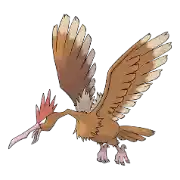
Spearow evolves into Fearow after reaching a certain level, often around level 20 in the various game versions. This evolution marks a significant leap in terms of stats and battlefield presence. Fearow gains in size, weight, and power, becoming a much more impressive Flying-type Pokémon capable of competing with more durable opponents.
From the trainer's perspective, the transition from Spearow to Fearow is a key moment. It is often the first time one of their route Pokémon transforms into a larger, more powerful creature. This evolution considerably boosts the Pokémon's HP, Attack, and Speed, making it a major asset for the battles that follow obtaining several Badges.
Why Evolve Spearow
In most cases, it is advisable to evolve Spearow as soon as the required level is reached. Keeping an unevolved Spearow beyond that level offers little advantage, except in specific challenges where one wishes to keep a basic Pokémon for fun or to reproduce a particular set at a given level. Outside these cases, Fearow is almost always superior, with better stats in all important areas.
Evolving Spearow also unlocks new Pokédex entries, sometimes changes how EVs are distributed as the Pokémon gains levels, and opens the door to more powerful moves through level-up or via TM. Among the Flying-type Pokémon accessible early in the game, the Spearow and Fearow duo holds a prime spot, particularly for players of Red and Blue.
Capture, Locations, and Breeding
Encounter Locations and Catch Rate
Spearow is generally caught on the early routes of a region, often in the tall grass near starting towns. In some versions, it can also be encountered on beaches, near islands, or in wind-swept areas. Its catch rate is fairly high, making it easy to add to the team even with basic Poké Balls.
For players completing a Pokédex, Spearow is often one of the first Flying-type Pokémon on the list. Its number places it in the group of easy-to-find basic Pokémon, which simplifies the creation of a progression chart showing which species to catch and when.
Breeding and Eggs
On the breeding side, Spearow can lay eggs when placed in the Day Care with a compatible partner. These eggs hatch into new Spearow, which can inherit certain moves and stat values. For players who like to optimize their Pokémon, it is possible to produce successive generations of Spearow to obtain individuals with better EVs, better natures, and specific moves learned through breeding.
Spearow in Pokémon GO
CP, Distance, and Catches
In Pokémon GO, Spearow is one of the most common wild Pokémon in many regions. It is often found while walking along routes, in parks, or near open areas. Its base CP is modest, making it a limited choice for high-level raids, but a good secondary Pokémon for new players discovering the game.
The buddy distance required to earn Candy with Spearow is generally low, sometimes around 1 km. This makes it easy to evolve Spearow into Fearow in the game by quickly accumulating Candy through walking.
Usefulness in Raids and Gym Battles
In raids and Gym battles, Spearow is not meant to play a central role due to its limited max values. However, in early game levels, it can serve as a secondary Pokémon to fill out a team when stronger options are not yet available. Its Flying type gives it an advantage against certain Fighting or Grass-type opponents, which can make a difference in small confrontations.
Strategy and Team Role
Spearow in the Early Game
Early in the game, Spearow is an excellent companion for strengthening a still-fragile team. Its quick access to Flying-type moves allows it to handle Grass and Bug-type Pokémon that are frequent on certain routes. Additionally, its decent Speed often lets it attack before the opponent, which is particularly useful when the team's HP pool is limited.
For the beginning trainer, Spearow is also a good example of a Pokémon to train through a few levels in order to understand stat progression, the impact of EVs gained in battle, and the power difference between a freshly caught Pokémon and one that has reached a higher level.
Spearow in Advanced Strategy
In advanced strategy, Spearow is rarely used in standardized competitive battle, mainly because of its limited base stats. However, in alternative formats, personal challenges, low-level battles, or formats restricted to basic-form Pokémon, it can regain some relevance. In these settings, the focus is on optimizing its EVs, nature, and moves to get the most out of this small Flying-type Pokémon.
Some trainers enjoy including Spearow in themed teams — for example, teams made up exclusively of Pokémon from the first routes, or in challenges where the player voluntarily caps the max power of their Pokémon to make the adventure harder.
Summary
Spearow is a Normal and Flying-type Pokémon emblematic of the series' early days. Small in size but big in character, it perfectly embodies the idea of an aggressive, fast, and always battle-ready route bird. With its lively wings, sharp beak, decent Attack and Speed stats, and modest HP, it fills a clear role in the team: strike fast, exploit favorable type matchups, and give way to more resilient Pokémon when the battle drags on.
This page has provided a complete overview of the key information on Spearow: its appearance, its names in French, English, and Japanese, its Pokédex entries, its base stats, its EVs, its level-up moves, its TM options, its evolution into Fearow, its capture in tall grass or near beaches, its breeding and eggs, and its presence in Pokémon GO. Whether you want to complete a Kanto Pokémon list, build a themed team, or better understand evolution and stat mechanics, Spearow remains an essential reference.
Whether it appears along a wind-swept route, on a remote island, or among the grass near a town, Spearow is one of those Pokémon you encounter early and never quite forget.
