



N°0026 · Generation 1
Raichu
If its cheeks run out of energy, it raises its tail and draws on the electricity in the atmosphere.
Share this Pokémon
Characteristics
- Height:
- 0.80
- Weight:
- 30.00
- Gender differences:
- Yes
Base stats
Total: 485Combat strengths and weaknesses
Damage multiplier taken by Raichu depending on the attacking move's type. ×2 and ×4 are the attacks to avoid.
Weaknesses - dangerous attacks

Resistances - weak attacks


The complete Pokédex, in your pocket
Detailed pages, types, stats and your favourite Pokémon - on the app.
Evolutions

Forms
Forms available in your language are clickable. The others show their stats below.
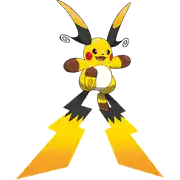
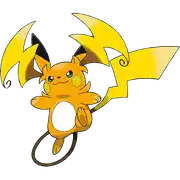

Additional information
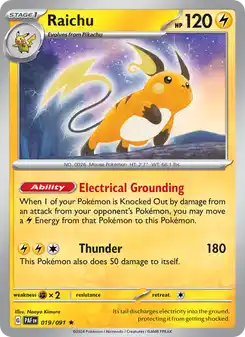
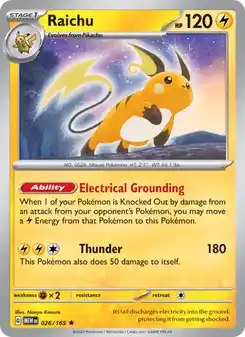
Pokémon Cards (62)
Showing the latest 12








Official artwork
Base sprites


Pokémon Home

Dream World
Showdown



Detailed information
Introducing Raichu
Raichu is an Electric-type Pokémon from the first generation, known as the direct evolution of Pikachu. In the Kanto Pokédex, it appears as a larger, more powerful, and faster version of the famous yellow mouse. Its orange body, electricity-charged cheeks, and long whip-like metallic tail make it immediately recognizable to all trainers. In the early games like Pokémon Red and Blue, encountering a Raichu generally meant facing a powerful Thunderbolt ready to melt through your team's HP.
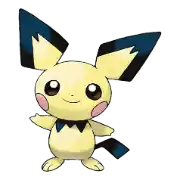
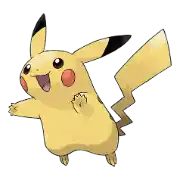
Raichu represents the logical continuation of the Pichu → Pikachu → Raichu evolutionary line. Pichu is the pre-evolution, often associated with friendship and happiness, Pikachu is the series' iconic form, and Raichu embodies the final stage, where all that accumulated energy condenses into raw power. Even though, in the animated series, Pikachu often refuses to evolve, in the games, evolving Pikachu into Raichu provides better base statistics, more HP, and higher Speed, which is essential in many battles.
This Pokémon is often considered an "adult" electric mouse: it retains the general look of a rodent, but its body is more massive, its ears longer and more pointed, and its lightning-shaped tail thinner but longer, ending in a thunderbolt-shaped tip. In this complete overview, we will detail the essential information on Raichu: its type, its statistics, its position in the Pokédex, its abilities, how to obtain it, its strategic role in the different games, and the reasons why it deserves a place in a well-built team.
Whether you first encountered it in Pokémon Red, on a Raichu Pokémon card from a classic set, or in an episode of the series, Raichu remains a symbol of successful evolution — a Pokémon that shows what Pikachu becomes when one chooses to prioritize strength and battle efficiency.
Description and Origins of Raichu
General Description
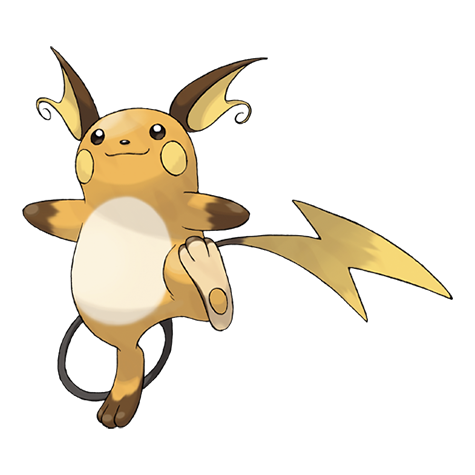
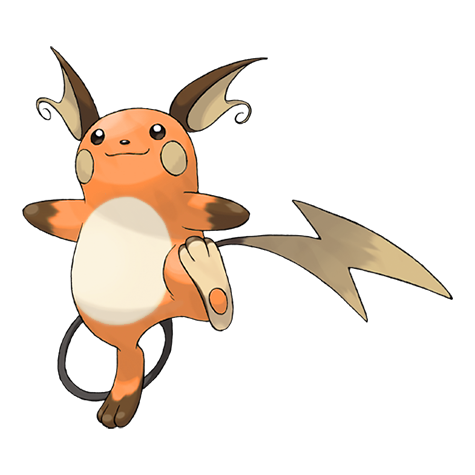
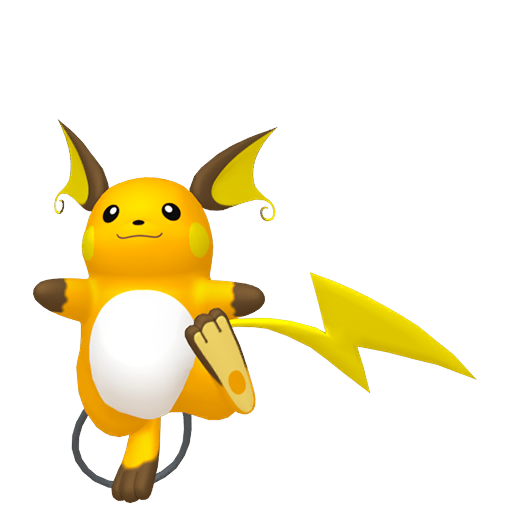
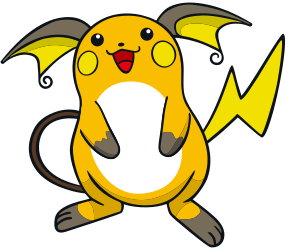
Visually, Raichu resembles a large bipedal mouse with an orange body, a lighter belly, and round cheeks capable of storing an enormous amount of electricity. Its ears are rounded at the base, with a slightly curved tip, and its eyes convey an expression that is both determined and sometimes gentle, depending on the illustration. Its long, thin tail ends in a lightning bolt shape of yellow color, acting like a grounding cable capable of discharging electrical surges when it accumulates too much.
Pokédex descriptions often mention that Raichu can release electrical tensions so high that the grass around it becomes scorched or the ground cracks under the impact. This energy permanently flows through its body, and its cheeks act as natural "pouches" of storage, batteries that recharge as it moves. When the charge becomes too great, Raichu plants its tail in the ground to discharge, allowing it to avoid being hurt by its own power.
One can also note that Raichu's design retains a cute side inherited from Pikachu, but with a more threatening dimension. Its limbs are more robust, its posture more assured, and its overall appearance gives the feeling of a Pokémon ready for action. It is often illustrated running or leaping, ready to strike with an attack of the Electric type like Thunder Shock, Thunderbolt, or Thunder.
Etymology and Foreign Names
The name Raichu probably comes from the combination of "rai" (lightning in Japanese) and "chu," the Japanese onomatopoeia for a mouse's cry. This etymology directly reflects its nature as a "lightning mouse." In Japanese, it is written ライチュウ, and in English it keeps the same name as in other languages, reinforcing its international identity. One sometimes reads "raichu raichu" in certain fan descriptions or comments to insist on the classic Kanto form as opposed to other regional forms.
Raichu is therefore a logical evolution of Pikachu, itself derived from Pichu. The complete line Pichu → Pikachu → Raichu forms one of the most celebrated families in the franchise. In most guides, pages, and articles, the trio is presented as an emblematic example of progression from a basic form to an evolved form, representative of the philosophy of first-generation Pokémon.
General Characteristics in the Pokédex
Number, Generation, and Appearances
Raichu belongs to the first generation of Pokémon, introduced in Red and Blue, then FireRed and LeafGreen. In the National Pokédex, it appears after Pikachu, holding a relatively low number, which makes it a Pokémon discovered early when going through the complete species list. Its pre-evolution Pichu would not appear until later, in subsequent generations, but the Raichu–Pikachu relationship is present from the very beginning of the franchise.
Across the different generations and the many franchise games, Raichu remains present in most regions, whether through capture, trade, transfer, or special events. One can encounter it in Kanto, Johto, Hoenn, Sinnoh, Unova, Kalos, Alola (with a different form), Galar, and Paldea, most often as the result of a trainer's decision to evolve Pikachu with a Thunder Stone rather than as a commonly found wild Pokémon.
Its appearances in the main games are supplemented by a strong presence in spin-offs, animated series, films, and merchandise. Even if Pikachu remains the official mascot, Raichu embodies for many fans the next step — the promise of a more powerful, more mature Pokémon, better suited to advanced battles.
Size, Weight, and Silhouette
In the various Pokédex entries, Raichu is described as a medium-sized Pokémon. It is larger than Pikachu, without reaching the size of some massive Pokémon. Its size in meters and weight in kg vary slightly between versions, but the idea remains the same: a "big mouse" heavy enough to deliver credible physical hits, but light enough to remain agile and fast.
Its silhouette is rounded, with a stocky body resting on two relatively short but solid legs. Its arms are short, but capable of channeling electric discharges, particularly when it uses moves like Thunder Punch in some games. Its tail plays a special role: it acts as a natural lightning rod, sometimes planted in the ground to discharge accumulated electricity and avoid internal damage. These details reinforce the biological consistency of the Pokémon in the fictional universe.
The dominant color of Raichu in its Kanto form is orange, with shades of brown and black at the level of its ears and tail. Its cheeks remain yellow, but can appear brighter when it is storing large amounts of electricity. These visual elements clearly distinguish it from its pre-evolution, while maintaining an obvious family resemblance to Pikachu.
Type, Strengths, and Weaknesses
Electric Type
Raichu is a pure Electric-type Pokémon in its Kanto version. This type confers several advantages and a few important weaknesses. As an Electric Pokémon, it is very effective against Water and Flying-type Pokémon, thanks to attacks like Thunder Shock, Thunderbolt, Thunder, or Discharge. In many games, Raichu plays the role of the perfect counter against aquatic opponents, particularly in Gyms or challenges where these types are prominent.
In return, Raichu is vulnerable to the Ground type. Moves like Earthquake, Dig, or Bulldoze are particularly dangerous, as they exploit its Electric specialization. It must therefore be used with caution when the opponent has Pokémon capable of using Ground-type moves. Being purely Electric allows it to avoid certain additional weaknesses that one might find on Pokémon with a dual type.
This Electric type affiliation is also consistent with its description and design. The lightning bolt-shaped tail, the electricity-charged cheeks, and the animations of its attacks in the different games make the connection between its nature and its abilities both obvious and satisfying for players.
Type Interactions and Team Role
In a balanced team, Raichu often fills the role of special or mixed sweeper, tasked with coming in to quickly eliminate targets weak to Electricity. Thanks to its very good base Speed, it often strikes first, allowing it to fully exploit its powerful Electric attacks. It pairs particularly well with Ground or Grass-type Pokémon, which can cover its main weakness and offer it a safer environment.
For example, in the early Red and Blue versions, a well-trained Raichu can be paired with a Grass or Water-type Pokémon to cover many matchups. Raichu handles Water and Flying types, while its teammates deal with Ground or Rock types. This kind of team building illustrates how Raichu's Electric type fits into the metagame of each generation.
Base Statistics, EVs, and Potential
Raichu's Base Statistics
Raichu's base statistics are noticeably superior to those of Pikachu, which is logical for a stone-evolved Pokémon. It has solid Special Attack, good physical Attack, very good Speed, and higher HP. Its Defense and Special Defense, while acceptable, are not outstanding, making it a somewhat fragile Pokémon if left too long on the field without support.
Its base Speed allows it to outrun many first-generation Pokémon, particularly at intermediate levels. In more recent games, where general statistics have increased with the arrival of new Pokémon, Raichu remains a fast Pokémon, even if some ultra-specialized opponents can outpace it. It nonetheless retains an important role as a fast attacker capable of exploiting any opening.
In terms of HP, Raichu has enough hit points to take a few hits, but it is not a defensive wall. Its best defense is often its ability to strike first and knock out the enemy before it has time to respond.
Recommended EVs and Optimization
To get the most out of Raichu in a more strategic context, it is common to distribute EVs primarily in Special Attack (or physical Attack for certain specific sets) and Speed. The goal is to reach enough Speed to outrun as many opponents as possible and to maximize the damage dealt by Electric moves.
In certain games and formats, alternative distributions exist: for example, investing a small portion of EVs in HP or Special Defense to allow it to survive one extra hit before retaliating. However, most trainers prefer to capitalize on its natural calling as a fast attacker. Its main attack line often relies on Thunder Shock, Thunderbolt, Discharge, or Thunder, complemented by coverage options like Shadow Ball, Surf (in some generations), or various TM moves.
Recommended Natures
For an optimized Raichu, natures that increase Speed or Special Attack are most often favored. A nature that boosts Speed while reducing a less-used stat (such as physical Attack on a special set) maximizes its sweeper potential. Conversely, on a more physical set, one can favor a nature that increases physical Attack at the expense of Special Attack.
Players who want a more resilient Raichu can opt for a nature that boosts Special Defense, but this approach is less common as it strays from its natural role. In all cases, the combination of nature, EVs, and chosen moves will determine your Raichu's battle style: pure attacker, support attacker, or a more versatile hybrid.
Moves and Abilities of Raichu
Moves Learned by Level-Up
One particular point to keep in mind is that, in some generations, Raichu learns relatively few moves through level-up, because it is generally Pikachu that learns the majority of moves before evolving. Many trainers therefore choose to keep Pikachu for a while before using the Thunder Stone, in order to maximize the available move pool, then dramatically boost base stats with the evolution into Raichu.
Once Raichu is obtained, it benefits from STAB on all its Electric moves. Attacks like Thunder Shock, Thunderbolt, Thunder, or Discharge then become genuine threats, capable of draining entire HP bars in a single charge. In some games, Raichu can also learn support techniques like Thunder Wave, allowing it to paralyze opponents and increase the likelihood of striking first.
TMs, HMs, and Additional Moves
Raichu draws much of its versatility from TMs and other move-learning methods. Depending on the games and generations, it can learn various moves such as Shadow Ball, Surf, Thunder Punch, Iron Tail, or powerful Normal-type moves that take advantage of its excellent Speed. These options allow it to surprise opponents who would normally be comfortable against Electric attacks.
Old HMs were sometimes usable by Raichu for exploration, but from a strategic standpoint, the preference is for battle-oriented moves. Experienced players often build a set with one heavy Electric attack, one or two coverage moves (for Ground, Grass, Dragon, or other types), and possibly a support move to handle specific situations.
Evolution and How to Obtain Raichu
From Pichu to Pikachu, then to Raichu
Raichu's evolutionary line passes through Pichu and Pikachu. In games where Pichu is present, it appears as the pre-evolution obtained through breeding or special methods. Pichu evolves into Pikachu when its happiness is high enough and it gains a level. This mechanic emphasizes the relationship between the trainer and their Pokémon, underlining that evolution is not just about statistics, but also about emotional bonding.
Once Pikachu is obtained, it can evolve into Raichu through a Thunder Stone. This evolution is not tied to a specific level: it depends solely on using the item. Some trainers prefer to wait until a certain level to allow Pikachu to learn additional moves, then trigger the evolution when they feel the move pool is sufficient. The decision to evolve Pikachu into Raichu thus becomes a strategic choice depending on progress in the game and the team's needs.
Raichu Across Different Generations and Games
In Pokémon Red and Blue, Raichu can be obtained by evolving Pikachu, whether a caught wild Pikachu or a given one. In FireRed and LeafGreen, the mechanic remains the same, as it does in most remakes and re-releases. In more recent games like Let's Go, Pikachu! and Let's Go, Eevee!, the presence of Pikachu as the main partner sometimes changes the way to obtain Raichu, but the general principle of Thunder Stone evolution remains consistent.
Across the generations, Raichu thus appears in many games, often accessible either through evolution, transfer, or special events or specific areas. It is also present in Paldea, Kalos, and other regions, showing that despite the introduction of new Electric Pokémon, Raichu remains a franchise pillar.
Raichu in Video Games and Strategy
Solo Campaign Role
In the solo campaign, Raichu is a precious asset for many trainers. As soon as you evolve Pikachu, you obtain a Pokémon with much higher base statistics, which greatly facilitates battles against certain Gym Leaders, rivals, or Elite Four members. Its ability to quickly eliminate Water or Flying-type Pokémon makes it an almost indispensable ally in certain passages.
Thanks to its Speed, Raichu often acts first, allowing it to control the pace of the battle. It can use its Electric moves to weaken the opponent, then give way to other team members if the situation requires it. In the early generations, a well-trained Raichu can literally sweep entire teams in certain areas, which makes it very appreciated by players who want to progress efficiently.
Advanced Strategy Role
In advanced strategy, Raichu is not always at the top of competitive rankings, notably because more recent Electric Pokémon may offer higher stats or more interesting type combinations. However, it retains its place in restricted formats, first-generation leagues, themed tournaments, or fan teams that value aesthetics as much as raw performance.
In these formats, Raichu benefits from its Speed, its varied moves, and its offensive potential to fill the role of a dangerous sweeper. Well built, with a suitable nature, a good EV distribution, and a well-considered move set, it can surprise opponents who have underestimated this Kanto Pokémon. One can then see strategies highlighting Raichu with items that boost its power, abilities that favor Speed, or move combinations allowing it to outpace an entire team.
Raichu in the Pokémon Trading Card Game and Franchise Culture
Raichu in the Pokémon TCG
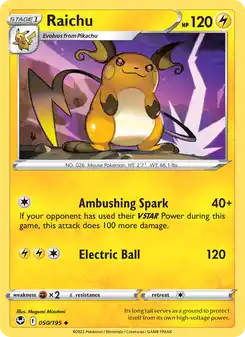
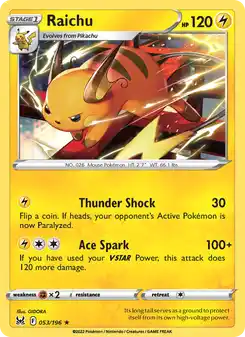
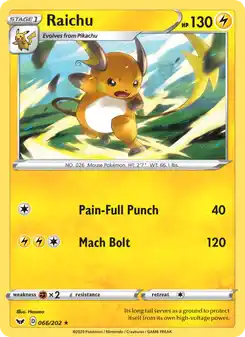
Raichu has appeared on many Raichu cards across TCG sets. A Raichu Pokémon card generally features its orange body, its lightning bolt-shaped tail, and dynamic illustrations where it channels electricity. The various editions, from the oldest to the most recent, offer different HP values, attack values, Energy costs, and damage, but the Pokémon's identity remains the same: a powerful, fast Electric attacker, sometimes hard for the opponent to handle.
For collectors, some rare or holographic Raichu cards are iconic pieces. They recall the early years of the franchise and Raichu's place alongside Pikachu in the collective imagination. Raichu cards can also represent different forms or versions, but the classic Kanto form remains the most iconic for many fans.
Raichu in Other Media
Raichu also appears in the anime, sometimes as an opponent, sometimes as another trainer's companion. It is often portrayed as a stable, strong Pokémon, but one less in the spotlight than Pikachu. In some episodes, the question of evolving Pikachu into Raichu is at the heart of the plot, illustrating the dilemma between loyalty to the starting companion and the pursuit of battle performance.
It can also be found in spin-off games and titles like Super Smash Bros. (where Pikachu is playable, but not always Raichu) or other franchise productions. In the general fan culture, Raichu often embodies the idea of the "adult" Pokémon — the one obtained when pushing the evolutionary line to its end — even if Nintendo's marketing sometimes prefers to put Pikachu forward as the universal face.
Breeding, Egg Groups, and Other Details
Egg Groups and Breeding
Raichu belongs to the egg groups associated with "Field" and "Fairy" Pokémon (depending on the generation and systems). By placing it in the Day Care with a compatible partner, one can obtain eggs that hatch into Pichu, the pre-evolution. This process allows trainers to build complete lineages, select natures, IVs, and particular moves, and shape a Raichu perfectly suited to their play style.
Breeding also allows inheriting certain egg moves, opening the door to more original sets. Committed trainers can spend a great deal of time hatching, training, and perfecting their Raichu, especially in more recent generations where breeding mechanics are richer.
Summary
Raichu is a first-generation Electric-type Pokémon, the evolution of Pikachu, whose superior base statistics, high Speed, powerful Electric moves, and orange mouse silhouette make it an iconic figure of the franchise. It embodies the more mature and more powerful version of Pikachu, the result of a trainer's choice to use a Thunder Stone to prioritize battle performance.
This page has presented in detail the key information on Raichu: its type, its strengths and weaknesses, its base statistics, its place in the Pokédex, its methods of obtaining it, its strategic role in the games, its relationship with Pikachu and Pichu, as well as its presence in Pokémon cards and franchise culture. From simply catching a Pichu or a Pikachu to the final evolution into Raichu, each step illustrates the progression of a small electric rodent into an imposing and feared lightning mouse.
Whether you want to build a Kanto-inspired team, relive your memories of Red and Blue, or simply enjoy a reliable Electric attacker in your adventure, Raichu remains a solid choice. Well trained, with a good EV distribution, a suitable nature, and a balanced move set, it can still today surprise and prove that the Pichu–Pikachu–Raichu line is not only symbolic, but also terribly effective on the battlefield.
