


N°0172 · Generation 2
Pichu
The electric pouches in its cheeks are very small. When they are overloaded, it shocks itself.
Share this Pokémon
Characteristics
- Height:
- 0.30
- Weight:
- 2.00
Base stats
Total: 205Combat strengths and weaknesses
Damage multiplier taken by Pichu depending on the attacking move's type. ×2 and ×4 are the attacks to avoid.
Weaknesses - dangerous attacks

Resistances - weak attacks


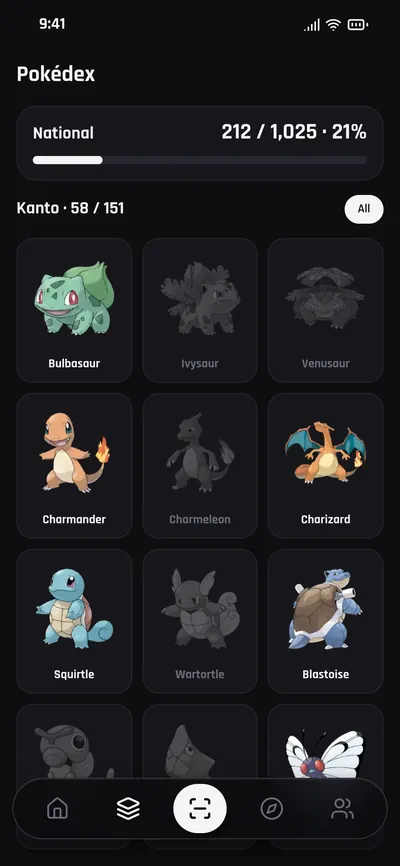
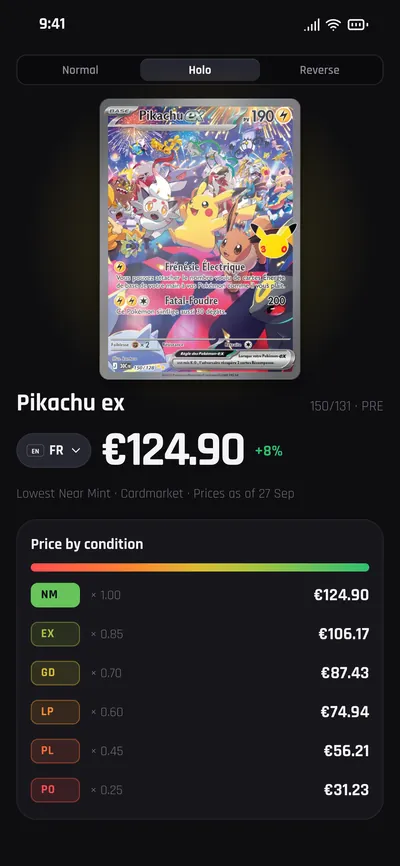
Your Pokédex, in cards
Every card of every Pokémon, what you already have and what you're missing.
Evolutions



Additional information
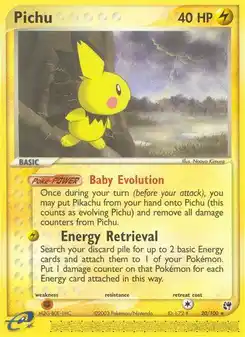
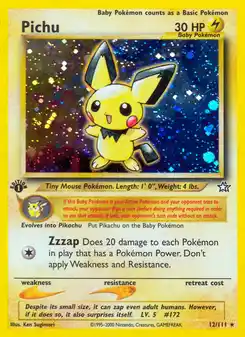
Pokémon Cards (11)
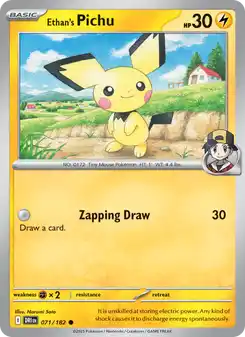


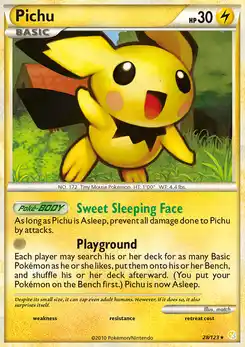

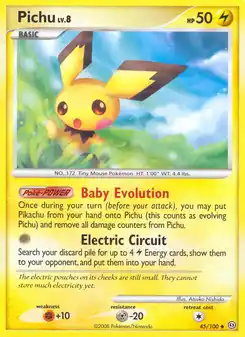

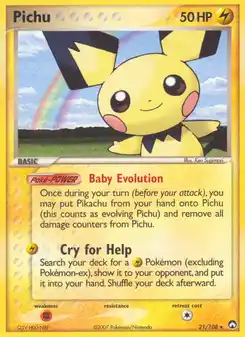
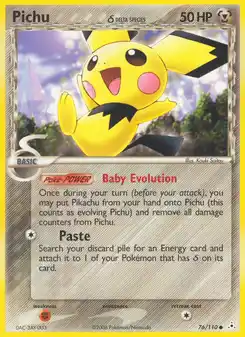
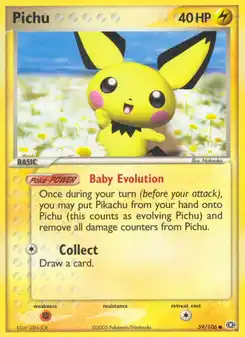


Official artwork


Base sprites


Pokémon Home


Dream World

Showdown


Detailed information
General Overview of Pichu
Pichu is the best-known baby Electric-type Pokémon in the franchise, a true icon since its debut in the second generation. Classified as a Tiny Mouse Pokémon, it represents the direct pre-evolution of Pikachu, which can itself evolve further into Raichu. In the Pokédex, Pichu holds number 172 and appears as a small yellow creature that stores electricity in its cheeks. It is a Pokémon greatly loved by players for its fragile yet cute "baby" quality, and because it lets players enjoy an Electric type from the very first levels — effective against many types encountered early in the game, such as Water and Flying.
In the games, Pichu is not always catchable in the wild. Often, it must be hatched from an egg obtained by breeding a Pikachu or a Raichu. Its raw power is low, but the appeal of this Pokémon for advanced players lies mainly in the ability to optimize its base stats, IVs, and EVs from level (Lv.) 1, in order to later obtain an extremely well-optimized Pikachu and then Raichu for strategic battling. In other words, raising a Pichu instead of simply catching a Pikachu offers more control over the hidden values of your Pokémon.
Pichu remains very fragile, however: its HP are low, its Defense and Special Defense are weak, and even its Special Attack is unimpressive without investment. On the other hand, its decent Speed sometimes allows it to act before the opponent, which is useful for placing a support move like Thunder Wave or Light Screen. The Pokémon is not designed to take hits: it is a baby Pokémon that mainly serves as a starting point, a pre-evolution, for building a complete set around Pikachu or Raichu.
Pokédex Information, Type, Size, and Weight
Pokédex Number, Name, and Generation
In the National Pokédex, Pichu holds number 172. It was introduced in the second generation of games, alongside the Johto region (Pokémon Gold, Silver, and Crystal). It is one of the first baby Tiny Mouse Pokémon added to complete already famous evolutionary lines, in this case that of Pikachu. Over the generations, the Pokédex of each region has reintegrated Pichu, sometimes through events, sometimes directly via eggs or specific areas of the map. The Japanese name for Pichu is ピチュー, while in English it keeps the same name: Pichu. This basic information is useful for players who frequently consult their Pokédex or complete lists of Pokémon by generation.
Size, Weight, and Physical Description
In terms of size and weight, Pichu is extremely light. It measures about 0.3 m and weighs around 2.0 kg. It has a tiny Tiny Mouse body, with large black-tipped ears, a short and angular tail, and round cheeks capable of storing electricity. When it generates too much electricity, it tends to shock itself, which is reflected in certain Pokédex entries. This inability to control its own electricity clearly shows that it is still a clumsy baby. Visually, it is primarily yellow and black, which is reminiscent of Pikachu but in a more "compact" and simplified form.
Electric Type and Type Interactions
Pichu is a pure Electric type. This type grants it important resistances and weaknesses in battle. As an Electric-type Pokémon, it resists Steel, Flying, and Electric itself. However, it is particularly vulnerable to the Ground type, which deals super-effective damage and makes any attack of that type extremely dangerous. The fact that Pichu is solely Electric type simplifies reading its matchups for players: no double type to manage, which makes decisions in battle easier, especially at the start of a game or when first learning it.
To make the most of this type, it is interesting to pair it in a team with Grass-, Flying-, or even Water-type Pokémon that cover its Ground-type weakness. For example, a Grass-type Pokémon often resists Ground-type attacks and benefits from the opponent focusing on Pichu or Pikachu. In Doubles formats, certain team sets exploit the electricity produced by Pichu to activate moves or abilities on allies, even if this remains more theoretical for a casual player.
Pichu's Base Stats
Overall Stat Overview
Pichu's base stats are intentionally very low, as it is a baby Pokémon. Its HP base is around 20, meaning it will faint very quickly if you let it take powerful attacks. Its physical Attack sits around 40 at base, its Defense around 15, its Special Attack approximately 35, its Special Defense around 35, and its Speed around 60. Its total stat sum is therefore very low compared to evolved forms or even other low-level Pokémon.
In practice, this means that Pichu is not designed to stay on the field for long. Its HP and Defense make it very fragile against virtually any serious attack. However, its decent Speed sometimes allows it to act first, especially to use a status or support move. For a player who wants to keep it in battle, extreme attention must be paid to opposing types and the level of power of enemy moves, as a single Ground-type attack or an overpowering neutral hit can be enough to knock it out.
IVs, EVs, and Stat Optimization
Even though Pichu's base stats are low, it is still worthwhile to optimize its IVs and EVs to prepare for an excellent evolution. IVs (Individual Values) define the maximum potential of each stat. A Pichu with good IVs in Special Attack, Speed, and HP will become a much stronger Pikachu and then Raichu. EVs (Effort Values) allow you to steer the Pokémon toward a specific role: fast special attacker, fast support, or otherwise.
For an offensive build, players often invest EVs in Special Attack and Speed. Defense remains low, but the idea is to maximize the power of moves like Thunderbolt or Thunder when Pichu becomes Pikachu or Raichu. Another option is to allocate some EVs into HP to survive one or even two attacks, especially if you plan to run moves like Thunder Wave or Light Screen to support the team. Fine EV management from Pichu's earliest levels is a major advantage of going through this Pokémon rather than catching a wild Pikachu mid-game.
Nature, Set, and Battle Role
In terms of nature, players often prefer one that raises Speed or Special Attack: Timid (+Speed, -Attack) or Modest (+Special Attack, -Attack) both work well. Since Pichu primarily uses special Electric-type attacks, it makes sense to optimize these two stats. If you want a more support-oriented set, you can also use a nature that boosts Special Defense or HP, though the impact will remain limited on such a fragile Pokémon.
Pichu's role in a competitive battle set is largely symbolic: it is generally too weak to be used seriously. However, for players taking on challenges (such as completing the game with baby Pokémon, low-level battles, or a "baby run"), Pichu can become a fun pivot thanks to its decent Speed and access to moves like Thunder Wave, Tackle, Quick Attack, Magnet Rise, and even Thunderbolt after a few TMs. For these challenges, precise EV, nature, and IV management becomes crucial to compensate as much as possible for its very limited base stats.
Pichu's Evolution into Pikachu and Then Raichu
Pichu as a Pre-Evolution and Baby Pokémon
Pichu is the pre-evolution of Pikachu. It is one of the first baby Pokémon introduced in the series, alongside other Tiny Mouse babies like Togepi. For players, this means you can choose to start the evolutionary line from its weakest stage and accompany your Pokémon throughout the adventure, controlling its level, its growth in power, and its move learning.
The baby Pokémon concept also comes through in the breeding mechanic: in general, Pichu is obtained by breeding two compatible Pokémon, for example Pikachu with another Pokémon of the same Egg Group. The hatched egg produces a Pichu, which allows you to hatch it multiple times to seek better IVs, a better nature, or specific moves learned through breeding, such as certain punching attacks (Thunder Punch, for example) or special moves useful for the final set.
Happiness-Based Evolution and Level-Up
Pichu evolves into Pikachu when it reaches a sufficient happiness level and gains a level. The exact level is not fixed: the evolution is tied to the happiness (or friendship) system rather than a set level. In practice, you must raise Pichu's happiness by keeping it in your party, walking with it on the map, putting it in battle, avoiding letting it faint too often, and using certain items or options that increase its affection. Once happiness is high enough, at the next level-up, Pichu will evolve into Pikachu.
For players who want to optimize it, it can be smart to slightly delay the evolution in order to learn certain moves earlier or with better scaling at level. Nevertheless, given the weakness of Pichu's stats, most players prefer to evolve it as soon as possible to quickly benefit from the increased power of Pikachu. This choice depends on playstyle: some prefer to keep it in baby form longer, while others want to reach the final form Raichu as quickly as possible.
From Pikachu to Raichu and Related Forms
Once Pichu has evolved into Pikachu, the next step is obtaining Raichu. Pikachu evolves into Raichu via a Thunder Stone rather than by level. Depending on the game, you can obtain a standard Raichu or Alolan Raichu (an alternate form with Electric/Psychic type). For a player focused on battling, the timing of evolution is important: a Pikachu learns certain moves earlier than Raichu, so it can be worth waiting until you have an interesting moveset (for example Thunderbolt, Iron Tail, Thunder Punch, Light Screen) before using the stone.
There are also special variants of Pichu, such as the Spiky-eared Pichu in certain games in the series (notably in the Johto region in the remakes). This Pichu has a slightly different design, a black ear with a distinctive shape, and is often restricted to a specific game without the ability to transfer it elsewhere. Collector players appreciate this kind of unique form, even if in battle the difference is rarely significant.
Pichu's Moves, Attacks, and TMs
Moves Learned by Level-Up
Pichu generally starts with very simple attacks like Tackle or Thunder Shock, which allow it to exploit its Electric type from level 1 or 5 depending on the game. As it levels up, it can learn status moves like Charm or Sweet Scent in certain games, which reduce the enemy's attack or make wild Pokémon encounters easier. These moves remain consistent with the idea of a fragile baby Pokémon, better at disrupting than hitting hard.
Later, evolving into Pikachu grants it access to more powerful moves like Thunderbolt, Thunder, and physical options like Quick Attack, Iron Tail, or Volt Tackle (obtained through breeding). The player must therefore think about which moves to keep at the time of evolution, as a high-level Pichu with good Special Attack will immediately benefit from powerful moves once it becomes Pikachu or Raichu. In terms of progression, the key is to keep Electric-type attacks to benefit from STAB (same-type attack bonus) and, if possible, to add type coverage with a Grass- or Ground-type move via a TM or a special move in certain games, even if this is rare for the Pichu line.
TMs, HMs, and Breeding (Egg Moves)
In games where TMs (Technical Machines) and HMs (Hidden Machines) still exist, Pichu can learn certain TMs focused on support or coverage. It does not get access to major field HMs like Surf or Fly, but it can sometimes learn moves such as Thunderbolt via TM, Thunder Wave to paralyze the opponent, Light Screen to boost the team's Special Defense, or even Electric punching moves like Thunder Punch via breeding or TM depending on the generation. These options allow you to create a balanced set between damage and utility.
Breeding is essential for making the most of Pichu's best moves. By breeding Pikachu or Raichu with other Pokémon from the same Egg Group, you can pass down moves like Disarming Voice, Thunder Punch, or other special moves that would not be accessible by simply leveling up. A Pichu from a good pairing, with an ideal nature, optimized IVs, and several relevant egg moves, will become a particularly dangerous Pikachu and then Raichu in battle. It is this combination of breeding, TMs, and EV management that makes the Pichu line one of the best examples of a Pokémon where preparation matters more than raw level.
Key Offensive and Defensive Moves
For a Pichu or Pikachu intended for battle, the key offensive moves are generally Thunder Shock first, then Thunderbolt, possibly Thunder, and Volt Tackle for players seeking maximum power at the cost of recoil damage. On the defensive and utility side, Thunder Wave is crucial for slowing down the opponent and increasing the relative Speed of your team. Light Screen and Reflect can also be useful on certain sets to compensate for the Pokémon's weak defensive stats.
Depending on the game, Pichu can also access non-Electric moves via TM, such as Grass- or Normal-type attacks, which offer additional coverage against types that resist Electricity, for example Ground combined with another type. However, in most cases, the raw power of its base Special Attack is not sufficient to fully exploit all these options at the Pichu stage. The idea remains to prepare an optimal set for the evolved forms, keeping a few key moves in memory as levels increase.
Pichu Across Different Generations and Games
Johto and Generation II (Gold, Silver, Crystal)
In the second generation, Pichu appears mainly through breeding. To obtain it, the player must breed compatible Pokémon, specifically Pikachu or Raichu at a Day Care. The resulting egg hatches into Pichu, introducing the baby Pokémon mechanic. On the Johto map, Pichu is not directly present in tall grass in most cases, which makes it somewhat special and shows that the developers wanted to encourage players to experiment with breeding.
In battle, Pichu's stats in Pokémon Gold, Silver, and Crystal remain weak. Players who want to use it must accept that it will faint very quickly if it faces Pokémon at too high a level. In general, players simply raise it a few levels, then evolve it into Pikachu as soon as happiness is sufficient, in order to reduce the time spent at this very low power level. However, some players enjoy the challenge of completing Johto with a team of babies including Pichu, which will require excellent management of time, levels, and battle zones to avoid being overwhelmed.
Ruby, Sapphire, Emerald, and Hoenn
In the Hoenn region (Ruby, Sapphire, Emerald), Pichu is often available via trades, events, or breeding from Pikachu. In these games, it does not always occupy a central role in progression, but it remains a popular choice for those who want to build a themed team around Pikachu. Players can import Pichu from Johto or Kanto in certain compatible versions, then raise it in Hoenn to take advantage of the TMs specific to those games.
The synergy between Pichu, the TMs unique to Ruby and Sapphire, and the map layout allows for fun sets to be created, especially if you want to battle via link cable or in local tournaments. The biggest difference for an experienced player comes from the available TM pool, which changes from game to game, and from the way EVs and IVs are managed, which is more or less accessible depending on the generation.
Diamond, Pearl, Platinum, and Sinnoh
In Pokémon Diamond, Pearl, and Platinum, Pichu is more easily accessible, often through breeding or certain events. Platinum in particular highlighted the Pikachu and Pichu line through various interactions and areas where the Electric type is interesting to play. Players can take advantage of the day/night mechanics specific to these games to hatch eggs at the right moment, manage happiness, and plan Pichu's evolution at the desired level.
In these versions, players have access to a very varied set of TMs and moves, allowing the Pichu/Pikachu/Raichu set to be customized for battle. The importance of base stats, EVs, and IVs becomes clearer for players, as competition in battle is fiercer, and structured formats begin to emerge where a poorly optimized Pokémon is quickly outpaced by more specialized opponents.
Black, White, and Later Generations
In Pokémon Black and White, as well as in later games (X and Y, Omega Ruby, Alpha Sapphire, Sun/Moon, Ultra Sun/Ultra Moon, Sword/Shield, Legends: Arceus, etc.), Pichu remains a breeding Pokémon and sometimes an event Pokémon. It can be transferred from one generation to the next, which allows a perfectly optimized Pichu to be preserved, with max IVs, an ideal nature, and rare egg moves. This continuity is greatly appreciated by players who invest time in their Pokémon.
With the arrival of new systems such as Max Moves, regional legends, or new open areas like in Legends: Arceus, Pichu can find itself in very different environments, sometimes visible in the wild in certain areas. Its weaknesses remain the same, but it benefits from new items, moves, and mechanics that can temporarily boost it. You sometimes see players use a Pichu in Dynamax for a few turns to enjoy a bonus to HP and damage, even if, in the long run, it is rather Pikachu or Raichu that are the true beneficiaries of these new mechanics.
Pichu in Pokémon GO and Other Spin-offs
In Pokémon GO, Pichu appears mainly as an egg Pokémon, which echoes the breeding logic of the main games. Players obtain it either by luck or by targeting specific eggs. Its value is primarily cosmetic and collectible, even though it can obviously be evolved into Pikachu and then Raichu for battle. Pichu also exists in Pokémon GO with different forms or accessories depending on certain events (hats, special colorings, etc.), making it a highly sought-after Pokémon for collectors.
Pichu also appears in games like Super Smash Bros. and other spin-offs, where its stats and power are adapted to the specific gameplay. In Smash, for example, Pichu damages itself when using Electric moves, reflecting the idea that its baby body is not yet adapted to handle the flow of electricity. For players of the main series, these appearances strengthen the emotional bond with the Pokémon, even if it remains fragile in classic battles.
Pichu's Role in Battle
Battle Strengths and Weaknesses
Pichu's strengths are primarily theoretical: access to an interesting Electric type, decent Speed, and the ability to support via status moves. In practice, its very low HP, Defense, and Special Defense make it difficult to use. It takes heavy damage from almost everything, and a single Ground-type attack can put it out of commission. It is therefore rarely played for its raw power.
On the other hand, Pichu is an excellent teaching tool for helping players manage stats, types, EVs, IVs, and breeding. Players can test sets, see the impact of a nature on Speed or Special Attack, and compare results in battle. This makes Pichu a very interesting Pokémon for deeply understanding the series' hidden mechanics, even if, in real battle, it quickly gives way to Pikachu or Raichu.
Set and Move Ideas
For a Pichu used in battle, a simple set might include: Thunderbolt or Thunder Shock as the main Electric-type attack, Thunder Wave to slow the enemy, Light Screen to help the team, and possibly Tackle or another coverage attack. This set exploits Pichu's Speed to act before the opponent, deal decent damage to Pokémon vulnerable to Electric, and offer minimal support.
A bolder set can make Pichu a pseudo special sweeper, with Thunderbolt, a Normal- or Grass-type attack, plus two support moves like Thunder Wave and Reflect. However, the reality is that most players will only use this set for challenges, friendly battles, or fun formats. Competitively, the preference is to build the set on Pikachu or Raichu, taking advantage of the EVs accumulated when Pichu was still at levels 1-20.
Use in Early Game and Challenges
In the early game, Pichu can serve as a support Pokémon, especially against trainers using Water- or Flying-type Pokémon. Its ability to deal Electric-type damage from the very first levels can help speed up certain battles, as long as it is well protected and withdrawn from the field if the situation becomes complicated. Its fragility requires a lot of micro-management, which can be enjoyable for players who like to optimize every turn of battle.
In special challenges (Nuzlocke, Electric monotype, baby run), Pichu becomes a symbol of deliberate difficulty. Playing exclusively with baby Pokémon or Tiny Mouse types like Pichu, or never evolving your Pokémon, makes the game more demanding, particularly in managing Speed, resistances, Ground types, and areas of the game where enemy levels far outpace yours. In this context, every stat point, every EV, and every chosen move truly matters.
Breeding, Eggs, and Special Forms
Egg Groups and Compatibility
Pichu belongs to the same Egg Group as Pikachu and Raichu, which makes breeding straightforward. In general, a male and female Pikachu or Raichu can produce an egg that will hatch into a Pichu. The player can also use other Pokémon from the same Egg Group to pass down specific moves. Understanding which Pokémon share the same Egg Group allows you to build an optimized breeding tree, giving a Pichu the best possible moves from birth.
Breeding is also an opportunity to aim for high IVs. Thanks to items that pass certain IV values from parents to offspring, the player can, with a little patience, obtain a Pichu with several IVs at 31 (maximum value). This effort is far from wasted: the effects will be felt throughout the Pokémon's entire life, whether you stay with a Pikachu for the story or go all the way to an optimized Raichu for online battle.
Raising a Powerful Pichu
To create a truly powerful Pichu, the classic strategy is to use one parent with the desired nature, holding an Everstone to guarantee that nature's transmission, and another parent with good IVs, holding an item like Destiny Knot. Over successive eggs, the player keeps only the Pichu with good IVs, the right nature, and ideally useful egg moves like Thunder Punch or other special attacks.
Once this perfect Pichu is obtained, all that remains is to teach it the desired moves via level-up, TMs, and possibly move tutors in certain games. In the end, Pichu is no longer just that fragile baby, but the starting point of an incredibly solid line in battle. This approach takes time, but it guarantees a final Pokémon well above average in terms of power.
Spiky-Eared Pichu and Special Forms
In certain games such as the Johto remakes, Pichu has a special form called Spiky-eared Pichu. This Pokémon stands out with a black ear that has an irregular shape, a kind of visual "scar." Often associated with events or special scripts, this Pichu cannot always be transferred to other games, making it a very particular Pokémon for players attached to a specific version.
Special forms of Pichu, whether the Spiky-eared form or event-exclusive colorings (for example in Pokémon GO or in certain console events), are mainly cosmetic in nature. They do not directly improve stats, but they deepen the player's attachment to this Pokémon. Owning a rare Pichu, obtained at a specific moment, becomes a kind of personal legend within the player's journey, a memory tied to time spent on a specific game or during a particular event.
Locations, Map, and Capture Tips
Where to Find Pichu by Game
In many games, Pichu is obtained through breeding, but certain versions also allow you to encounter it directly. For example, in some editions like Diamond, Pearl, or Platinum, it can appear in specific areas or via the Trophy Garden. In other games, it is given as a gift, as an event reward, or found in specific areas of the map after fulfilling certain conditions.
In more recent games, such as certain versions with a more open world, Pichu can be spotted directly in the wild: it often hides in grassy areas or places where electricity is highlighted by the scenery. In Pokémon Legends, for example, it can be found in forested areas or meadows, often rarely, making the capture exciting. Paying attention to the time of day, weather, and specific conditions can increase the chances of it appearing.
Tips for Happiness and Fast Evolution
To evolve Pichu quickly, you need to optimize happiness gain. Walk a lot with it, keep it at the front of your party, give it items that raise its affection, avoid letting it faint, and sometimes use berries that raise happiness. The more attention you give it, the faster its happiness will rise. Once the right threshold is reached, a single level-up will be enough to evolve it into Pikachu.
Some players combine this method with EV training, heading to areas where wild Pokémon grant the desired EVs (Special Attack or Speed, for example). This way, each battle simultaneously builds happiness, increases EVs, and levels up Pichu. It is a very worthwhile time-saver for those who want a Pikachu or Raichu ready for high-level battle as quickly as possible.
Summary
Pichu is a Tiny Mouse Electric-type Pokémon, number 172 in the Pokédex, and the direct pre-evolution of Pikachu. Extremely light and fragile, with very low HP, Defense, and Special Defense, it compensates with decent Speed and quick access to Electric-type moves. Its main role for players is not to dominate battles, but to serve as the ideal starting point for building a perfectly optimized Pikachu or Raichu, through careful management of IVs, EVs, nature, and moves from breeding.
Available in many games, often via eggs, Pichu is a baby Pokémon that primarily learns support moves and a few offensive attacks like Thunder Shock or Thunderbolt. It evolves into Pikachu through happiness when its level increases, then into Raichu via a Thunder Stone. Thanks to TMs, egg moves, and breeding, moves like Thunder Punch, Thunder Wave, or Light Screen can be passed to it in order to prepare a very solid set for its evolved forms. Even though it takes damage poorly, Pichu remains a key Pokémon for players who love optimizing their teams, taking on "baby run" challenges, and enjoying a complete progression from the baby stage all the way to the final form.