



Share this Pokémon
Characteristics
- Height:
- 1.10
- Weight:
- 30.00
Base stats
Total: 349Combat strengths and weaknesses
Damage multiplier taken by Pidgeotto depending on the attacking move's type. ×2 and ×4 are the attacks to avoid.




The complete Pokédex, in your pocket
Detailed pages, types, stats and your favourite Pokémon - on the app.
Evolutions



Additional information
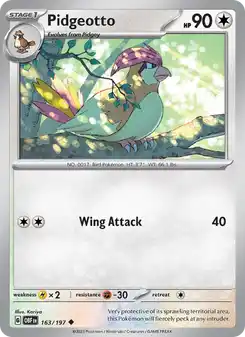
Pokémon Cards (13)
Showing the latest 12













Official artwork


Base sprites


Pokémon Home


Dream World

Showdown


Detailed information
General overview of Pidgeotto
Pidgeotto is the intermediate Pokémon between Pidgey and Pidgeot, known as Roucoups in the French versions of the Pokémon games. This Pokémon occupies a special place in the hearts of players, as it often symbolizes the transition from the early adventure to mid-game. More robust than the small Pidgey but less imposing than Pidgeot, Pidgeotto offers an excellent balance of power, Speed, and endurance. In the Pokédex, this Pokémon is presented as a territorial bird that monitors its territory from the air and dives on its prey with remarkable precision. Its role as an accessible Flying-type Pokémon fairly early in the game makes it a valuable ally for traversing routes, battling wild Pokémon, and advancing through the story.
In most first-generation games and their remakes, Pidgeotto appears as a natural evolution for players who caught a Pidgey early on, often on Route 1 or other paths near the first towns. As levels go up, this evolution brings higher base stats, more powerful moves, and a more aggressive battle style. While many Fire- or Electric-type Pokémon can rival it in terms of raw damage, Pidgeotto stands out for its versatility, its ability to cover multiple opponent types, and its access to very useful Flying- and Normal-type attacks.
Pidgeotto's characteristics and typing
Type, nature, and team role
Pidgeotto is a Normal/Flying-type Pokémon. This type combination grants it interesting resistances, particularly against Grass- and Bug-type attacks, as well as a complete immunity to Ground-type attacks. However, it has weaknesses to Rock, Ice, and Electric types, which can quickly become problematic if the team is not prepared. A nature that boosts Pidgeotto's Speed or Attack allows for stronger and faster hits, which perfectly matches its offensive role. Depending on the Trainer's playstyle, EVs can be allocated to Attack and Speed to optimize its offensive stats.
In terms of team roles, Pidgeotto sits between a light physical sweeper and an offensive pivot. It can switch in thanks to its resistances, capitalize on a poorly effective incoming hit, and retaliate with a Flying or Normal-type attack. Even if its max stats do not match those of some ultra-powerful Pokémon, it delivers a solid performance for a mid-game Pokémon. Its presence often puts pressure on wild Pokémon and Trainers encountered on routes, while setting the stage for Pidgeot as the final evolution.
Height, feathers, wings, and Pokédex description
In the Pokédex description, Pidgeotto is often presented as a proud-looking Pokémon with elegant feathers and sturdy wings. Its height is more imposing than Pidgey's, making it visually more impressive on a Pokémon card or in its sprite across the various generations. The Pokédex frequently mentions its ability to glide for long distances in the air, using the wind to cover great distances without tiring. Its large wings allow it to soar over its territory and spot the slightest prey below. Whether facing a small Pokémon or a more resilient opponent, Pidgeotto does not hesitate to swoop down and seize it with sharp talons.
Its Pokédex number varies across national and regional versions, but in the Kanto Pokédex it remains one of the first Flying-type Pokémon to appear. Its description emphasizes its territorial behavior: it fiercely defends its territory and may attack wild Pokémon larger than itself if they come too close to its nest or hunting grounds. This image of guardian of the sky is also present in the stories and lore players share about the first generations, where Pidgeotto already played an important role in the balance of the region's ecosystem.
The evolution from Pidgey to Pidgeotto, then Pidgeot
Pidgeotto is the second stage of an iconic evolutionary line. Pidgey, the small starting bird, evolves into Pidgeotto at a certain level, generally quite early in the adventure — once the Trainer has already traversed a few routes and faced a few Gym Leaders. This evolution brings a significant gain in base stats: Attack and Speed increase, HP becomes more comfortable, and Defense improves enough to take a few extra hits. For players following the classic progression, the evolution level from Pidgey to Pidgeotto is often a memorable milestone in the first major transformation of their team.
Later, Pidgeotto evolves into Pidgeot, an even more powerful form with broader wings, a majestic bearing, and even more powerful Flying attacks. This final evolution allows the line to become a serious asset in the endgame. The name Pidgeotto is equally appreciated by international players, particularly in the first versions like Red and Blue, but also in more modern remakes. The gradual evolution from Pidgey to Pidgeotto and then to Pidgeot perfectly illustrates the concept of growth and increasing power as the Kanto Pokémon generation takes shape through the game.
Pidgeotto's moves and recommended sets
Moves learned by level-up
The moves Pidgeotto learns by leveling up form the foundation of its offensive arsenal. It often inherits moves from Pidgey, such as Tackle, Sand Attack, or Gust, then gradually learns more powerful techniques like Wing Attack, Night Slash, or Hurricane depending on the version. Hurricane, for example, perfectly illustrates its mastery of wind and air: Pidgeotto unleashes a whirlwind of air that can confuse the opponent and deal respectable damage. As the level increases, these moves gain in power and allow it to take on tougher wild Pokémon or Trainers.
In a standard offensive set, a mix of Flying- and Normal-type attacks, complemented by one or two coverage moves learned via TM, is worth considering. The goal is to capitalize on Pidgeotto's Speed and Attack to land a strong hit before the opponent can react. While exact values may vary by generation and game (for example in Pokémon FireRed versus Pokémon GO), the logic remains the same: exploit Flying moves to defeat Grass-, Bug-, and Fighting-type Pokémon, while having at least one Normal-type move for general coverage.
TM-learned moves and strategies
TMs give Pidgeotto access to a broader range of moves. In some games, it can learn moves like Aerial Ace, Roost, or even support options like Double Team or Feather Dance. These capabilities allow for a set tailored to the team's needs. For example, a purely offensive set will make the most of powerful Flying attacks, while a more strategic set will use support moves to lower the opponent's Attack or heal Pidgeotto at the right moment. Merchandise like Pidgeotto Pokémon cards often reflects this battle style, depicting the Pokémon mid-flight, ready to deliver a decisive blow.
In terms of EVs, it is common to concentrate most points in Attack and Speed in order to maximize offensive performance. A rough optimization breakdown shows that spreading EVs into Special Defense or HP does not allow Pidgeotto to achieve the same impact against its opponents. However, a minimum of HP EVs can help absorb an extra hit or survive an unexpected Electric attack. For players seeking peak performance, the right balance between power and survivability makes the difference between an average Pidgeotto and one capable of carrying the team in crucial battles.
Pidgeotto in the Pokémon games and on routes
Wild encounters and territories
Pidgeotto can be encountered in various locations depending on the generation. In many games, it appears in the wild on certain routes, sometimes as an evolved Pidgey, sometimes directly as Pidgeotto. It can be seen on Route 8 or on other routes near large cities, soaring over territory in search of prey. On certain beaches, on an isolated island, or above a forest, it symbolizes the presence of a natural balance between Flying-type Pokémon and ground-based ones. Its feathers and wings are often described as capable of generating powerful gusts when it beats them with energy.
In Pokémon GO, Pidgeotto appears regularly in certain areas, particularly in open locations. Players can catch this Pokémon to complete their Pokédex, improve their team, or simply enjoy the nostalgia associated with this classic of the first generation. Pidgeotto's resistances and weaknesses remain similar, making it a decent choice for facing certain raids or filling out a Flying-type attacker lineup. Even if newer and more powerful Pokémon have been introduced, Pidgeotto remains a reference, especially for those who enjoy playing with their historical favorites.
Pokémon cards, prices, and merchandise
The Pidgeotto Pokémon card, whether from old editions or modern sets, also holds a special place among collectors. Illustrations often highlight the Pokémon's aerial posture, facing the wind, with detailed feathers and a focused gaze. Depending on the set, rarity, language, and condition of the card, prices can range from a few euros to higher amounts for ultra-rare or holographic versions. Cards produced in limited quantities, some from special sets, can reach greater value on the collectibles market.
Players and collectors sometimes consult a Pokémon card as a kind of visual summary of the Pokémon's strengths and weaknesses. Even without a detailed table, one can read the HP, move costs, resistance, and weakness at a glance. On specialized sites, Pidgeotto has become far more than just a virtual Pokémon: it is part of an entire universe of products, collections, and memories.
Pidgeotto's base stats, EVs, and potential
Base stats and progression
Pidgeotto's base stats sit midway between Pidgey's and Pidgeot's. It has decent HP, convincing physical Attack, and Speed sufficient to outpace many wild Pokémon and casual Trainers. Its Defense and Special Defense remain average, which means the Trainer must play on combat tempo and avoid letting it absorb too many consecutive hits. Compared to some Fire-type Pokémon of similar power, Pidgeotto relies more on mobility and air control than on sheer force.
As levels rise, the player sees steady gains: each level-up brings HP, Attack, Defense, and Speed increases. The most methodical players can track these gains mentally, comparing current stats against those of other Pokémon at the same level. Even if Pidgeotto cannot rival ultra-legendary Pokémon or Mega forms, it remains a solid option for those who appreciate natural, unforced progression through the adventure.
EV distribution and performance optimization
EV distribution is a key element for Trainers who want to get the most out of Pidgeotto. Most of the time, a spread focused on Attack and Speed is preferred: this allows it to hit hard and fast, perfectly matching its battle style. A few HP points offer a margin of survivability, while a light allocation in Special Defense helps absorb the occasional special hit. It is rare, however, to invest many EVs in pure Defense, as Pidgeotto's primary vocation is not to serve as a defensive wall.
Once max level is reached in certain versions, or when well trained in others, Pidgeotto can achieve a very satisfying level of performance. Without being the most optimal option in a highly competitive setting, it remains a reliable, enjoyable Pokémon capable of winning many battles, especially in solo story campaigns. Its potential also shows in fast-paced battles where the choice of which move to use each turn determines the outcome of the duel.
Pidgeotto's resistances, weaknesses, and combat style
Pidgeotto's strengths and resistances
Thanks to its Normal/Flying typing, Pidgeotto benefits from good resistance to Bug- and Grass-type attacks, while being immune to Ground-type moves. This resistance to Ground makes it particularly interesting on certain routes where Ground-type wild Pokémon dominate encounters. Its ability to gain the upper hand on these opponents lets it secure experience and level up quickly. Moreover, the Flying moves it uses are often powerful against Fighting-type Pokémon that might otherwise threaten other members of the team.
Its combat style rests on air control and the ability to strike first. By beating its wings, it creates a wind that unbalances the target and gives it the opportunity to land a decisive blow. Moves like Hurricane or other wind-based abilities strengthen this connection to the air element. When well trained and equipped, Pidgeotto can transform into a true hunter, soaring over fields, beaches, or hills in search of a vulnerable target.
Weaknesses and limitations to bear in mind
On the downside, Pidgeotto suffers from clear weaknesses against Rock, Ice, and Electric attacks. A single well-aimed Rock move can sometimes end the battle if it is not properly protected. Electric Pokémon like Pikachu pose a particular danger, as they can exploit this weakness with powerful attacks, limiting Pidgeotto's ability to remain on the field. Trainers must therefore pay attention to team composition and plan for Pokémon capable of covering these weaknesses.
As the Pokémon roster grew with new types and new moves over the generations, Pidgeotto's role was slightly relativized in favor of more specialized Pokémon. Nevertheless, both in classic games and in formats like Pokémon GO, it remains relevant for filling out a Flying-type offensive set, particularly when seeking a straightforward Pokémon with solid attacks and a clear identity. Its weaknesses are not insurmountable if you anticipate potential threats and learn to switch it out at the right moment.
Pidgeotto compared to other Pokémon
Compared to other iconic Kanto Pokémon like Pikachu or certain Fire-type Pokémon, Pidgeotto stands out for its aerial role and versatility. Where an Electric-type Pokémon focuses on special attacks, Pidgeotto bets on physical Flying- and Normal-type moves. Compared to Pidgey, it is a clear improvement in terms of power, HP, and resilience, while retaining the same general nature as a mid-adventure Flying Pokémon. Compared to Pidgeot, Pidgeotto is slightly behind, but faster to obtain and less demanding in terms of level.
Pidgeotto is also frequently compared to other Flying-type Pokémon across different generations. Even when looking at other regions or islands introduced throughout the series, this Pokémon retains a special charm. It may not be the most powerful or the rarest, but it represents a reliable companion for traversing routes, overcoming obstacles, and winning many battles. Its history, presence in the earliest games, and consistency within the Pidgey → Pidgeotto → Pidgeot line make it a cornerstone of the first generation.
Frequently asked questions about Pidgeotto
How to catch Pidgeotto easily?
To catch Pidgeotto, Trainers have several options. The first is to catch a Pidgey on a route at the start of the game, then evolve it by battling wild Pokémon or Trainers until reaching the evolution level. The second option, depending on the version, is to encounter it directly in the wild — sometimes on intermediate routes like Route 8 or in areas near the sea or a beach. In Pokémon GO, catching is done by throwing Poké Balls at its wild form, potentially using Berries or accuracy bonuses.
Pidgeotto's catch rate is generally reasonable, though harder to catch than Pidgey. Players can maximize their chances by weakening the Pokémon before throwing, or by using more powerful Poké Balls. Once caught, Pidgeotto quickly becomes a team staple, capable of covering many situations.
Is Pidgeotto a good Pokémon for beginners?
Pidgeotto is considered an excellent Pokémon for beginning players. It offers an ideal combination of simplicity, reasonable power, and flexibility. Its Normal/Flying typing covers a lot of situations, and its moves are easy to understand. It naturally learns powerful moves as its level increases, without requiring complex TM usage or highly precise EV management. For a player discovering the series, Pidgeotto serves as a model of clear progression: catch a Pidgey, evolve it, train it, then unlock Pidgeot to further strengthen the team.
Even for more experienced players, Pidgeotto can serve as a support or transitional Pokémon in a team under construction. It can travel across various routes, participate in battles against wild Pokémon, defend a specific territory, or serve as a catching partner to weaken other Pokémon. Its balanced nature, powerful Flying moves, and ability to exploit wind and air make it a pleasant companion regardless of the chosen generation.
What is a Pidgeotto Pokémon card worth?
The value of a Pidgeotto Pokémon card depends on many factors, including the set of origin, rarity, edition (first edition or not), language, and card condition. In some modern sets, Pidgeotto may appear as common or uncommon cards, while in other generations or special editions, it may feature more elaborate artwork, holographic finishes, or alternate versions. Collectors monitor price fluctuations and regularly consult catalogs or specialized platforms to track card values.
Even if the Pidgeotto Pokémon card is not always the most sought-after compared to ultra-rare legendaries or Mythical Pokémon, it holds strong sentimental and nostalgic value. It evokes past battles, routes traveled, early catches, and standout in-game moments. In some shops or online, products featuring Pidgeotto are offered at affordable prices, allowing fans to complete their collection without breaking the bank.
