

N°0089 · Generation 1
Muk
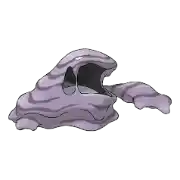
Its foul odor causes fainting. Its sense of smell has atrophied from its own stench.
Share this Pokémon
Characteristics
- Height:
- 1.20
- Weight:
- 30.00
Base stats
Total: 500Combat strengths and weaknesses
Damage multiplier taken by Muk depending on the attacking move's type. ×2 and ×4 are the attacks to avoid.


Resistances - weak attacks




Your Pokédex, in cards
Every card of every Pokémon, what you already have and what you're missing.
Evolutions

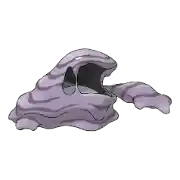
Forms
Forms available in your language are clickable. The others show their stats below.
Additional information
Pokémon Cards (29)
Showing the latest 12










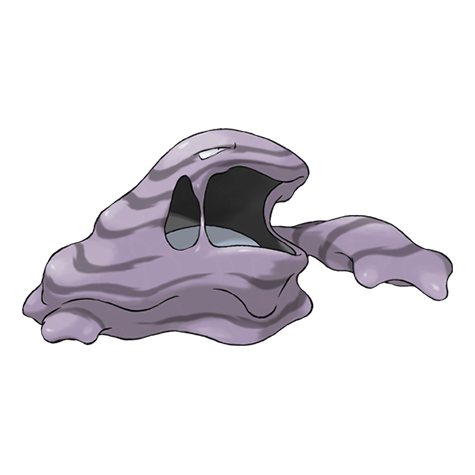
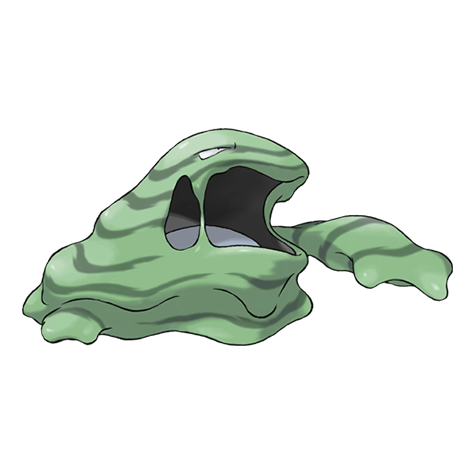
Official artwork
Base sprites


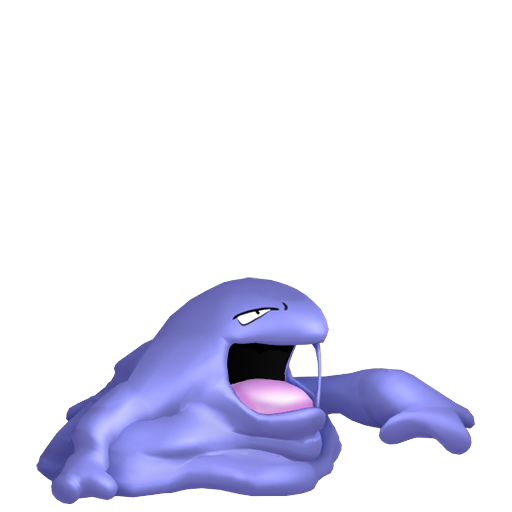
Pokémon Home

Dream World
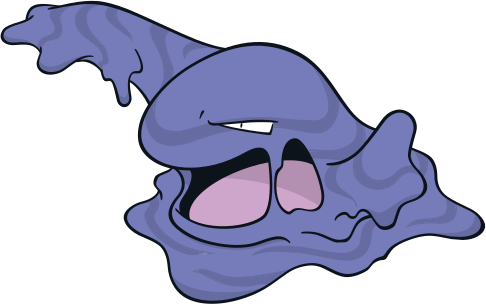
Showdown


Detailed information
General overview of Muk
Muk, known under the English name Muk and Japanese name ベトベトン Betbeton, is a Poison type Pokémon highly appreciated by players for its defensive role and its ability to deal constant damage through toxic attacks. In the Pokédex, it appears as the direct evolution of Grimer, generally around the level where Grimer reaches its full offensive potential. Its slimy body, blue or purple depending on the generation, emits a very strong odor capable of repelling any enemy that comes into contact with it. The key information for players focuses on its Poison type attacks, its capture in the applicable versions, as well as its base values and strategic potential in battle.
Characteristics and type of Muk
Muk belongs to the pure Poison type, giving it useful resistances against Grass and Fighting attacks, while being vulnerable to Ground and sometimes Psychic depending on the game. Its weight reaches several dozen kilograms, and its imposing size reflects its body entirely composed of toxic sludge and waste. Players looking for a tank capable of absorbing physical hits will particularly appreciate its decent Defense and wide pool of contact-based attacks. There is no notable difference between a male and female regarding stats or evolution.
Evolution and obtaining it in the games
The evolution from Grimer to Muk occurs generally by leveling up. Its appearance varies by generation, but it can often be encountered in polluted areas, such as an abandoned mansion, sewers, or debris-laden routes. For players looking to complete their Pokédex, capture remains fairly simple thanks to a catch rate higher than that of many evolved Pokémon.
Its Alolan form, available in certain versions, introduces a multicolored variant with a dual Poison and Dark type, completely changing its matchups and providing a new strategic perspective.
Moves and interesting sets
In battle, Muk excels when using Poison moves like Poison Jab, Toxic, Sludge Bomb, or Sludge Wave. To maximize its effectiveness in one-on-one matchups, many players opt for contact moves enhanced by its slimy body. Moves like Headbutt, and certain TMs are also used to broaden its offensive set. Ghost-type attacks can sometimes be learned depending on the version, allowing it to hit enemies that would normally resist it.
Strategically, its role as an offensive wall relies on high HP, good physical strength, and access to moves that deal progressive damage. Thanks to its well-rounded base stats, it can serve as a very reliable anti-Grass option or as a Poison absorber in a specialized team.
Stats, nature and EV distribution
Muk's base values emphasize HP and Attack, which favors a nature that boosts Attack or Defense depending on the desired role. An EV spread focused on HP and Attack is often recommended for an offensive set, while a more defensive build focuses more on Defense and Special Defense.
Its max CP in certain games and its potential to reach a high level make it an excellent choice for players looking for a reliable Pokémon for raids or difficult content. Its in-game description highlights its repulsive smell and its ability to dissolve almost everything it touches.
Muk Pokémon Cards
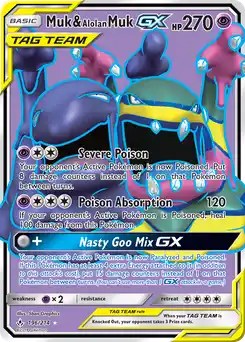
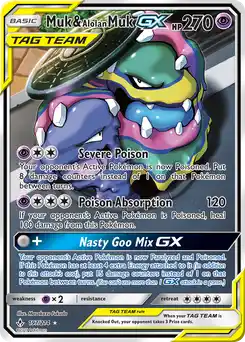
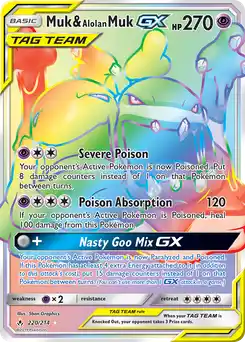
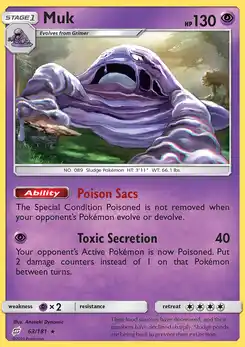
In the collectible card game, Muk often appears as a nuisance-focused Poison Pokémon, using attacks that inflict Poison, residual damage, or energy loss on the opponent. Some editions feature its Alolan form, with green and multicolored illustrations that are highly sought after.
Team utility and tips
Muk easily finds its place in a team looking to counter Grass Pokémon, disrupt the opponent, or build around persistent damage. Its toxic body acts as a deterrent for all Pokémon relying on direct contact. Its easy capture, fast progression, and alternative form give it a solid place across many generations.