


N°0011 · Generation 1
Metapod
Although its body is encased in a solid shell, the inside is so soft that a powerful blow could still be dangerous.
Share this Pokémon
Characteristics
- Height:
- 0.70
- Weight:
- 9.90
Base stats
Total: 205Combat strengths and weaknesses
Damage multiplier taken by Metapod depending on the attacking move's type. ×2 and ×4 are the attacks to avoid.


Resistances - weak attacks


The complete Pokédex, in your pocket
Detailed pages, types, stats and your favourite Pokémon - on the app.
Evolutions

Additional information
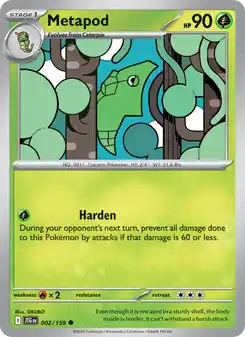
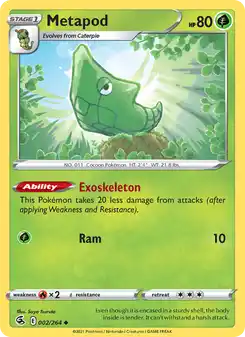
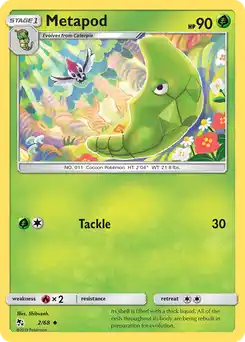
Pokémon Cards (17)
Showing the latest 12





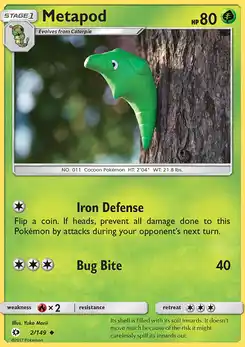
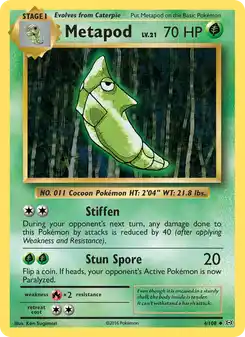

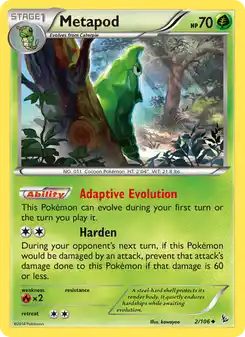
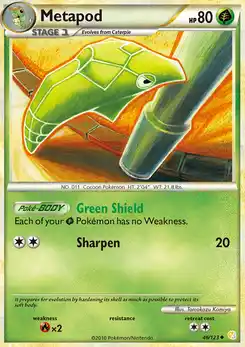
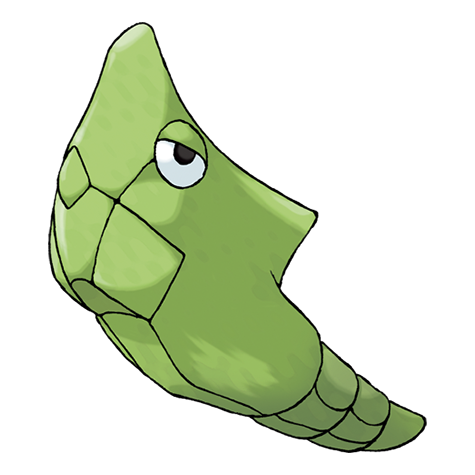
Official artwork

Base sprites


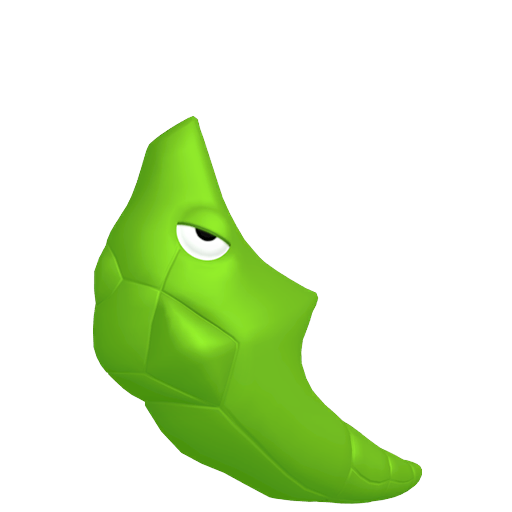
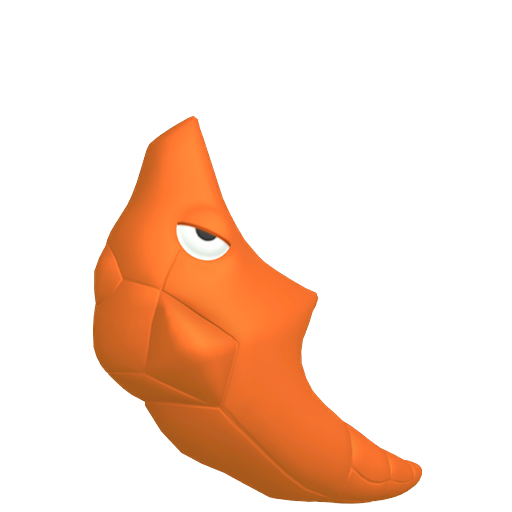
Pokémon Home
Dream World
Showdown


Detailed information
Key characteristics of Metapod
Metapod, known as Chrysacier in French and トランセル in Japanese, is the first-generation Cocoon Pokémon. Listed very early in the Kanto Pokédex (No. 011), it represents the intermediate stage between Caterpie and Butterfree. This Bug-type Pokémon is best known for its extremely hard shell, which functions as a natural suit of armor protecting its fragile, transforming body.
In Pokémon Red, Blue, Yellow, and later FireRed and LeafGreen, Metapod is commonly encountered in Viridian Forest or on nearby routes, shortly after crossing paths with Caterpie. Its role is clear: to show players a multi-stage evolution while introducing the concept of a defensive Pokémon focused on HP and Defense rather than offense.
Appearance and behavior
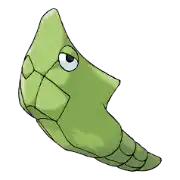
The body of Metapod is entirely encased in a rigid shell, shaped like an upward-pointing teardrop. Its color ranges from light green to a deeper green depending on the game and the artwork. Its white, half-closed eyes give an impression of calm and focus, as though it is entirely absorbed in its inner metamorphosis.
This Pokémon's shell resembles a casing of steel — even if, in terms of typing, it remains purely Bug. Many official descriptions note that the shell is so hard it is very difficult to damage, even with powerful attacks. When Metapod feels threatened, it does not flee: it simply hardens its shell and endures hits as best it can.
Its behavior is therefore nearly motionless. Unlike Caterpie, which moves around and feeds constantly, Metapod often hangs from a branch or rests on the ground, focused entirely on its transformation. This stage mirrors that of a real-world cocoon in nature, between the caterpillar and the butterfly. In the games, it barely moves at all, which is reflected in its animations and its limited moveset in battle.
Base stats
In terms of stats, Metapod is an extremely specialized Pokémon. Its HP is modest, its Attack and Special Attack are very low, and its Speed is also fairly poor. Its Defense, however, skyrockets compared to Caterpie, making it a surprisingly solid wall for such a simple Pokémon.
- Base HP: low to moderate
- Attack / Special Attack: very low
- Defense: very high for a Pokémon at this stage
- Speed: low
In many games, battling a wild Metapod means facing an opponent that does nothing but use Harden, raising its Defense even further each turn. This can be frustrating for new players, but it perfectly illustrates its role as a highly resilient cocoon, nearly impervious to physical hits.
In terms of EVs, defeating Metapod generally yields Defense effort points, making it a good training target for Trainers who want to boost the defensive stats of other Pokémon on their team. With a little patience, one can significantly improve another Pokémon's defensive stats by chaining battles against this green cocoon.
How to evolve Metapod?
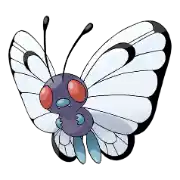
Metapod's main appeal lies in its central place in Caterpie's evolution chain. It is a required stepping stone to obtain Butterfree, a Bug/Flying (or Bug) Pokémon with far more useful combat abilities.
Evolution methods
In most mainline games, Metapod's evolution method is very straightforward:
- Caterpie evolves into Metapod at level 7.
- Metapod evolves into Butterfree at level 10.
There is no need for a stone, special item, or complex condition — simply gaining experience is enough. This makes it one of the fastest Pokémon to fully evolve in the entire first generation. As early as the starting areas — Viridian Forest, routes around Pallet Town and Pewter City — a player can already have a fully evolved Butterfree.
This simple progression has remained unchanged across most versions: Red, Blue, Yellow, FireRed, LeafGreen, but also in the HeartGold and SoulSilver remakes, as well as in more recent titles such as Pokémon Let's Go, Pikachu! and Let's Go, Eevee!. In certain games, Metapod can also be found directly in the wild, skipping the Caterpie phase and fast-tracking the player toward the final form.
Tips to speed up the evolution
To evolve Metapod into Butterfree quickly, a few simple tricks can help:
- Place it at the front of the party: even if it only stays in for one turn, it will gain experience from the battle if swapped out for a stronger Pokémon.
- Use Exp. Share: in games where the item or the global EXP share system exists, Metapod gains experience without even entering battle.
- Battle weak Pokémon: against very low-level opponents (Viridian Forest, early areas), it can sometimes hold on for a few turns while a partner finishes off the fight.
- Exploit Trainer battles: these grant more EXP than wild Pokémon encounters, which speeds up the evolution.
Since Metapod has almost no offensive moves in some games (sometimes knowing only Harden), the most effective strategy is to send it in at the start of battle and immediately switch to a stronger Pokémon to finish the fight. After just a few battles, it reaches level 10 and transforms into Butterfree, which then learns far more useful moves such as Confusion, Sleep Powder, or Poison Powder.
For players interested in EVs and IVs, it can be worthwhile to raise Caterpie first, obtain good IVs through breeding, and then evolve it all the way to Butterfree via Metapod. That way, the entire line benefits from optimization right from the first stage.
Metapod in the Pokémon games
Metapod appears in many versions, from the first generation to more modern titles such as Sword and Shield (via transfers) or Let's Go. Its role remains essentially the same: an intermediate Pokémon focused on Defense, not threatening offensively but very symbolic of the fast progression of Bug-type Pokémon.
Appearances in the early generations
In Pokémon Red, Blue, and Yellow, Metapod can be found in Viridian Forest, usually at a slightly higher level than Caterpie. It sometimes appears already as a cocoon Pokémon, allowing impatient players to skip training the caterpillar from scratch. In FireRed and LeafGreen, Metapod's role remains identical, with similar appearances in the same areas.
In Gold, Silver, Crystal, and their HeartGold and SoulSilver remakes, Metapod can be found in certain wooded areas of Johto, as well as through the Safari Zone or other encounter mechanics. Diamond and Pearl, along with Ruby and Sapphire, introduce it either through trades or events, showing that it remains a meaningful symbol even outside Kanto.
Metapod in Let's Go and recent games
In Pokémon Let's Go, Pikachu! and Let's Go, Eevee!, Metapod reappears in Viridian Forest. The catch system there is inspired by Pokémon GO: there are no longer classic wild battles, but instead the player must throw Poké Balls at moving targets. Metapod is a relatively easy Pokémon to catch thanks to its low mobility, even if its shell hints at considerable resilience.
In Sword, Shield, Sun, Moon, or other recent games, it can join a team via Pokémon Bank or Pokémon HOME. While it is not always available in the wild, its line remains appreciated for its nostalgic value, especially by players who started with the first-generation games.
Metapod's role in battle and strategy
Competitively, Metapod is not a common choice. Its offensive stats are too low and its movepool very limited. However, it does have a few specific uses, particularly in personal challenges, restricted game modes, or "challenge run" play styles.
Usefulness early in the adventure
Early in the adventure, Metapod can serve as an HP sponge, absorbing physical hits thanks to its very high Defense. While it tanks hits, other team members can heal, use items, or set up attacks. It can also help whittle down non-threatening opponents while it gains the experience needed to reach its evolution level.
In certain fan challenges such as Nuzlocke runs or Bug-type-only playthroughs with optimized EVs, Metapod can fill this "living shield" role until Butterfree is ready to take over. Its low Speed makes it vulnerable to Fire- and Flying-type Pokémon, which can knock it out in one or two hits.
EV training and use as a target
Many Trainers use Metapod as an EV training target for their other Pokémon. Since defeating a wild Metapod yields Defense EVs, battling a long series of cocoons in the Forest or on certain routes lets players raise that stat very quickly for a defensive Pokémon, such as a Rock or Steel tank.
Players who want to optimize their Pokémon for competitive play often use EV training charts to identify the best targets: Metapod appears regularly on those lists as a simple, accessible source of Defense effort points, especially in the first-generation games and their remakes.
