



Share this Pokémon
Characteristics
- Height:
- 1.10
- Weight:
- 32.00
- Gender differences:
- Yes
Base stats
Total: 395Combat strengths and weaknesses
Damage multiplier taken by Butterfree depending on the attacking move's type. ×2 and ×4 are the attacks to avoid.
Weaknesses - dangerous attacks


Resistances - weak attacks


Immunities - no damage taken

The complete Pokédex, in your pocket
Detailed pages, types, stats and your favourite Pokémon - on the app.
Evolutions



Forms
Forms available in your language are clickable. The others show their stats below.
Additional information
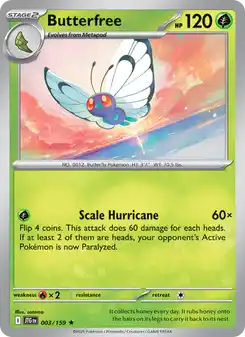
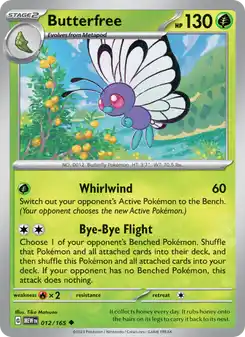
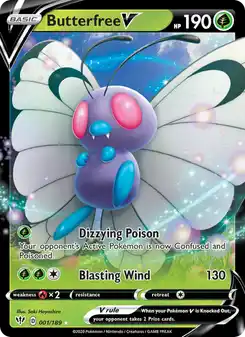
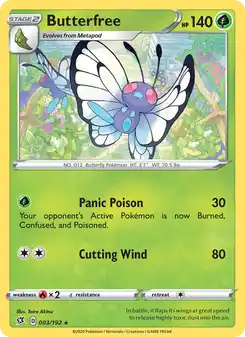
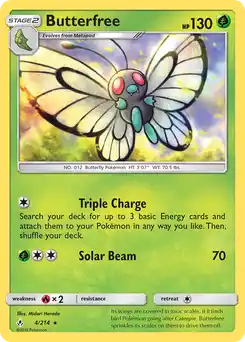
Pokémon Cards (22)
Showing the latest 12









Official artwork
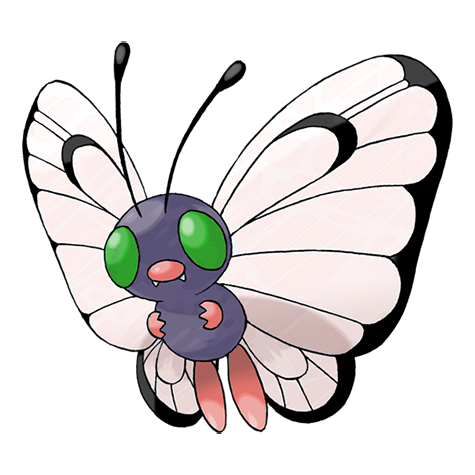
Base sprites


Pokémon Home


Dream World

Showdown


Detailed information
Overview of Butterfree, the Bug/Flying-type Pokémon
Butterfree, known as Papilusion in French, is a first-generation Pokémon that appears very early in the Kanto Pokédex. It is the final evolution of Caterpie, reached after passing through Metapod. This Bug/Flying-type Pokémon is renowned for its large white wings veined with black, its enormous red eyes, and its calm yet determined demeanor. In many games and media, Butterfree symbolizes the transformation from a small, vulnerable worm into a majestic butterfly capable of flying freely through the air.
In most official descriptions, Butterfree is portrayed as a Pokémon that lives in flower-filled forests. It feeds on nectar and pollen, which it collects using the fine hairs on its legs and wings. It stands just over one meter tall and has a modest weight, allowing it to remain agile in battle despite average defensive stats. Its large-butterfly appearance makes it instantly recognizable, whether in the video games, the anime, or on a Pokémon card.
Origins of Butterfree
Butterfree's design dates back to Game Freak's earliest work on the Red and Blue generation. The creators wanted to offer a simple evolutionary line — Caterpie → Metapod → Butterfree — inspired by the real-life insect life cycle. The idea was to show players how a Pokémon can progress very quickly over just a few levels, going from a small caterpillar to a fully developed butterfly.
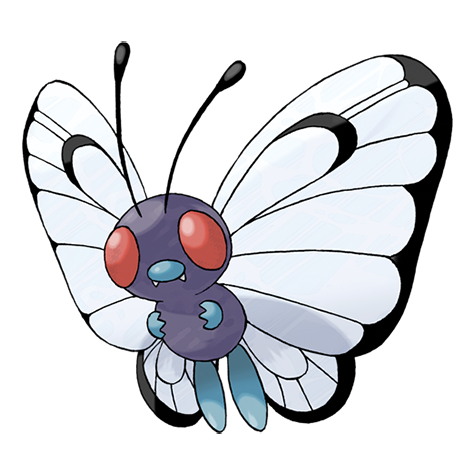
Aesthetically, Butterfree borrows elements from several butterfly species, with a dark purple body and large white wings veined with black. Its coloring contrasts sharply with the green of Caterpie and the rigid cocoon of Metapod, highlighting the radical change brought about by evolution. In the Pokémon world, it represents freedom, lightness, and strategic strength thanks to its many status-inflicting moves.
Butterfree in the world of Pokémon
In the Pokémon world, Butterfree is often observed in forests, meadows, and flower-filled plains where it collects nectar from blossoms. Some Pokédex entries note that it can travel long distances to find the most honey-rich flower, making it an important pollinator. Its wings are coated with a fine powder — with various effects — that can be soothing, toxic, or sleep-inducing depending on the move used.
In the anime, Butterfree is particularly famous for Ash's Butterfree, which evolved from a Caterpie he caught in Viridian Forest. The farewell episode, in which Butterfree leaves the team to depart with a pink mate, is one of the most memorable moments of the series. It helped cement Butterfree in the hearts of many fans as a loyal, sensitive, and courageous Pokémon.
Butterfree's evolution
Butterfree's evolutionary line is among the simplest and fastest in the entire series. It spans three distinct stages — Caterpie, Metapod, then Butterfree — all accessible at very low levels. This is why many guides advise beginners to catch a Caterpie right at the start of the adventure.
The evolution process from Caterpie to Butterfree
The evolution process unfolds in two steps:
- Caterpie evolves into Metapod at level 7.
- Metapod evolves into Butterfree at level 10.
This is an extremely fast evolution: in just a few battles on the starting routes or in Viridian Forest, a player can already have a fully evolved Butterfree. This simple mechanic lets players discover the joy of evolving a Pokémon very early on and unlocking new moves.
In some versions, it is possible to find Metapod or even Butterfree in the wild directly, but the most common method is to raise a Caterpie yourself. This also allows you to optimize the line with good IVs and tailor EVs to whatever role you want Butterfree to fill on your team.
Advantages of evolving
Moving from Caterpie to Butterfree offers many advantages. First, stats increase significantly: HP gains in solidity, Special Attack and Speed become respectable, while Defense remains average but acceptable for such a lightweight Pokémon. Above all, access to a wide range of moves makes Butterfree immediately useful in battle.
Thanks to its dual Bug/Flying typing (and sometimes the ability to learn moves of the Grass or Psychic type), Butterfree benefits from very good offensive coverage. It can reach its full potential relatively quickly, without requiring special items or evolution stones. For players looking for a versatile Pokémon in the early hours of the game, Butterfree is an excellent choice.
In certain generations, Butterfree can also take on a special form: Gigantamax Butterfree, available in Pokémon Sword and Shield via Dynamax Raids. In this form, its wings take on a gigantic appearance, its attacks gain in power, and it obtains a G-Max move capable of dealing massive damage while applying secondary effects through clouds of powder.
Butterfree's characteristics and main moves
Once fully evolved, Butterfree becomes a very interesting offensive support Pokémon. Its strengths lie in its status moves (sleep, poison, paralysis), its special attacks, and its ability to hit a wide range of types thanks to a varied movepool. Even if its defenses remain modest, its versatility makes it a solid strategic option in both early and more recent generations.
Moves and abilities
Butterfree has a wide array of moves learned by level-up, TM, or breeding. Among the most important:
- Gust — a basic Flying-type attack, often one of Butterfree's first offensive moves.
- Sleep Powder — puts the opponent to sleep, allowing you to set up other attacks or make capturing easier.
- Poison Powder — badly poisons the enemy, ideal for gradually wearing down resistant opponents.
- Stun Spore — paralyzes the target, reducing its Speed and sometimes causing it to miss its turn.
- Confusion — provides Psychic-type coverage, useful against Fighting- or Poison-type Pokémon.
- Silver Wind or Bug Buzz — more powerful Bug-type attacks, learned at higher levels or via TM.
- Psybeam, Shadow Ball, or other special moves in modern generations, which exploit its solid Special Attack.
With TMs and sometimes HMs depending on the version (such as Fly in certain editions), Butterfree can extend its repertoire further. In games such as Diamond, Pearl, Ruby, Sapphire, or Black and White, it can learn techniques like Giga Drain, Energy Ball, or Flash Cannon, giving it surprising options against Water-, Rock-, or Steel-type opponents.
Strategically, Butterfree shines above all through its ability to control the field. A classic set might combine Sleep Powder, Poison Powder, Quiver Dance (or Swords Dance in some versions) and a special attack like Bug Buzz or Psychic. Quiver Dance in particular raises Special Attack, Special Defense, and Speed, allowing Butterfree to transform into a genuine threat after a few turns of setup.
In Pokémon GO, Butterfree also has an interesting selection of moves: a fast Bug- or Flying-type attack (e.g., Bug Bite, Gust) and charged attacks like Bug Buzz or Hurricane. While its max CP does not make it a powerhouse, it is still appreciated for completing the Pokédex and for specific challenges.
Weaknesses and strengths
Like most Bug/Flying-type Pokémon, Butterfree has clear strengths and weaknesses. On the positive side:
- Good Special Attack for a Pokémon at this stage.
- Excellent access to status moves (sleep, poison, paralysis).
- A dual typing that lets it threaten Grass-, Fighting-, and some Poison-type Pokémon.
- Fast progression: it is usable very early thanks to its low evolution level.
On the other hand, its weaknesses are equally pronounced:
- Low physical and special Defense, making it vulnerable to powerful attacks.
- Double weakness to Rock, which can knock it out in a single Stealth Rock or Rock Slide hit.
- Additional weaknesses to Fire, Electric, and Ice types.
To make the most of Butterfree, it is therefore recommended to play it as an offensive support, leveraging its status powers and special attacks while avoiding direct exposure to opposing hits. Competitively, some Trainers invest its EVs in Special Attack and Speed, while giving it an item such as a Life Orb or Leftovers to maximize its impact.
Despite these limitations, Butterfree remains a much-loved Pokémon for its nostalgic appeal, its majestic butterfly design, and its many appearances in merchandise: plushies, figures, clothing, and of course in the trading card game.
Butterfree and the Pokémon cards
In the TCG, several Butterfree cards exist, from the first generation all the way to modern Sword and Shield or Sun and Moon sets. The base set Wizards card depicts Butterfree in flight against a pastel green or blue sky, with modest stats but an illustration highly appreciated by collectors. Other cards highlight its powder abilities, inflicting special conditions on the opposing Pokémon.
The prices of these cards vary depending on the edition, condition, and rarity. Certain holographic or alternate-art versions can reach significant values, especially when graded. Butterfree also regularly appears in themed products centered on Bug-type Pokémon or the Kanto region, confirming its status as a timeless classic.
