



N°0009 · Generation 1
Blastoise
The cannons on its shell fire water jets capable of piercing even tempered steel.
Share this Pokémon
Characteristics
- Height:
- 1.60
- Weight:
- 85.50
Base stats
Total: 530Combat strengths and weaknesses
Damage multiplier taken by Blastoise depending on the attacking move's type. ×2 and ×4 are the attacks to avoid.


The complete Pokédex, in your pocket
Detailed pages, types, stats and your favourite Pokémon - on the app.
Evolutions



Forms
Forms available in your language are clickable. The others show their stats below.

Additional information
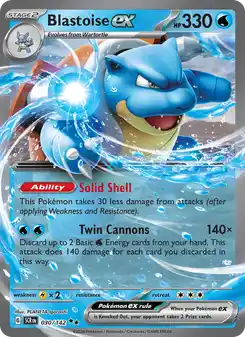
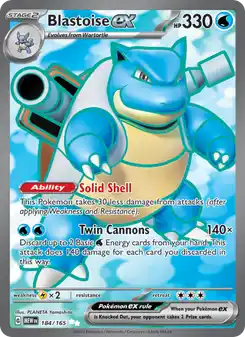
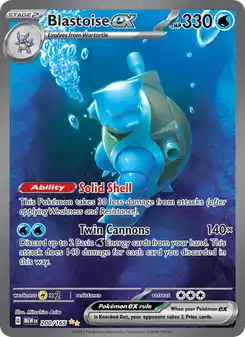
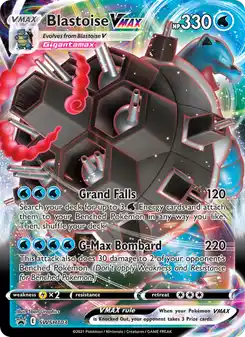
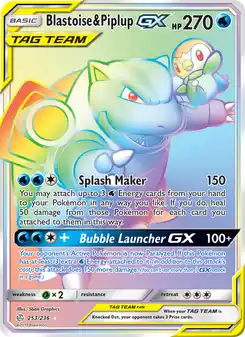
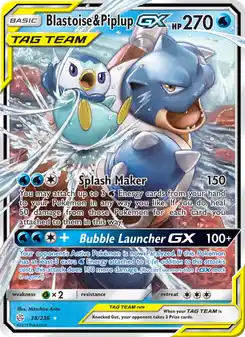
Pokémon Cards (41)
Showing the latest 12






Official artwork


Base sprites


Pokémon Home


Dream World

Showdown


Detailed information
Blastoise: base stats and the Water type
Blastoise, known as Tortank in French and カメックス in Japanese, is one of the most iconic Water-type Pokémon of the Kanto region. It is the final evolution of Squirtle, after Wartortle, and it holds a place of choice in the National Pokédex. Its silhouette as a large armored turtle, its massively reinforced shell and its two enormous water cannons mounted on its back make it instantly recognizable among all the generations.
In the early Red and Blue versions, Blastoise is often presented as the ultimate Water tank: resistant, powerful, capable of firing water jets at very high pressure. Its official information indicates that it can launch true torrents of water capable of breaking concrete walls. This description made an impression on players from the very first generation and continues to inspire fans today.
Description and physical characteristics
Blastoise is a medium-to-large Pokémon: its official height is about 1.6 m for a weight of nearly 85 kg. Its dark blue body, its robust limbs and its dark brown shell make it a true living fortress. The two metal cannons emerging from its shell are capable of concentrating water into ultra-powerful jets; they are its most striking visual symbol.
Its broad head, its often half-closed eyes and its short but solid tail give it a calm, serious, almost strategic demeanor. Blastoise generally comes across as a thoughtful Pokémon, rarely impulsive: it analyzes the situation before striking. Darker versions like Shadow Blastoise or certain card illustrations sometimes give it a more aggressive side, but its overall image remains that of a protector and a defensive leader.
Blastoise's shell is not just a decorative element. It boosts its natural defense, cushions physical blows and lets it retreat completely inside when the pressure becomes too great. This combination of shell, water jets and body mass explains its reputation as a very resistant Pokémon in high-stage battles.
Stats, defensive and offensive role
In terms of stats, Blastoise is an extremely balanced Pokémon. Its base HP is comfortable, its defense and special defense are high, and its special attack reaches a more than respectable level. Its speed is not the highest in the game, but it remains sufficient to outpace certain heavier opponents, especially with a good EV and IV spread.
In many games, Blastoise is used as a defensive pivot: it absorbs blows, uses Water-type moves to threaten Fire, Rock or Ground Pokémon, and can even support the team with utility moves. Thanks to moves like Ice Beam, Water Pulse, Rapid Spin or Toxic (sometimes learned via TM or HM), it becomes a true strategic tool in service of the team.
A properly trained Blastoise can reach an impressive stat total. At level 100, with well-distributed EVs, it can exceed 300 HP, become extremely solid in defense and deal significant damage with its Water moves. In modern games, some players opt for a special offensive Blastoise (Hydro Pump, Scald, Ice Beam, Aura Sphere) while others prefer a more defensive set (Protect, Rapid Spin, Toxic, Scald) to control the pace of the battle.
Evolution from Squirtle to Blastoise
Blastoise's strength is only truly understood when you look at its complete line, from the little Squirtle up to the final form. This progression is one of the most well-known and beloved evolutions in the entire series.
From Squirtle to Wartortle
It all begins with Squirtle, a small Water-type Pokémon chosen as a starter Pokémon in the Red, Blue and Yellow versions. As it levels up, Squirtle develops moves like Water Gun, Bubble or Bite, and strengthens its shell. At level 16, it undergoes its first evolution and becomes Wartortle. The latter sports a heavier shell, a bushy tail and characteristic white ears, already displaying a more mature character.
Wartortle gradually gains power, learns moves like Water Pulse, Surf or Ice Beam depending on the version, and turns into an excellent intermediate between the fragile starter and the ultimate tank. Its base stats increase significantly, especially in defense and HP, setting the stage for the arrival of the formidable Blastoise.
From Wartortle to Blastoise
The second evolution occurs at level 36: Wartortle transforms into Blastoise. This moment is often experienced as an important milestone by players, since it marks access to a high-level Pokémon capable of rivaling many bosses. The transition to Blastoise unlocks access to powerful moves such as Hydro Pump, Surf or even certain Fighting- and Ice-type moves via TM.
In certain generations, Blastoise also benefits from a Mega Evolution: Mega Blastoise. In this form, its cannons become gigantic, its shell strengthens further, and its offensive stats, in particular the special attack, skyrocket. Mega Blastoise can use moves like Water Pulse, Aura Sphere or Dark Pulse with increased power thanks to its special ability Mega Launcher.
The spin-off games and animated series sometimes show variants like Shadow Blastoise, more aggressive versions used by enemy trainers or by Team Rocket. These appearances reinforce Blastoise's image as a dangerous Pokémon when it fights for the wrong causes, but always impressive in its abilities.
Blastoise in the Pokémon games
Blastoise has crossed almost every generation of Pokémon games, from Kanto to the modern regions. Its constant presence and its role as an iconic Water Pokémon make it a true gaming icon.
Presence in the early generations
In Pokémon Red, Blue and Yellow, Blastoise appears naturally as the final evolution of the Water starter. It can be used to take on the Pokémon League thanks to its excellent stats and its ability to absorb many blows. Its Water type gives it a notable advantage against several Gym Leaders and against many Fire-, Rock- or Ground-type Pokémon.
In Pokémon Gold, Silver and Crystal, Blastoise is not available as a starter, but it can be obtained through trades or events. It nonetheless remains an appreciated choice for players who want to import their Kanto team into Johto. In Ruby, Sapphire and Emerald, as well as in the FireRed and LeafGreen remakes, Blastoise keeps its aura of a rare and powerful Pokémon, often tied to special gifts or transfers from other versions.
The Black and White versions, then XY, Sun, Moon, Sword, Shield and the more recent games, often let you obtain Blastoise through events, transfers or special raids. It regularly appears in official entries and in strategy guides, which shows just how much it remains a pillar for many trainers.
Blastoise in the recent games and in Pokémon GO
In modern generations, Blastoise continues to play a very useful Water tank role. In games where Mega Evolutions are present, Mega Blastoise is considered one of the best users of Mega Launcher, with pulse- or aura-based moves that are very dangerous for opposing teams.
In Pokémon GO, Blastoise is often spotlighted during community events. It benefits from charged moves like Hydro Cannon during certain Community Days, which makes it a particularly powerful Pokémon in this game. With good IVs, a high level and optimized moves, Blastoise can serve as a pillar on a Water team for Raids or league battles.
Its impressive design and its reputation as a reliable Pokémon encourage many players to keep it on their team even when new Water Pokémon appear in later generations. The combination of raw strength, solid defense and offensive versatility makes Blastoise a still very competitive choice.
Blastoise in the Pokémon cards and the collection
Beyond the video games, Blastoise also occupies a central place in the world of Pokémon cards. The famous Blastoise Pokémon card from the Base Set, published by Wizards of the Coast in the 1990s, is one of the most iconic cards of the trading card game. Illustrated with a Blastoise ready to launch a destructive water jet, it has become a symbol for an entire generation of collectors.
The most famous Blastoise Pokémon cards
Among the most famous cards are:
- Blastoise from the Base Set (French, English and American editions)
- Holographic Blastoise from the more recent series
- Blastoise EX and its various forms
- Shadow Blastoise, from certain darker themed sets
- Blastoise cards from the Sun & Moon, Sword & Shield series, etc.
The price of these cards depends heavily on their condition, their rarity and their PSA or BGS grade. A Blastoise Pokémon card in perfect condition, from the Base Set and graded 9 or 10, can reach considerable sums, particularly in the 1st edition version.
Appeal for collectors
For Kanto fans, owning at least one Blastoise card is often considered essential to complete a collection centered on the first generation. Collectors appreciate the visual consistency between Squirtle, Wartortle and Blastoise across the various sets, creating a true graphic story of the line.
Modern cards continue to feature Blastoise in new forms: V cards, VMAX, alternate illustrations, full-art or secret versions. This constant presence proves the longevity of its popularity and its status as a reference Pokémon alongside Charizard and Venusaur.
Battle strategies and Blastoise's best moves
Thanks to its excellent mix of defense, HP and offensive abilities, Blastoise is a Pokémon that naturally finds its place on many teams, whether in solo play or in competition.
Moves, TMs/HMs and classic sets
The major moves used on Blastoise include:
- Hydro Pump — a very powerful but less accurate Water move
- Surf or Scald — more reliable options, often preferred in strategy
- Ice Beam — indispensable for handling Grass or Dragon Pokémon
- Rapid Spin — useful for clearing Stealth Rock and Spikes
- Toxic — lets you wear down defensive opponents
- Protect or Reflect — to stall and exploit status damage
In certain games, Blastoise can also learn Fighting- or Dark-type moves via TM, which gives it very interesting offensive coverage. With the right combination of moves and held items, it can turn into an impenetrable wall or an unpredictable attacker.
EVs, IVs and role on a team
By distributing its EVs correctly, a trainer can emphasize the role Blastoise is meant to play. An investment in HP and defense makes it a defensive pillar, while a spread in special attack and speed lets it surprise slower enemies. Good IVs guarantee max stats close to the theoretical potential, which is crucial in competitive formats.
Against opponents, Blastoise must nonetheless beware of Electric- or Grass-type Pokémon, as well as certain users of status moves like Toxic or Thunder Wave. Despite this, its excellent overall profile, its quiet strength and its versatility make it a major asset for any team seeking a robust and reliable Water Pokémon.
Blastoise in popular culture
Its image as a large armored turtle equipped with cannons makes it an easily recognizable character, often used on box arts, posters or promotional products. Blastoise has thus become a true symbol of controlled power: a calm, thoughtful Pokémon, yet capable of unleashing incredible power when the situation demands it.
Whether it is the first time a player sees their little blue turtle evolve into a stern-faced colossus, or the discovery of a shiny card in a vintage booster, Blastoise remains associated with major moments in Pokémon history. Its longevity, both in the games and in the hearts of fans, makes it one of the most important Water Pokémon in the entire franchise.
