


N°0325 · Generation 3
Spoink
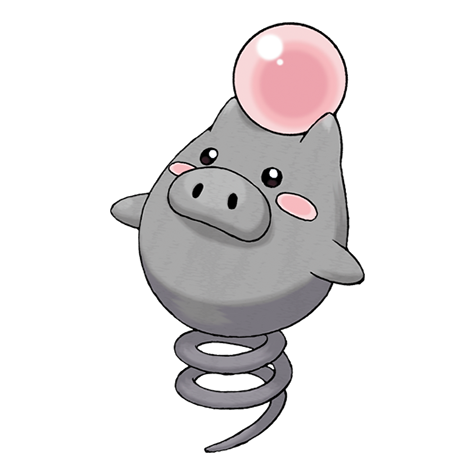
Spoink keeps a pearl on its head. It uses the pearl to amplify its telekinetic powers. It is constantly searching for a bigger pearl.
Share this Pokémon
Characteristics
- Height:
- 0.70
- Weight:
- 30.60
Base stats
Total: 330Combat strengths and weaknesses
Damage multiplier taken by Spoink depending on the attacking move's type. ×2 and ×4 are the attacks to avoid.


Resistances - weak attacks


Your Pokédex, in cards
Every card of every Pokémon, what you already have and what you're missing.
Evolutions


Additional information
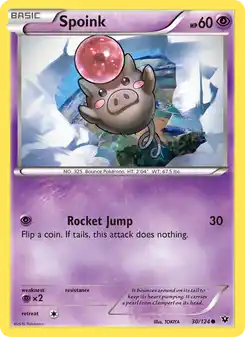
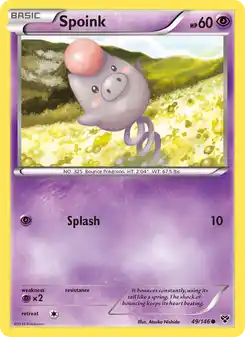
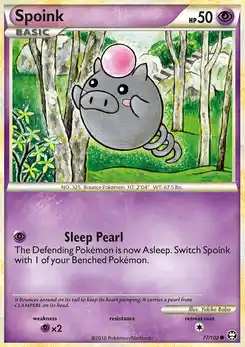
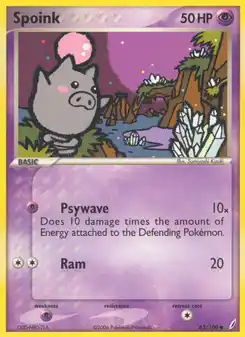
Pokémon Cards (16)
Showing the latest 12






Official artwork

Base sprites


Pokémon Home


Dream World

Showdown


Detailed information
Overview of Spoink
Spoink is a Psychic-type Pokémon introduced in the third generation. Its English name is Spoink and its Japanese name is バネブー. This Pokémon is instantly recognizable thanks to the spring it uses to move by bouncing continuously. In the Pokémon universe, Spoink is known for its dependence on this constant bouncing — if it stops for too long, its heart ceases to beat.
Spoink holds a particular place in the Pokédex as a Pokémon focused on luck and indirect battle management. It is not built to absorb heavy damage but rather to hinder opponents and create strategic openings. For players, it is an interesting Pokémon early in a playthrough or as a stepping stone toward its evolution.
Type and key information
Spoink is exclusively Psychic type. This typing gives it access to effective mental attacks against Fighting and Poison types, while leaving it vulnerable to Dark, Ghost, and Bug moves. Its defensive profile remains fragile, demanding thoughtful use in battle.
Primary type: Psychic
Category: Bounce Pokémon
Height: approximately 0.7 m
Weight: approximately 30.6 kg
In the Pokédex, Spoink is often described as a Pokémon that cannot survive without bouncing. This trait influences its battle style and in-game behavior, especially in animations and official descriptions.
Level, evolution, and progression
Spoink evolves into Grumpig starting at level 32. This evolution marks a significant shift in its battle effectiveness. Before reaching that level, Spoink remains limited in raw power, but it can already learn useful moves for control and support.
For players aiming to optimize their progression, it is recommended to level Spoink up through battles against Pokémon weak to the Psychic type. Once the required level is reached, its evolution noticeably improves its stats, particularly HP and Defense.
Base stats and luck in battle
Spoink's stats lean toward Special Attack and moderate Speed. Its Defense and HP remain low, leaving it vulnerable to powerful physical attacks. However, some of its moves rely on luck and secondary effects, which can turn the tide of a battle when used well.
HP: low
Special Attack: decent
Defense: low
Speed: average
This reliance on luck makes Spoink sometimes unpredictable. In battle, it can catch an unprepared opponent off guard, but it requires careful anticipation from the Trainer.
Spoink in cards and games
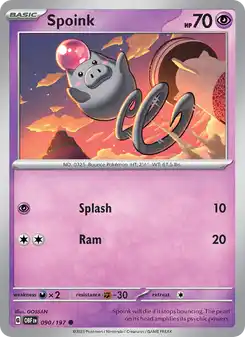
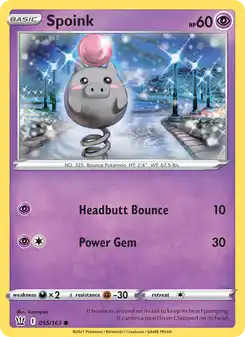
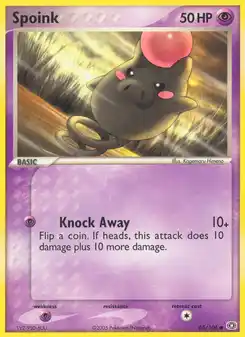
In the Pokémon Trading Card Game, Spoink generally appears as a basic card with simple, low-energy attacks. These cards are often used in evolution-oriented decks or as temporary support. Their price remains accessible, making them a common choice for beginner collectors.
In Pokémon GO, Spoink is available in the wild and during certain events. It can be encountered at various levels, sometimes reaching level 40 for advanced players. Its usefulness in raids is limited, but it retains value for completing the Pokédex and evolving it.
Capture, breeding, and availability
Spoink can be caught in several areas depending on the version, often in open environments. Its catch rate is standard, making it relatively easy to add to a team. It is also compatible with breeding, allowing players to obtain low-level Spoink with specific natures to optimize their future performance.
For optimization-minded players, choosing the right nature and managing levels such as 15, 20, or 25 can influence its effectiveness before evolution. Spoink thus remains an interesting secondary Pokémon, especially for strategies based on control and surprise.