


Share this Pokémon
Characteristics
- Height:
- 1.20
- Weight:
- 152.00
Base stats
Total: 410Combat strengths and weaknesses
Damage multiplier taken by Pupitar depending on the attacking move's type. ×2 and ×4 are the attacks to avoid.


Resistances - weak attacks


Immunities - no damage taken



Your Pokédex, in cards
Every card of every Pokémon, what you already have and what you're missing.
Evolutions



Additional information
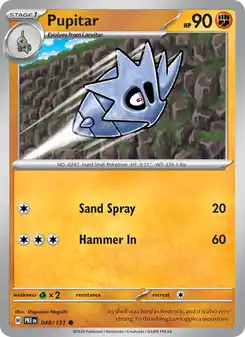
Pokémon Cards (24)
Showing the latest 12













Official artwork


Base sprites


Pokémon Home
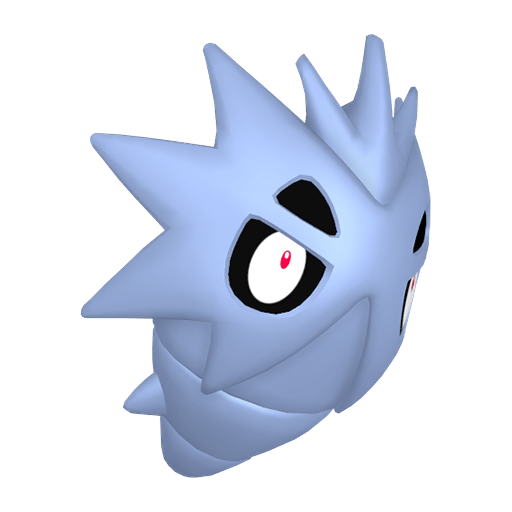

Dream World

Showdown


Detailed information
General overview of Pupitar
Pupitar is a Rock and Ground-type Pokémon belonging to the second generation. Its Japanese name is サナギラス. Pupitar represents the intermediate form of the evolutionary line that begins with Larvitar and leads to Tyranitar. This evolution makes Pupitar a key Pokémon for players looking to build a powerful team oriented around battle and raw power.
In the National Pokédex, Pupitar carries the official number #247. It is often described as a Pokémon in the midst of metamorphosis, sealed inside an extremely resilient rocky shell. This characteristic strongly influences its defensive stats and its playstyle, which is highly appreciated in competitive battles.
Evolution and level progression
Pupitar is the direct evolution of Larvitar. This evolution occurs automatically when Larvitar reaches level 30. Pupitar then evolves into Tyranitar at level 55, making it a Pokémon that requires a significant investment in experience and time.
This gradual evolution allows players to strengthen their Pokémon step by step, learning key moves and optimizing base values before reaching the final form. Pupitar is often used as a solid transitional stage before fully exploiting the power of Tyranitar.
Type and weaknesses in battle
Pupitar's dual Rock and Ground typing grants it excellent resistance against several common types, notably Fire, Poison, and Rock. On the other hand, it has notable weaknesses against Water, Grass, Ice, Ground, and Fighting attacks, which must be taken into account during battles.
In battle, Pupitar is often used as a temporary defensive wall, capable of taking many hits thanks to its shell. Its ability to endure several turns allows powerful moves to be set up or attrition-based strategies to be prepared.
Stats and base values
Pupitar's base stats perfectly reflect its defensive role. It has a balanced stat total, with very high Defense and decent HP for an intermediate Pokémon. Its Attack is average, but sufficient to deal consistent damage.
Its Speed remains low, which means it will often attack after its opponent. Players generally compensate for this drawback with high-power moves or tactical choices adapted to the pace of the battle.
Notable moves and abilities
Pupitar can learn several iconic moves oriented around Rock and raw power. Among the most commonly used moves, you will find Crunch, Rock Slide, Earthquake, and Ancient Power. These moves offer good offensive coverage and allow it to face different types of Pokémon.
Crunch is particularly appreciated for its ability to hit Ghost and Psychic types, while Earthquake remains a reliable option in battle thanks to its high power. TMs and level-up moves allow Pupitar to be adapted to several playstyles.
Usefulness for players and collectible cards
For players, Pupitar is an almost mandatory step in the Larvitar line. It constitutes a strategic stage before reaching an extremely powerful final form. When used well, it can also hold its own on certain intermediate teams.
On the collectible card side, Pupitar is featured in several Pokémon series. Cards highlighting its rocky shell and massive appearance are sought after by collectors who appreciate the complete evolutionary line. Its value often depends on the edition, rarity, and overall condition of the card.