


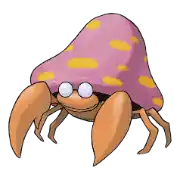
Share this Pokémon
Characteristics
- Height:
- 1.00
- Weight:
- 29.50
Base stats
Total: 405Combat strengths and weaknesses
Damage multiplier taken by Parasect depending on the attacking move's type. ×2 and ×4 are the attacks to avoid.


Resistances - weak attacks



The complete Pokédex, in your pocket
Detailed pages, types, stats and your favourite Pokémon - on the app.
Evolutions
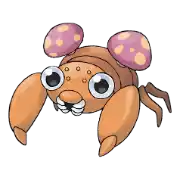
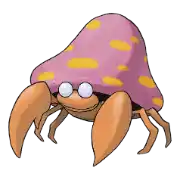
Additional information
Pokémon Cards (16)
Showing the latest 12








Official artwork
Base sprites


Pokémon Home
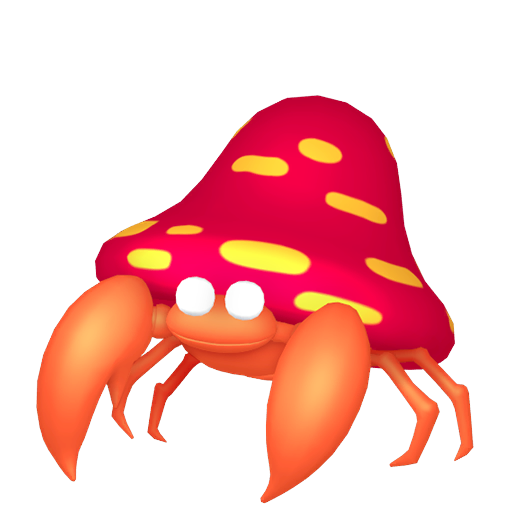

Dream World
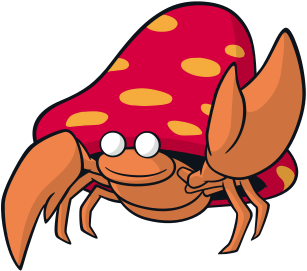
Showdown


Detailed information
General Overview of Parasect
Parasect is one of the most fascinating and unsettling Pokémon of the first generation. The direct evolution of Paras, this Bug and Grass-type Pokémon represents the physical and biological culmination of a unique parasitic process in the Pokémon universe. Its immediately recognizable appearance, dominated by an immense mushroom on its back, constitutes the very essence of its identity and fully influences its moves, its behaviors, and its strategic role in battle.
Known as パラセクト (Parasekuto) in Japanese, Parasect has always been described in the Pokédex as a Pokémon whose mushroom has taken total control of the host body. At this stage, the small insectoid crustacean barely exists as an autonomous entity: it is merely a biological support for the proliferation of the mycelium. This concept, inspired by real organisms such as the cordyceps, gives Parasect a narrative depth rare in the Pokémon roster. This is what makes it a simultaneously strange, frightening, and captivating Pokémon for players interested in Pokédex lore.
From a gameplay standpoint, Parasect occupies a very particular role. Endowed with solid offensive stats, access to Spore — the best sleep move in the game at 100% accuracy — and a range of Grass, Poison, and Bug moves, it excels in control strategies. However, its extreme weaknesses to Fire and Flying types, along with its slowness, make it a Pokémon to handle with care. Despite these flaws, its raw power, decent HP, status moves, and unique style more than justify its use in many story-mode teams.
Origins and Inspirations of Parasect
A Pokémon inspired by real parasitism
The design and concept of Parasect are directly inspired by the fungal parasitism observed in nature. Certain fungi, such as the famous cordyceps, parasitize insects by progressively taking possession of their nervous system, then growing through their exoskeleton. This analogy is perfectly reflected in the evolution from Paras to Parasect: the mushroom develops to the point of becoming the species' primary structure.
The Pokémon has no visible eyes, its movements become mechanical, and everything about its appearance reinforces the idea that the host no longer exists as an individual. This blend of real biology and fantasy makes Parasect a particularly striking design among the first-generation Pokémon. Its "zombie-insect" look also evokes Japanese cultural references, sometimes mentioned in official articles or creator interviews.
Symbolism of the large parasitic form
The final form of Parasect illustrates the mushroom's total control. The small insectoid body becomes almost insignificant beneath the immense cap, red or orange depending on the game. The textures reminiscent of toxic amanitas, the white spots, and the disproportionate size of the mushroom create a deliberate contrast with the Pokémon's body. The designers intended the player to understand, merely by looking at Parasect, that this Pokémon is a victim of the parasite it hosts.
This concept, reinforced in the Pokédex entries of HeartGold and SoulSilver, as well as in Diamond, Pearl, Ruby, Sapphire, and Yellow, contributes to its tragic and complex identity. In some descriptions, the mushroom is even said to be capable of controlling all of the Pokémon's behaviors to promote the dispersal of its spores.
Physical Appearance and Characteristics
Size, weight and body structure
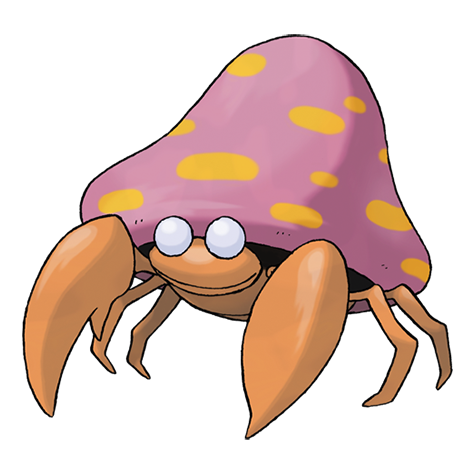
Parasect measures about half a meter in height and weighs several kilograms, making it a compact yet visually imposing Pokémon. Its mushroom covers almost the entirety of its back, spanning a width greater than its body. The cap, domed and striated, ranges in hue from deep red to reddish-orange, adorned with characteristic white spots.
Its body, orange sometimes tending toward black in its Shiny form, has six rigid legs ending in claws. Its eyes are completely blank, reinforcing the idea of total control by the mushroom. Visually, Parasect retains some elements of Paras, but the transformation is evident: the host is surpassed, the appearance evokes a "consumed" Pokémon.
Type and Weaknesses
A risky Bug/Grass dual typing
Parasect is a Bug and Grass-type Pokémon. This combination, while unique and rich in possibilities, is one of the riskiest in the game. It grants it useful resistances to Ground, Grass, and Water types, but also brings extreme weaknesses:
- ×4 weakness to Fire
- ×4 weakness to Flying
- Weakness to Poison, Rock, and Ice
These vulnerabilities explain why Parasect must be protected and sent into battle at the right moment. Misused, it falls in one hit against any Fire or Flying attack. Well used, it can paralyze, put to sleep, absorb, and turn around entire battles.
Parasect's Statistics
Stat analysis and general role
Parasect has quite singular stats:
- Very high Attack
- Very high Defense
- Decent Special Defense
- Average HP
- Limited Special Attack
- Very low Speed.
These base values immediately indicate its battle role: a physically powerful, slow Pokémon capable of tanking hits and striking hard. In stat tables and damage calculators, Parasect stands out primarily for its ability to survive neutral hits and apply a status via Spore before striking.
EV distribution and optimization
To optimize Parasect, players generally invest their EVs in:
- Attack: maximize damage from its physical moves
- Special Defense: compensate for its fragility against certain abilities
- HP: increase overall endurance.
An investment in Speed is generally pointless, except in very specific sets based on Trick Room, where its slowness becomes a strategic advantage.
Parasect's Moves
Spore: its signature ability
The most famous and important ability of Parasect is Spore. With 100% accuracy, it puts the opponent to sleep immediately, which is extremely rare in the franchise. It is one of the best control tools in the entire game.
The combination "Spore + physical attack" or "Spore + Leech Life" makes Parasect a Pokémon capable of neutralizing opponents far stronger than itself, especially in solo adventure.
Grass-type moves
Parasect has several Grass moves naturally or via TM. Among the best:
- Giga Drain (recovery),
- Spore, Stun Spore, Poison Powder,
- Leaf Blade,
- Seed Bomb (depending on the game),
- Leaf Storm (in certain remakes).
These moves allow it to exploit its high Attack and its Bug/Grass dual STAB.
Bug moves and other options
Beyond Grass moves, Parasect has access to:
- Bug moves such as X-Scissor,
- Ground moves (depending on the version),
- TMs covering Rock or Normal types.
Access to X-Scissor is particularly useful, as this very powerful physical move benefits perfectly from its high Attack.
Evolution and Advanced Biology
From Paras to Parasect
Paras evolves into Parasect at a defined level depending on the game. This evolution is more than a mere change of form: it represents the total takeover by the parasitic mushroom. The host Pokémon ceases to be dominant and becomes the primary support for spore propagation.
The role of the mushroom
Unlike other Grass-type Pokémon, Parasect is not a typical plant creature: its mushroom is a nearly independent entity. In some descriptions, the Pokédex states that "it is now only the mushroom that thinks," underscoring the unsettling nature of the species. Parasect's spores are said to be capable of colonizing large areas of damp soil.
Parasect in the Pokémon Games
Appearances across generations
Parasect appears in the vast majority of generations, notably in:
- Red, Blue, Yellow
- Gold, Silver, Crystal
- Ruby, Sapphire, Emerald
- Diamond, Pearl, Platinum
- FireRed, LeafGreen
- HeartGold, SoulSilver
- Pokémon GO, where it is often available in humid or wooded areas.
Encounters and appearance rates
Parasect's encounter rate varies by game. It is often found in the same areas as Paras but at higher levels, or as a direct evolution of a Paras caught early in the adventure. In Pokémon GO, Parasect can appear during special events or in forested areas.
Strategic Use
Parasect in battle
Parasect shines through its control tools, notably Spore. This ability allows it to handle powerful opponents by putting them to sleep immediately. Combined with Giga Drain or X-Scissor, Parasect can sustain long attrition battles.
However, Fire and Flying-type attacks must absolutely be avoided, as they can instantly knock it out. This imposes careful management of healing items, move sets, and defensive switches.
Parasect in competitive play
Competitively, Parasect is not a front-line Pokémon, primarily due to its slowness and ×4 weaknesses. However, it can be used in certain specialized or monotype formats, particularly around strategies based on:
- Trick Room
- guaranteed sleep
- high-power Grass moves
- Spore + Leech Life
- Sun or Rain environments depending on abilities.
Nature, Abilities and Optimization
Recommended natures
A good nature for Parasect depends on its role:
- Adamant to maximize Attack
- Impish to reinforce Defense,
- Careful to improve Special Defense.
Possible abilities
Depending on the version, Parasect can have:
- Effect Spore (risk of applying a status on contact)
- Dry Skin (healing in rain, damage in Sun)
- Damp in rare forms.
Useful Items and TMs
Recommended items
To strengthen Parasect, useful items include:
- Leftovers
- White Herb
- Berry reducing Fire or Flying damage (though often insufficient).
Recommended TMs
Via TMs, Parasect can learn:
- X-Scissor,
- Toxic,
- Giga Drain,
- Swords Dance,
- Seed Bomb.
Parasect in Media and Merchandise
Pokémon Trading Card Game
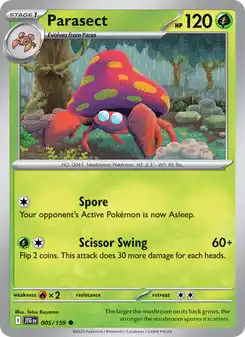
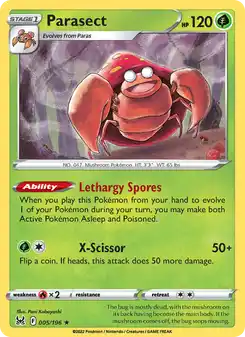
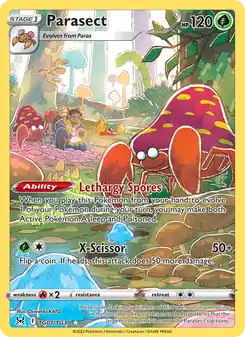
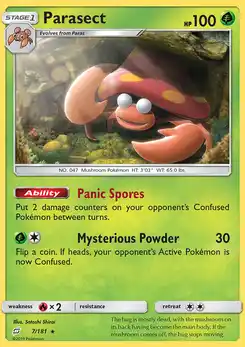
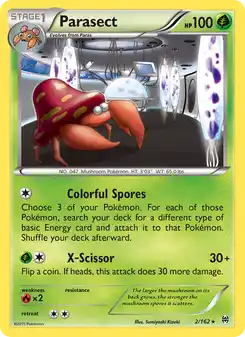
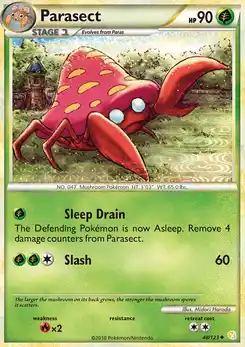
Parasect appears on many TCG cards, notably in the Kanto series such as Yellow, FireRed, LeafGreen, but also in modern series. The illustrations often highlight its massive mushroom and its luminous spores.
Shiny Parasect
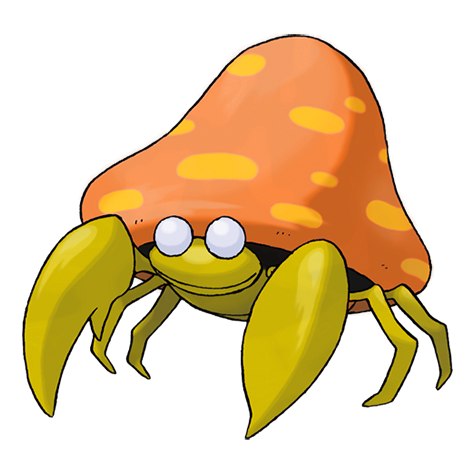
In its Shiny form, Parasect adopts a color palette tending toward white and black, with a paler mushroom and an almost purple body. This variant is particularly appreciated by Shiny hunters.
Summary
Parasect is the final evolution of Paras, a Bug/Grass Pokémon dominated by an immense parasitic mushroom. Despite very low Speed and severe weaknesses to Fire and Flying, it excels as a control Pokémon thanks to Spore, Giga Drain, and X-Scissor. Physically solid, powerful in Attack, versatile via its TMs and natural abilities, Parasect is a unique Pokémon in the Pokédex, capable of turning a situation around when used correctly.
