


Share this Pokémon
Characteristics
- Height:
- 0.30
- Weight:
- 5.40
Base stats
Total: 285Combat strengths and weaknesses
Damage multiplier taken by Paras depending on the attacking move's type. ×2 and ×4 are the attacks to avoid.


Resistances - weak attacks


The complete Pokédex, in your pocket
Detailed pages, types, stats and your favourite Pokémon - on the app.
Evolutions
Additional information
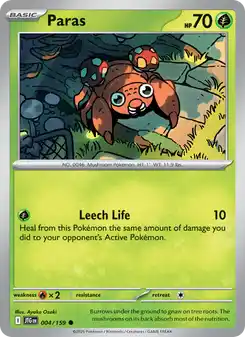
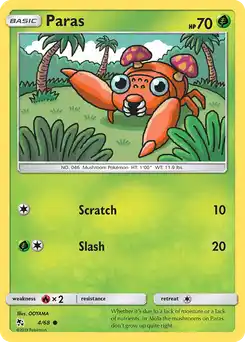
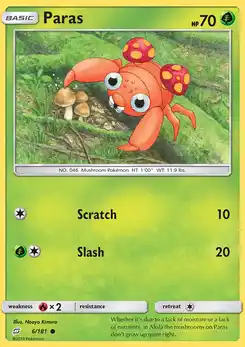
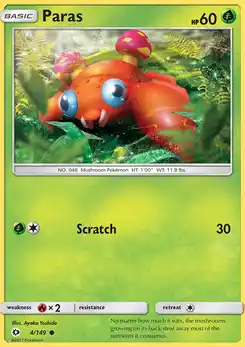
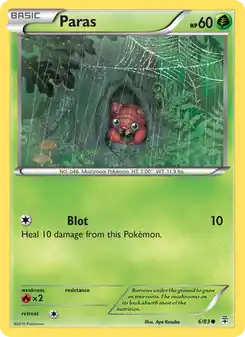
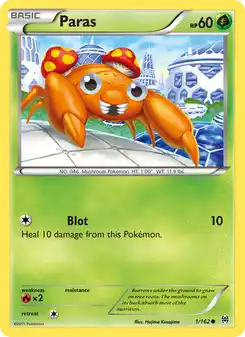
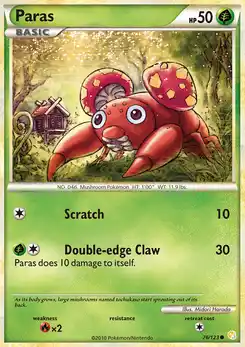
Pokémon Cards (17)
Showing the latest 12





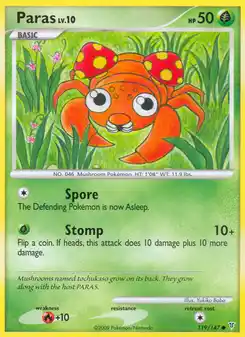
Official artwork
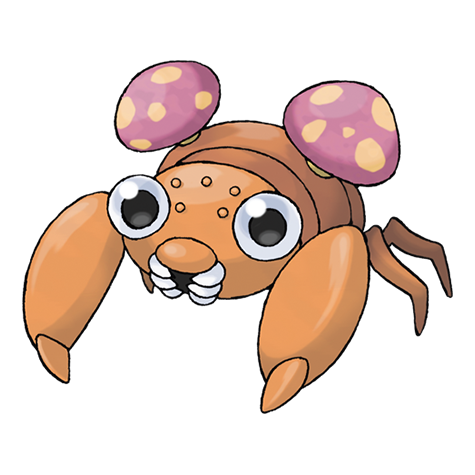
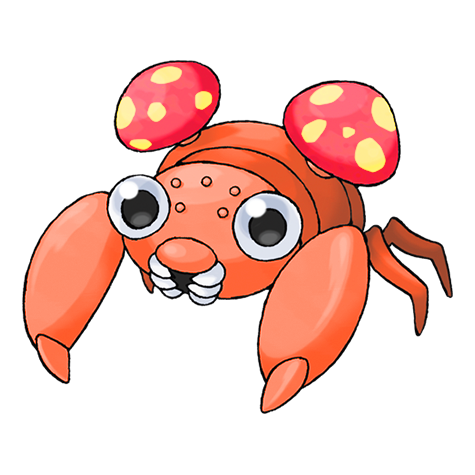
Base sprites


Pokémon Home
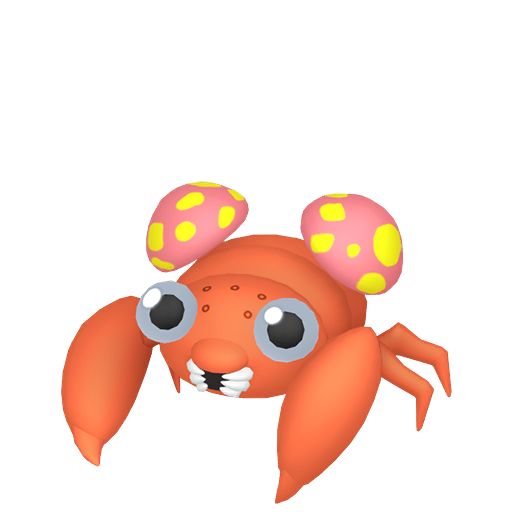

Dream World
Showdown


Detailed information
General Overview of Paras
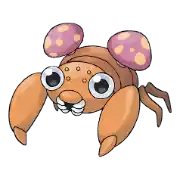
Paras is a unique Pokémon in the Pokémon universe, immediately recognizable by its appearance as a small orange crustacean carrying two mushrooms on its back. These mushrooms, called tochukaso in some descriptions inspired by real parasitic mycelium, shape its behavior, its type, its abilities, and even its future evolution. In the Pokédex, Paras is known as パラス (Parasu) in Japanese and "Paras" in English. It belongs to the first generation, that of Red and Blue, and has left an impression on players with its design that is both cute and unsettling — part insect, part fungal parasite.
Its most iconic feature lies in the relationship between the small insectoid body of the Pokémon and the mushrooms that progressively dominate it. These fungal organisms are not mere decorations: they control part of the Pokémon's behavior, feeding on its nutrients, influencing its growth, and determining its Bug and Grass typing across several generations. This parasitic symbiosis also explains the toxic nature of some of its moves, as well as its defensive weaknesses.
In battle, Paras is a Pokémon that demands some mastery: it has very good support moves, early access to status abilities (Sleep, Paralysis, Toxic), and to effective Bug moves. On the other hand, its overall stats make it fragile, especially against Fire, Flying, and Ice. But when well used, Paras can become a powerful control tool and an excellent choice early in the adventure, especially for players who enjoy catching, paralyzing, and weakening opponents before securing the victory.
Pokédex Information
Number and classification
Paras holds a number very close to the beginning of the national Pokédex, being among the first Pokémon encountered on the forested routes of the initial games. Its presence on routes populated by insects makes it a classic encounter for players of Red, Blue, and Yellow, as well as in modern remakes and certain other games.
It is classified as the "Mushroom Pokémon," precisely because of the two mushrooms on its back. This species, a hybrid of insect and mushroom, exerts a dual influence in the Pokémon world: biological (toxic symbiosis) and strategic (Bug + Grass typing).
Physiology and appearance
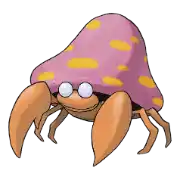
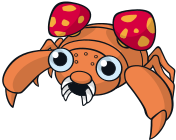
Paras resembles a small orange crab with six legs, a hard shell, and two large round eyes with cross-shaped pupils. This feature, seen in Paras across several games, accentuates its hypnotic and slightly unsettling side. Its two red mushrooms with white spots are reminiscent of toxic amanitas.
Its size is approximately a few dozen centimeters and its weight is around one or two kilograms, making it a lightweight Pokémon, easily transported but also vulnerable to certain attacks. The mushrooms grow with age, and the evolution into Parasect shows this phenomenon in an extreme way, the mycelium almost totally taking control of the host Pokémon's body.
Ecology and Behavior
Natural habitat
Paras is found in forested areas, damp locations, or at the foot of trees, including places such as Mt. Moon, deep forests, or shaded areas near caves. This type of environment allows its mushrooms to thrive thanks to moisture and a nutrient-rich soil.
It often burrows into the ground to harvest minerals necessary for the growth of its mushrooms. As they develop, these mushrooms pump nutrients directly from the Pokémon's blood, giving Paras its often tired or weakened appearance.
Behavior and reproduction
Paras is a fairly calm Pokémon that is very focused on finding nutrients in the ground. It feeds on roots and decaying matter. It can lay eggs like the majority of insectoid Pokémon. Its reproductive cycle is strongly influenced by the health of the mushrooms living on its back.
The reproduction process in the games follows the usual rules: Paras belongs to the Bug and Grass egg groups, allowing it to produce many useful combinations for a competitive set or for the transmission of specific egg moves.
Type, Strengths and Weaknesses
Paras is a Bug and Grass-type Pokémon, giving it an interesting but also risky dual typing. It naturally resists:
— Grass moves, — Ground moves, — certain Water moves (depending on the generation).
But it is extremely vulnerable to:
— Fire (×4), — Flying (×4), — Poison, — Rock and Steel-type attacks.
This quadruple weakness against Fire and Flying makes it a fragile Pokémon in direct combat, but its great usefulness rests on its ability kit, notably its status moves.
Base Statistics
Analysis of Paras's stats
Although Paras is a relatively weak Pokémon in raw stats, some elements stand out:
— Decent Attack for early-game use, — Decent but limited physical Defense, — Low Special Defense, — Very low Speed, — Low Special Attack, — Low HP.
In terms of EVs, Paras often yields points in Attack and Defense depending on the game, matching its profile of a small insectoid fighter bolstered by its mushrooms.
Essential Moves and Abilities
Status moves
Paras is one of the very first Pokémon in the game to learn powder or paralysis moves. These abilities allow it to:
— put an enemy to sleep, — paralyze it, — poison it (often via Toxic in modern versions), — lower its statistics.
For players looking to catch other Pokémon, Paras is an exceptional option: its success rate is bolstered by its ability to weaken and neutralize opponents on multiple fronts.
Bug and Grass moves
Paras learns Bug moves very early, such as Scratch or False Swipe via TM in some games (very useful for catching), and then Grass moves through leveling up. These moves let it exploit the weaknesses of Ground, Rock, or Water Pokémon.
Poison and fungal abilities
The mushrooms on its back can release toxic spores, acid, or other toxins. That is why Paras gains access to moves such as:
— Spore (one of the best sleep-inducing moves in the game), — Poison Powder, — Stun Spore, — Toxic (via TM).
These abilities make Paras a perfect Pokémon for immobilizing an opponent before sending in another Pokémon to finish the battle.
Paras's Evolution
Parasect: an unsettling evolution
Paras evolves into Parasect at a certain level. This evolution represents the pinnacle of the parasitic symbiosis: the mushroom takes complete control of the host Pokémon, which can be seen through:
— the disappearance of pupils, — the presence of a single large mushroom head, — very different behavior, slower and more controlled.
At the gameplay level, Parasect gains a huge Attack increase, better access to fungal abilities and to Spore, but keeps the same crippling defensive weaknesses.
Paras in the Games
Encounters, routes and generations
Paras appears in most generations of games, notably in:
— Red, Blue, Yellow (forests, Mt. Moon), — Gold, Silver, Crystal (forested areas), — Ruby, Sapphire (limited appearances), — Diamond, Pearl (specific encounters), — Pokémon GO (humid or shaded areas).
Its rarity varies by game, but it remains globally easy to find on forested routes, dark areas, or environments rich in vegetation.
Strategy and Battle Use
Paras's role in a team
Paras is rarely used as a primary attacker, but it fulfills several key roles:
— support Pokémon, — status master, — excellent at weakening robust opponents, — perfect for catching, — useful very early in the adventure.
Thanks to its access to powerful abilities like Spore, Paras can turn around battles even against Pokémon much stronger than itself.
Competitive use
Competitively, Paras is rarely played, but some players appreciate its ability to surprise with:
— Spore (100% accuracy), — priority Bug attacks, — combos based on spores and poison, — decent physical durability.
It can also be used to counter Grass or Ground Pokémon in certain specialized formats.
Abilities and Optimization
Available abilities
Depending on the generation, Paras can have abilities such as:
— Dry Skin (healing in rain, increased weakness to Fire), — Effect Spore (applies a status when struck), — Damp (hidden ability in some versions).
Dry Skin is extremely useful on a Water-oriented team, but further increases its weakness to Fire, which is already catastrophic.
Useful natures
An Adamant or Brave nature lets you exploit its physical Attack, but a Jolly or Careful nature can slightly reinforce its defense if you plan to use it as a support Pokémon.
Summary
Paras is a unique insectoid and fungal Pokémon, recognizable by the mushrooms on its back that influence its behavior and battle style. Despite its weak stats and marked weaknesses to Fire, Flying, and Rock, it excels as a support Pokémon thanks to moves such as Spore, Stun Spore, and Toxic. Its presence across many generations, its strategic early-adventure role, its evolution into Parasect, and its usefulness for catching other Pokémon make it an excellent companion for players seeking a versatile and original tool.
