


Share this Pokémon
Characteristics
- Height:
- 0.60
- Weight:
- 10.00
Base stats
Total: 205Combat strengths and weaknesses
Damage multiplier taken by Kakuna depending on the attacking move's type. ×2 and ×4 are the attacks to avoid.


Resistances - weak attacks


The complete Pokédex, in your pocket
Detailed pages, types, stats and your favourite Pokémon - on the app.
Evolutions
Additional information
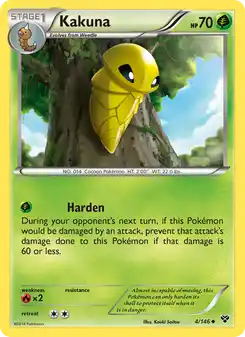
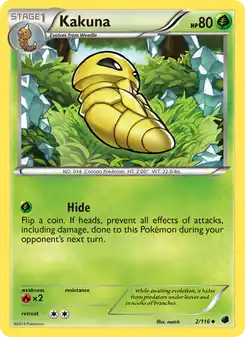
Pokémon Cards (18)
Showing the latest 12



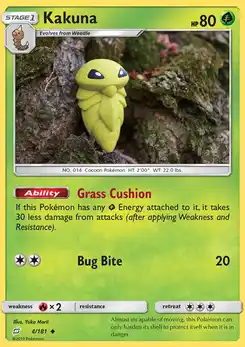
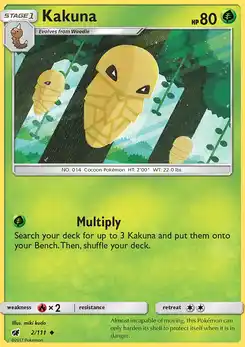
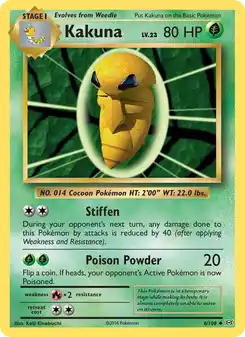
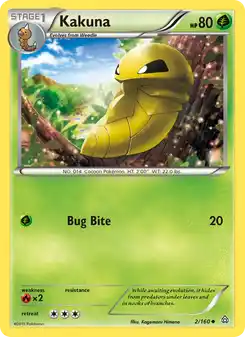

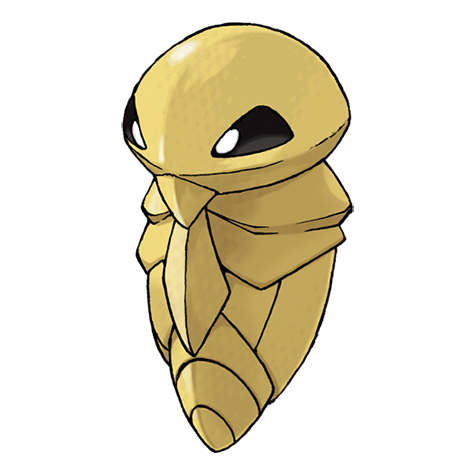
Official artwork

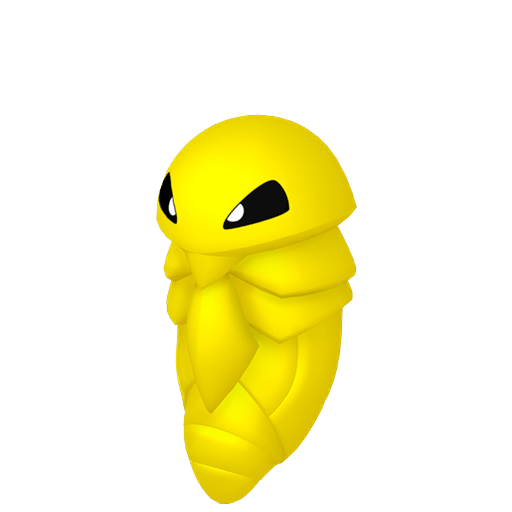
Base sprites


Pokémon Home
Dream World

Showdown


Detailed information
Overview of Kakuna
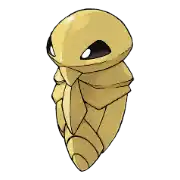
Kakuna, known as Coconfort in French, is a Bug/Poison-type Pokémon that appeared in the very first generation in the Kanto region. It is the intermediate stage between Weedle and Beedrill, playing the role of a defensive cocoon before its final evolution. Visually, Kakuna resembles a rigid, nearly motionless yellow cocoon, designed to protect the insect transforming inside.
In Pokémon Red, Blue, and Yellow, Kakuna appears frequently in Viridian Forest. Its presence very early in the adventure helps players understand the mechanics of fast evolution, the progression of Bug/Poison Pokémon, and how intermediate forms work — with low stats but an essential role in the full evolutionary cycle.
Origins and role in the Pokédex
In the Kanto Pokédex, Kakuna is described as a motionless Pokémon, focused entirely on its internal metamorphosis. Its shell is so hard it functions as genuine armor, but this is not enough to compensate for its vulnerability to fire or powerful attacks while its evolution is still underway.
Official descriptions state that its muscles and internal structure are reorganizing inside the cocoon to prepare the emergence of Beedrill's wings and stingers, perfectly illustrating this stage of maturation.
Appearance and description of Kakuna
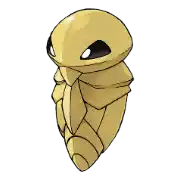
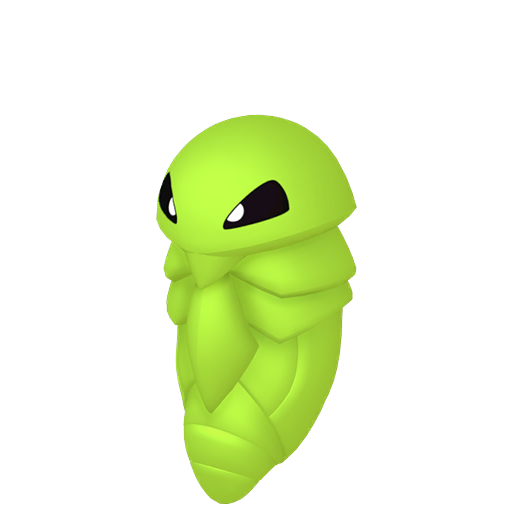
The body of Kakuna is a yellow or golden, segmented cocoon whose shape resembles a natural suit of armor. Its dark, half-closed eyes give it a focused look. Its lower section comes to a point, suggesting it normally hangs from branches.
In the forests of Kanto, it is often found clinging to trees, motionless, sometimes even in groups. Its bright color makes it visible, but its rigid shell provides reasonable protection against certain predators.
Kakuna's evolution and the full line
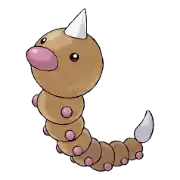
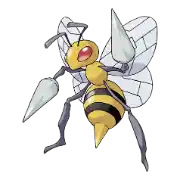
The Weedle line follows a rapid three-stage evolution: Weedle → Kakuna → Beedrill. Kakuna occupies the middle position, representing the defensive phase of the cycle.
From Weedle to Kakuna
Weedle evolves into Kakuna at level 7, a transition that emphasizes increased Defense while Attack and Speed remain low. The line is designed to evolve quickly, allowing players to obtain a powerful final-stage Pokémon very early in the adventure.
From Kakuna to Beedrill
Evolution into Beedrill occurs at level 10, just a handful of battles after Weedle. This evolution unlocks a fast and offensive Pokémon, expert in stinger attacks and Poison moves. Kakuna therefore serves as a necessary but temporary passage before unlocking its far more dangerous final form.
Kakuna in the Pokémon games
Kakuna appears in many games, usually in wooded areas where Weedle — and sometimes Beedrill — can also be found.
Presence in the early generations
In Pokémon Red, Blue, and Yellow, Kakuna can be found in Viridian Forest or by evolving a Weedle. It can also be encountered directly in the wild. Pokédex entries emphasize its hard shell and near-total immobility, as it typically does nothing but use Harden, making some battles drag on.
Kakuna in more recent games
In later generations, Kakuna appears less often in the wild but remains accessible through evolution or Pokémon HOME transfers. In Pokémon GO, it is an intermediate stage obtained using Weedle Candy. Its base stats being very low, players quickly evolve it into Beedrill.
Kakuna's stats, EVs, and IVs
Kakuna is considered one of the Pokémon with the lowest base stats in the first generation.
Base stat distribution
- HP: low
- Attack / Sp. Atk: very low
- Defense: fairly high — its main asset
- Speed: low
This profile matches its role as a motionless cocoon in the middle of transformation.
EVs, IVs, and training
Defeating a wild Kakuna generally yields Defense EVs, making it an excellent target for training tank Pokémon.
In terms of IVs, they matter very little for Kakuna itself: optimization only becomes meaningful once the line reaches Beedrill.
Kakuna in the Pokémon card game
In the Pokémon TCG, Kakuna appears regularly in first-generation sets.
Kakuna cards and iconic sets
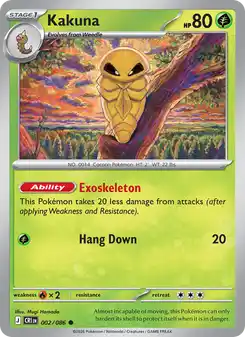
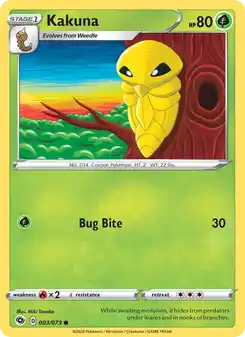
In base sets, Kakuna is often illustrated hanging from a branch in a forest. Its low HP and limited attacks are offset by its ability to evolve into Beedrill.
While its cards are inexpensive, they are essential for completing the Weedle → Kakuna → Beedrill line in collectors' binders.
Appeal for collectors
For fans of Kanto, owning a Kakuna card allows a visual completion of the evolutionary line.
Even though its stats are unimpressive, its cards perfectly embody its role as a cocoon awaiting evolution.
Strategic role and use in battle
Usefulness early in the adventure
Thanks to its Defense being higher than Weedle's, Kakuna can serve as a temporary shield in early battles against weak wild Pokémon.
It allows the player to stall while healing or preparing other Pokémon.
Kakuna as a training target
In optimization guides, Kakuna is recommended as a Defense EV target. Its low offensive power makes it an unthreating opponent and a very rewarding one for repetitive training sessions.
Kakuna in Pokémon culture
Even if it lacks the fame of Beedrill or Butterfree, Kakuna is one of the iconic Pokémon from the franchise's early days.
Its simple but striking design — a motionless cocoon with piercing eyes — evokes the first steps of Trainers through Viridian Forest. It regularly appears in the anime as a background Pokémon in forest scenes.
For many players, it brings back memories of endless battles against a Pokémon that did nothing but harden its Defense.
These memories have turned it into a small nostalgic legend of the first generation.
