


Share this Pokémon
Characteristics
- Height:
- 1.00
- Weight:
- 29.50
Base stats
Total: 395Combat strengths and weaknesses
Damage multiplier taken by Beedrill depending on the attacking move's type. ×2 and ×4 are the attacks to avoid.


Resistances - weak attacks


The complete Pokédex, in your pocket
Detailed pages, types, stats and your favourite Pokémon - on the app.
Evolutions

Forms
Forms available in your language are clickable. The others show their stats below.
Additional information
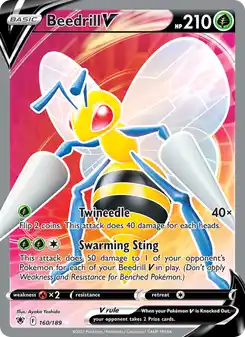
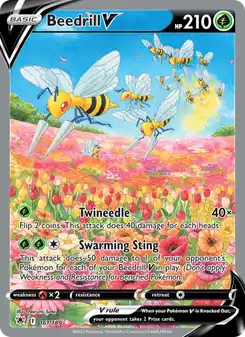
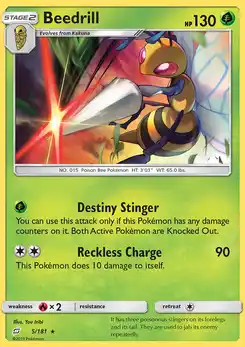
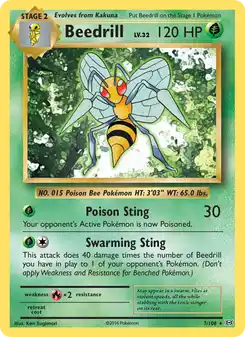
Pokémon Cards (24)
Showing the latest 12








Official artwork
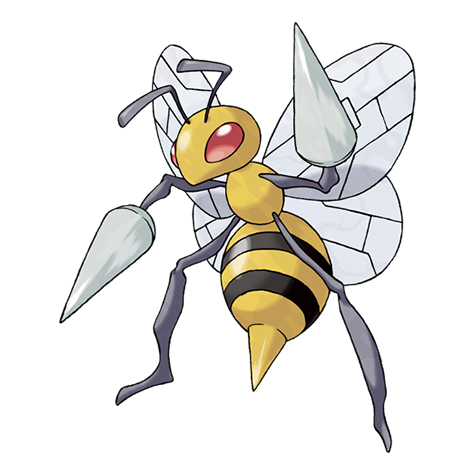
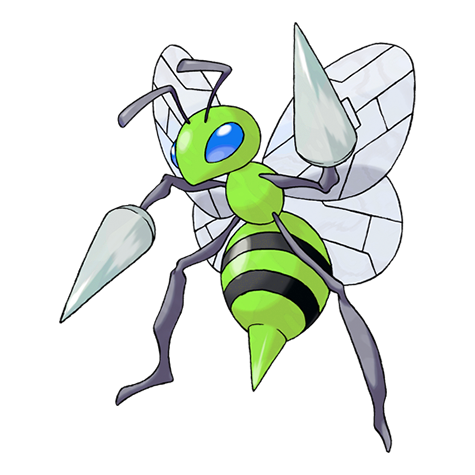
Base sprites


Pokémon Home
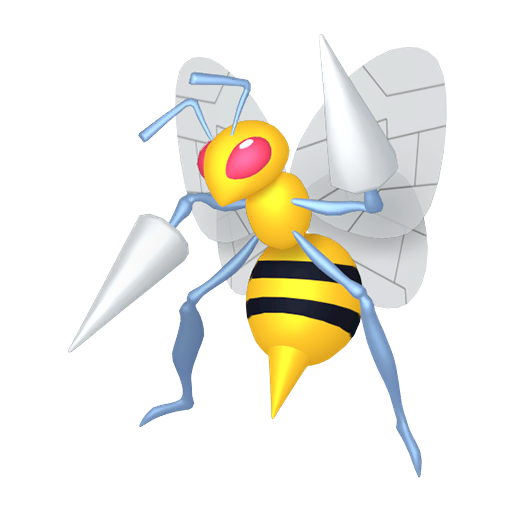

Dream World
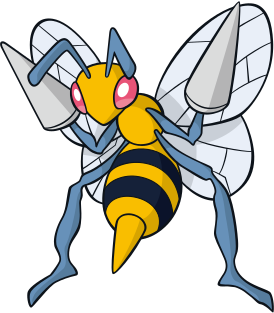
Showdown


Detailed information
Overview of Beedrill
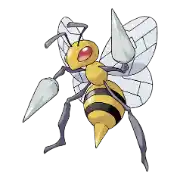
Beedrill, known as Dardargnan in French, is a Bug/Poison-type Pokémon that appeared in the very first generation, in the Kanto region. It is listed early in the Pokédex and represents the final stage of the Weedle evolutionary line. With its yellow-and-black body resembling a wasp, its three imposing sharp stingers, and its aggressive disposition, Beedrill is the quintessential fast, venomous predator.
Its design is inspired by wasps and hornets, but stylized to fit the Pokémon universe: a bulky thorax, two large stingers in place of hands, and a final one at the tip of its abdomen. In both games and the anime, Beedrill is often portrayed as a territorial Pokémon that does not hesitate to attack in swarms when its nest is threatened. Pokédex entries even describe swarms of Beedrill circling trees, ready to sting any intruder.
In the Pokémon world, Beedrill is one of the most immediately recognizable Bug-type Pokémon in the Kanto Pokédex, instantly identifiable by its wasp-like silhouette and triple stingers.
Physical characteristics and description
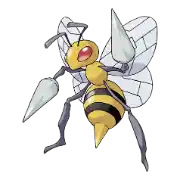
Beedrill stands about 1 meter tall and weighs close to 30 kg. Its body is divided into three parts — head, thorax, and abdomen — each bearing the characteristic yellow-and-black patterns of venomous insects. Its large red eyes give it a menacing gaze, reinforced by its slightly forward-curving antennae.
The most distinctive features are its three stingers:
- A stinger at the tip of its abdomen, used for diving attacks.
- Two stingers mounted in place of its hands, used to strike opponents rapidly from the front.
Each of these stingers is filled with potent venom capable of dealing considerable damage to enemies and poisoning any Pokémon that gets too reckless. Its slender silhouette and translucent wings allow it to fly at high speed around its target, striking repeatedly with a series of jabs that are nearly impossible to follow with the naked eye.
Pokédex entries frequently emphasize its aggressive temperament: if a Trainer gets too close to a nest, Beedrill and its companions quickly gather "around" the threat to drive it away. This is a Pokémon best faced with a prepared team adapted to Bug and Poison types.
Place in the Pokédex and in the Kanto region
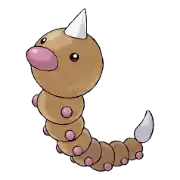
In the Kanto Pokédex, Beedrill appears as the final evolution of Weedle:
- Weedle → Kakuna → Beedrill.
This line perfectly illustrates the journey from a small fragile worm to an armed and dangerous insect. Like Butterfree for the Caterpie family, Beedrill is a kind of "graduation" for players who trained their Weedle from the very first routes — notably Route 2 and Viridian Forest. Watching it transform into such an intimidating creature gives a strong sense of rapid progress, even if its base stats remain modest compared to Pokémon encountered later in the game.
In terms of ecosystem, it is found primarily in the forested areas of Kanto and sometimes Johto, where it dominates other Bug-type Pokémon by virtue of its size and aggressiveness. Trainers in the region often regard it as a serious threat during early forest explorations.
Beedrill's evolution and how to obtain it
The Weedle line is known for its very fast evolution cycle, allowing players to obtain a Beedrill in just a few levels. This is one of the reasons this Pokémon is often cited as a teaching example in beginner guides.
From Weedle to Beedrill
The evolutionary process is as follows:
- Weedle evolves into Kakuna at level 7.
- Kakuna evolves into Beedrill at level 10.
In practice, this means that by fighting only the wild Pokémon on the first routes, a player can have a fully evolved Beedrill before even challenging the first Kanto Gym. This quick evolution partially compensates for its limited base stats, as it benefits from a fully evolved form and a more offensive movepool early on.
In later generations (Johto, Hoenn, Sinnoh, etc.), this line keeps the same structure. The low level required to reach Beedrill makes it an ideal candidate for players who enjoy building a complete team right from the start of the adventure.
Catch methods and catch rates
In first-generation games, the simplest way to obtain a Beedrill is to catch a wild Weedle — often found in Viridian Forest — and evolve it. It is also possible to find Kakuna or Beedrill directly in certain versions, but sometimes with a lower catch rate and at a slightly higher level.
As a general rule:
- Weedle has a very high catch rate, making it easy to recruit.
- Kakuna is somewhat harder to catch but manageable with a standard Poké Ball.
- Beedrill, as the final form, has a lower catch rate, sometimes requiring a Great Ball or status techniques (sleep, paralysis) to maximize the chances.
In recent games and in Pokémon GO, obtaining a Beedrill typically involves accumulating Weedle Candy through catching, hatching eggs, or transferring, before triggering the evolution. Its max CP remains modest but sufficient for some low-level raid battles or friendly Gym bouts between beginning Trainers.
Beedrill's moves, type, and strategic role
Beedrill is a Pokémon that specializes in fast physical attacks, often based on its multiple stingers. Its dual Bug/Poison typing gives it a precise offensive role, but also clear weaknesses against certain elements.
Main moves and abilities
Depending on the generation, Beedrill can learn a set of moves that strongly reflect its identity as a venomous wasp:
- Poison Sting — a Poison-type move, often learned at low levels, with a chance to poison the target.
- Poison Jab — a powerful and accurate Poison attack, widely valued in competitive play for its high damage and chance to badly poison the opponent.
- Bug Bite / Fury Cutter — Bug-type moves used to take advantage of its STAB bonus.
- Fury Attack — a series of rapid strikes, sometimes useful for breaking through Substitutes or finishing off weakened Pokémon.
- Twineedle — a Bug-type move that hits twice, very thematic for a Pokémon with multiple stingers.
- Toxic Spikes — a move that sets a hazard on the ground: competitively, it poisons any Pokémon that switches in.
- Toxic (via TM) — a Poison-type status move inflicting a worsening poisoning effect, useful against resistant Pokémon.
In some generations, Beedrill can learn Normal- or Flying-type moves (such as Roost or Aerial Ace) via TM, giving it a bit more flexibility. However, the majority of its best moves remain centered on Bug and Poison.
Types, weaknesses, and defensive profile
As a Bug/Poison-type Pokémon, Beedrill benefits from several resistances but also suffers from clear weaknesses.
Strengths:
- Resistance to Grass-, Fighting-, and Poison-type attacks.
- Slight resistance to Bug- and Fairy-type attacks in generations where that type is present.
- Immunity to poisoning, very useful against toxic-based strategies.
Weaknesses:
- Weak to Flying, a very common type among early-game Pokémon.
- Weak to Fire and Psychic, which can be problematic at Gyms and the Pokémon League.
- Vulnerable to Rock-type attacks, especially if the field has been set up with Stealth Rock.
Its base stats give it decent Speed and decent Attack, but average HP and Defense. It is therefore most comfortable as a "glass cannon" — striking fast to deal maximum damage before taking return hits.
Beedrill in the Pokémon games
Beedrill spans many game generations, retaining its role as an aggressive, fast Bug-type Pokémon accessible from the very start of the adventure.
Beedrill in classic versions
In Pokémon Red, Blue, and Yellow, Beedrill is obtained by evolving Kakuna at level 10. It is commonly used by Trainers in Viridian Forest, certain rivals, and some Team Rocket members. Its relatively high Speed makes it an annoying opponent for unprepared teams, especially when it chains Poison Stings and stab attacks.
In the Johto games (Gold, Silver, Crystal) and their HeartGold and SoulSilver remakes, Beedrill appears in several forested areas and on certain routes, sometimes used by Bug Catcher Trainers. Its role is similar: a fast, aggressive insect that symbolizes the forest Pokémon of the adventure's early hours.
In Ruby, Sapphire, Black, White, and their continuations, it is often available through transfers or events, but retains its identity as a Kanto Pokémon appreciated in retro-themed teams.
Beedrill in modern generations and Pokémon GO
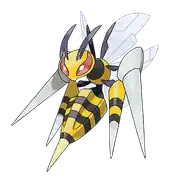
In more recent games, Beedrill received a Mega form: Mega Beedrill. This Mega Evolution greatly boosts its Attack and Speed, strengthening its role as an extremely dangerous physical sweeper. Mega Beedrill also gains an Ability that powers up some of its contact moves, turning its stabs into potential critical hits. However, its HP and Defense remain modest, meaning it must strike fast and hard before taking a hit.
In Pokémon GO, Beedrill can also Mega Evolve using Mega Energy. Its role in raids then becomes more prominent: it turns into a reasonable Bug/Poison attacker, useful against certain Grass- or Fairy-type bosses. Its max CP does not reach the heights of Legendary Pokémon, but it remains an affordable option for players who enjoy Kanto.
Beedrill in the Pokémon card game
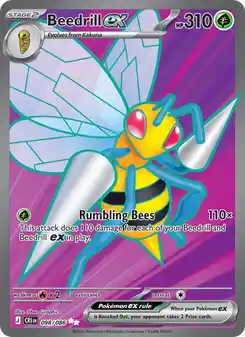
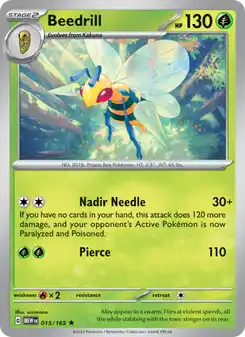
In the Pokémon TCG, Beedrill has appeared in many sets since the Base Set. Its illustrations often show it in flight, ready to attack with its enormous stingers. Its role mirrors that of the video games: an aggressive Pokémon specialized in swift damage and poisoning.
Iconic cards and value
Early Beedrill cards from the Base Set feature modest HP and attacks centered on stings and Poison damage. As expansions continued, new versions were introduced: Beedrill-EX, Beedrill-GX, and cards with special abilities that allow placing Toxic Spikes or boosting the damage dealt by Poison Pokémon on the team.
Beedrill card prices vary by edition and rarity. Older cards in excellent condition, especially from the first generation, may interest Kanto collectors. However, they generally remain more affordable than big-name cards like Charizard, making them a good entry point for fans on tighter budgets.
Use in decks
Strategically, Beedrill has sometimes found its place in decks built around spreading Poison or using low-energy-cost attacks. Certain versions allow dealing extra damage if the target is already poisoned, creating interesting combos with cards like Toxic, Poisonous Stinger, or other Poison Pokémon.
For players focused on storytelling rather than pure competition, including Weedle, Kakuna, and Beedrill in the same deck tells the entire evolutionary line, reinforcing a "Kanto Forest" or "bug swarm" theme in their games.
Strategic tips for using Beedrill
Even if Beedrill is not among the most powerful Pokémon at the top level, it can be very fun to use and fearsome under the right conditions, especially in formats limited to the first generation or in themed teams.
Stat distribution, EVs, and IVs
Beedrill's stats highlight:
- A solid physical Attack.
- Very good Speed for an early-game Pokémon.
- Low to average HP and physical Defense.
- Below-average Special Defense and Special Attack.
To maximize its potential, many Trainers invest its EVs into Attack and Speed, turning it into a true venomous missile. High IVs in both of these stats allow reaching a more interesting max potential, particularly in formats where Mega Beedrill is allowed.
On the other hand, there is no point in trying to make it a defensive wall: its HP base is too limited. It is better used as an offensive support attacker that comes in to set Toxic Spikes or finish off weakened opponents.
Possible move sets
A few example sets to consider (varies depending on the game):
- Physical offensive set: Poison Jab / Bug Bite / Bug Buzz or X-Scissor / Swords Dance. The idea is to boost Attack with Swords Dance and then strike fast with Poison Jab.
- Hazard setter set: Toxic Spikes / Toxic / Bug Bite / Protect. Beedrill uses its Speed to set poison traps, then withdraws once the job is done.
- Mega Beedrill set (in games that allow it): Poison Jab / Bug Bite or X-Scissor / Pursuit / Protect or Swords Dance. The Mega Evolution greatly improves Attack and Speed, making it an excellent late-game cleaner.
In all cases, it is absolutely essential to protect it from Rock-, Fire-, Flying-, and Psychic-type attacks: one wrong placement can knock it out in a single hit.
Beedrill in Pokémon culture
Beyond numbers and stats, Beedrill holds a special place in the memories of fans. Those who started their adventure on Pokémon Red, Blue, or their remakes still remember the Beedrill swarms in the forests, or the tough battles against Trainers who had several in a row.
Appearances in the anime and other media
In the animated series, Beedrill often appears as a collective threat: entire groups attack Ash and his friends when they disturb a nest. These scenes reinforce the image of a territorial Pokémon capable of dealing severe damage with its poisonous stingers.
It also appears in various films and special episodes, as well as in certain spin-off games such as the Mystery Dungeon series or spin-offs focused on raids and fast battles. Its recognizable yellow-and-black silhouette makes it a natural choice to represent the "bug threat" in the Pokémon universe.
Fan impact and merchandise
In terms of products, Beedrill appears in figures, plushies, promotional cards, and even Kanto-themed clothing. While it is less prominent than Charizard or Pikachu, it remains iconic for all those who appreciate Bug-type Pokémon or have a particular fondness for Viridian Forest and its inhabitants.
Players who enjoy challenges sometimes run entire games with an insect-focused team, in which Beedrill plays the role of fast and offensive leader. This niche popularity helps maintain its presence in the community, despite competition from new Bug-type Pokémon introduced over the generations.
To sum up, Beedrill is a Pokémon that, despite limited base stats, leaves a deep impression on players through its striking design, its fast evolutionary line, and its role as the forest's venomous predator. Whether used as a physical sweeper, a Toxic Spikes setter, or a simple nostalgic reminder of Kanto, it remains an unmissable figure in the Pokémon bestiary.
