


Share this Pokémon
Characteristics
- Height:
- 0.50
- Weight:
- 5.50
Base stats
Total: 270Combat strengths and weaknesses
Damage multiplier taken by Jigglypuff depending on the attacking move's type. ×2 and ×4 are the attacks to avoid.


The complete Pokédex, in your pocket
Detailed pages, types, stats and your favourite Pokémon - on the app.
Evolutions
Additional information
Pokémon Cards (29)
Showing the latest 12





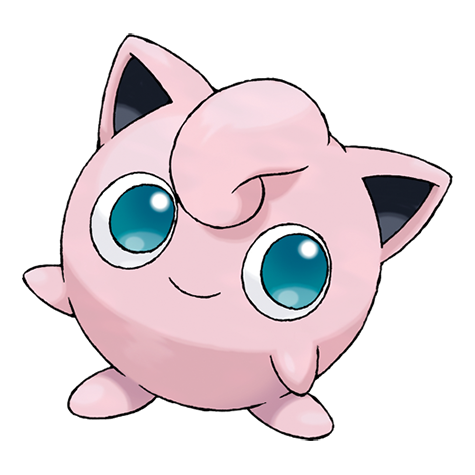
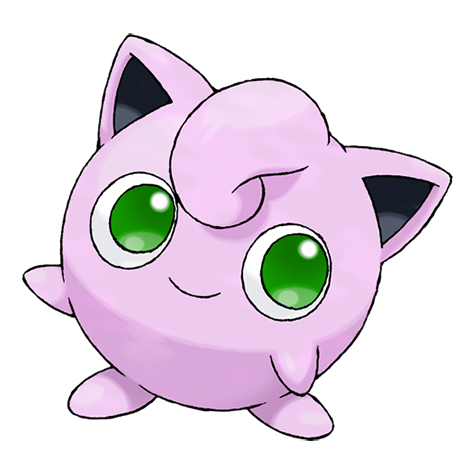
Official artwork
Base sprites


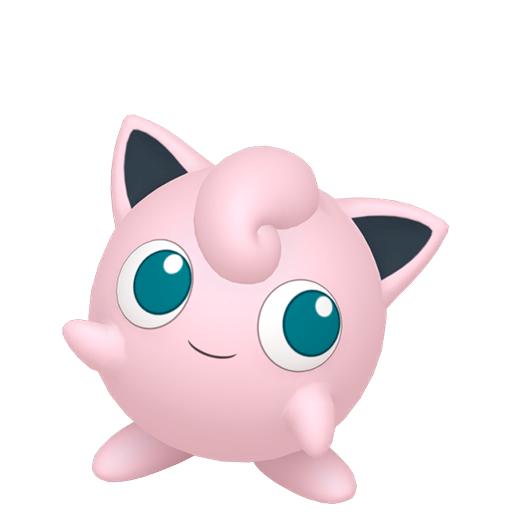
Pokémon Home

Dream World
Showdown


Detailed information
Overview of Jigglypuff
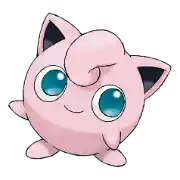
Jigglypuff is one of the most recognizable Pokémon in the entire series. With its completely rounded body, small size, and large sparkling eyes, it quickly captured the hearts of players from the first generation onward. This Pokémon, known as Jigglypuff in English and プリン (often romanized as Purin) in Japanese, has become a true icon, both in the video games and in the anime and merchandise. In the Pokédex, Jigglypuff is generally classified as a Normal-type Pokémon in the early versions, then as a Normal/Fairy-type in more recent generations, which strongly influences its role in battle.
Jigglypuff is best known for its voice and its Sing move. Its ability to sing a hypnotic melody allows it to put both enemy Pokémon and humans to sleep, a trait often highlighted in the anime. Its Pokédex description regularly emphasizes the softness of its voice and the fact that it puffs up like a balloon when it sings. It is a Pokémon that is small and light, often weighing only a few kilograms, but which compensates for its lack of raw power through status moves and a large HP reserve. Despite its cute appearance, it can prove formidable if one underestimates its strength in battle.
Names, Species, and Origins of Jigglypuff
The Various Names: Jigglypuff and プリン
The English name Jigglypuff reinforces the impression of a jiggling, inflated creature, like a small bouncing balloon. In Japanese, its name プリン (Purin) is reminiscent of creamy, soft desserts, which reinforces its image as a tender, light, and adorable Pokémon. These different names all correspond to the same species — a balloon Pokémon recognizable anywhere.
In the Pokédex, Jigglypuff is generally classified as a Balloon Pokémon. Its species is described as a being capable of changing its size by inhaling air. The more deeply it breathes, the more its body inflates, allowing it to float slightly, bounce, or impress an enemy. This trait is found in many official descriptions, both in first-generation games and in more recent versions like HeartGold and SoulSilver, where information on its form and voice is often updated with small additional details.
Pokédex Number and General Information
At the National Pokédex level, Jigglypuff holds a well-established number among the first Pokémon to appear in Red and Blue. This number remains the same across all generations, even though its type has evolved over time. Depending on the version, the description emphasizes the softness of its fur, the way its large eyes hypnotize a target, or the power of its Sing. This information, sometimes slightly different between games, builds a coherent image of a Pokémon that relies more on technique and control than on pure attack.
Whether in classic versions like Red, Blue, Yellow, or in more recent games like HeartGold, SoulSilver, Sun, and Moon, Jigglypuff regularly appears in areas near the first routes or forests, making it an easy Pokémon to catch at the start of the game. Its early availability allows Trainers to familiarize themselves with status mechanics, particularly sleep, and to experiment with battle strategies based on terrain control rather than sheer brute force.
Jigglypuff's Type and Its Evolution Across Generations
From Normal to Fairy
In the early generations, Jigglypuff is a purely Normal-type Pokémon. This means it has no spectacular resistances, but it has only one main weakness: the Fighting type. This situation changes starting from the sixth generation, when the Fairy type is introduced. At this point, Jigglypuff, like its evolution Wigglytuff, becomes a Normal/Fairy-type Pokémon. This new type combination greatly influences its place in battle and the way it interacts with other Pokémon.
With the Fairy type, Jigglypuff becomes resistant to Dark and Bug-type attacks, and especially immune to Dragon-type attacks, which is a considerable strength in certain generations. On the other hand, it gains a weakness to Steel and Poison types, which become priority threats for it. The player must therefore take these changes into account when building a team, pairing Jigglypuff with allies capable of handling those enemy types. The Fairy type also reinforces the symbolism of the Pokémon: a cute, light creature with a magical voice capable of putting to sleep and disrupting opponents.
Key Battle Match-Ups by Type
In battle, Jigglypuff's type allows it to be a good answer against certain Dragon, Dark, and Fighting Pokémon (depending on the generation and specific game). Thanks to its Fairy type, it can absorb Dragon-type attacks without taking any damage and respond with Fairy-type moves to deal super-effective damage. Against Dark types, it also benefits from its resistance, making it an interesting pivot when wanting to protect more fragile team members.
On the other hand, it must be wary of Steel and Poison-type Pokémon, which can exploit its weaknesses and KO it quickly. In those cases, it is preferable to use Jigglypuff as secondary support that puts status conditions in place or uses support moves before switching out, rather than as a frontline fighter. Its type nonetheless remains very useful and suited to its battle style based on Sing, stat changes, and support attacks.
Jigglypuff's Size, Weight, and Appearance
A Small Pink Ball with Big Eyes
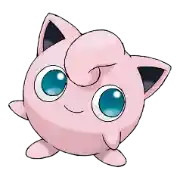
Jigglypuff is a small Pokémon, measuring barely a few dozen centimeters according to Pokédex entries. Its shape is essentially composed of circles: a spherical body, a head almost merged with the body, small arms and small feet, and a curled tuft on its forehead. Its large eyes, often described as light green or blue-green, occupy a large part of its face and contribute enormously to its popularity. They are true cartoon "big eyes," capable of expressing a wide range of emotions, from joy to anger.
Its weight remains very low, generally in a range of a few kilograms. This lightness reinforces the idea that it can inflate with air like a balloon. In some descriptions, the Pokédex specifies that Jigglypuff inflates its body until it reaches an almost perfectly spherical form to surprise the enemy or put on a show. Its simple silhouette, made up of circles, is ideal for drawings, Pokémon cards, and merchandise, which explains its recurring presence in the franchise.
Color Details and Variations
Jigglypuff's dominant color is pink. Depending on the generation and game, the shade of pink may be slightly different, sometimes more vivid, sometimes more pastel. Its eyes are often green or blue-green, sometimes slightly modified depending on the graphic palette of the version (Red and Blue, then HeartGold, SoulSilver, Sun, etc.). It also has pointed ears whose interiors are generally colored black or a dark color, contrasting with its light body.
In certain versions and artworks, the shape of its tuft and circles may vary slightly, but the essence of the design remains identical. There is no official regional form of Jigglypuff in the main games, but it is found in many different graphic styles, whether in 2D, 3D, or in spin-offs. Its simple silhouette and circles make it an immediately recognizable character, even for people who do not know the entire Pokédex.
Evolution: from Igglybuff to Jigglypuff and then Wigglytuff
Pre-Evolution: Igglybuff
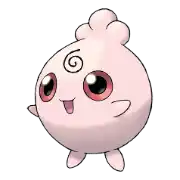
Jigglypuff has a pre-evolution: Igglybuff. The latter is a baby Pokémon introduced in later generations, also belonging to the Normal then Normal/Fairy type. To obtain a Jigglypuff from Igglybuff, the Trainer generally needs to increase its happiness level and then level it up. This pre-evolution system reinforces the cute side of the line, showing an even younger Pokémon before it becomes the more expressive Jigglypuff we know.
Igglybuff, Jigglypuff, and Wigglytuff form a coherent family, with rounded shapes, similar colors, and the same theme centered on voice, Sing, and high HP. The presence of Igglybuff as a pre-evolution also allows certain moves to be inherited through breeding, which can be useful for optimizing Jigglypuff's moves in competitive strategies or for building a complete team in more recent versions.
Evolution into Wigglytuff
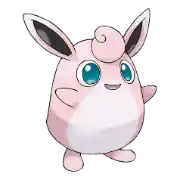
To evolve Jigglypuff into Wigglytuff, a Moon Stone must be used. There is no minimum level required, so the Trainer can trigger the evolution as soon as they have both a Jigglypuff and the item. However, it is often recommended to wait until Jigglypuff has reached a certain level to learn useful moves before evolving it. Indeed, once transformed into Wigglytuff, certain moves are no longer naturally learned and will have to be obtained via TMs, tutors, or breeding.
Evolving into Wigglytuff greatly boosts HP and the Pokémon's overall power, but Jigglypuff retains a particular role as an intermediate form: it is often the one that learns Sing and other essential status moves for the family's strategy. In versions like HeartGold and SoulSilver, for example, using the Moon Stone remains a key decision in building a team centered on this Pokémon.
Jigglypuff's Stats and Power
High HP and Modest Defenses
In terms of stats, Jigglypuff stands out for its relatively high HP for a small Pokémon. From the first levels, it has an HP total superior to many other Pokémon encountered early in the game. This allows it to absorb several hits before being KO'd, even though its defenses are rather weak. In return, its Attack and Special Attack remain moderate, making it a Pokémon that relies more on support moves than on raw power.
Its Speed is generally low, meaning it will often act after the enemy in battle. However, this can be compensated for by strategies aimed at putting the target to sleep or using moves like Defense Curl to increase its Defense, or Light Screen (when accessible in certain generations) to reduce damage received by the team. Even if its base values do not make it a powerhouse, its combination of HP, type, and status moves gives it a unique role in many teams.
Battle Role: Status and Control
Jigglypuff is not designed to be a pure attacker. Its offensive power remains decent but not exceptional, whether via Pound, Shock Wave (or other Normal moves), or some Ice or Psychic moves obtained via TMs. Its true asset lies in its ability to put the enemy to sleep via Sing. Once the opposing Pokémon is asleep, the player can either switch to a more offensive ally, or take advantage of this window to boost the team or deal damage safely.
With solid HP, support moves like Defense Curl or optionally Protect, and a good choice of held items, Jigglypuff can play a support role in battles. It is particularly useful for catching other Pokémon, as putting an enemy to sleep greatly increases the catch rate. From this perspective, its low damage output becomes an advantage, as it is less likely to accidentally KO the target.
Jigglypuff's Iconic Moves and Abilities
Sing and Sound-Based Moves
Jigglypuff's most iconic move is undoubtedly Sing. This Normal-type move, often available from the first levels, puts the target to sleep. In the anime, this lullaby is depicted as a gentle song that Jigglypuff sings while puffing up its body. When everyone around it falls asleep instead of applauding, it gets annoyed and draws on their faces, which has become a recurring gag.
In battle, Sing is a formidable weapon, especially when one wants to control a powerful enemy or facilitate the capture of a rare Pokémon. Other sound-based moves, such as certain sound waves or amplified voices in certain generations, reinforce this theme of a singing Pokémon. Jigglypuff is thus designed as a Pokémon that manipulates the pace of battle through its voice rather than through the sheer strength of its punches.
Pound, Defense Curl, and Other Moves
Beyond Sing, Jigglypuff can learn physical moves like Pound, which allow it to deal neutral damage to a wide variety of enemies. It can also learn Defense Curl, a move that increases its Defense by making it curl into a ball. This move well illustrates its round body and its ability to protect itself by compacting. With these moves, it can temporarily become a small wall, especially early in the game, to stall and weaken the enemy.
Depending on the game, Jigglypuff also has access to several TMs and HMs that give it varied moves: Ice-type (via Ice Beam, for example), certain Psychic moves, more powerful Normal moves, and even additional support tools. These possibilities allow it to adapt to different roles, whether in a classic adventure battle or in more competitive formats.
Jigglypuff's Appearances in the Main Games
Jigglypuff in Red, Blue, and Yellow
In Red, Blue, and Yellow, Jigglypuff appears very early in the adventure. It can be found in the grass near the first towns, making it one of the first Normal-type Pokémon the player can catch. At the time, it was only Normal type and stood out primarily for its high HP and its celebrated Sing. Its role in battle is already that of a support Pokémon that puts enemies to sleep and makes it easier to catch other species.
In these games, using TMs is important to give it additional moves. It is possible to teach it moves like Shock Wave or Ice Beam in certain circumstances, which helps boost its offensive power. However, most players use it primarily for status control, making it a valuable companion throughout much of the adventure.
Jigglypuff in HeartGold and SoulSilver
In HeartGold and SoulSilver, Jigglypuff makes its return in a newly updated context. The Pokédex entries of these versions provide an updated description, emphasizing its ability to inflate its body and the hypnotism of its large eyes. The player can encounter Jigglypuff in different areas, depending on progression and version. Being able to transfer it from other games also allows the recovery of an already-trained Jigglypuff, which can then evolve into Wigglytuff.
These versions also put greater emphasis on interactions with the Pokémon that follow the Trainer. Seeing a Jigglypuff bounce and follow the player reinforces the endearing side of the Pokémon. With the arrival of the Fairy type in subsequent generations, players who know HeartGold and SoulSilver later rediscover Jigglypuff from a slightly different angle, but its character as a small balloon Pokémon with a Sing remains intact.
Jigglypuff in Other Media and Spin-off Games
Jigglypuff in the Anime
In the Pokémon anime, Jigglypuff is one of the most memorable recurring Pokémon. It regularly appears with a marker microphone in hand, ready to sing. Every time it strikes up its lullaby, all the characters — humans and Pokémon alike — fall asleep. Frustrated at not receiving applause, it angrily draws on their faces. This visual gag has become a symbol of the character, to the point that many fans immediately associate Jigglypuff with this behavior.
Its role in the anime highlights its big eyes, small size, rounded shapes, and voice. It does not rely on violence or punches, but on the hypnotic power of its song. This portrayal is consistent with the Pokédex entries and with the moves it has in the games, such as Sing and other sound-based attacks. Jigglypuff appears sometimes as an enemy, sometimes as a temporary ally, but always as a comic and endearing figure.
Jigglypuff in Super Smash Bros. and Other Spin-offs
Jigglypuff is also playable in the Super Smash Bros. series, where it retains its light nature and its battle style based on aerial attacks and technical moves. In these games, its low mass makes it an easy character to launch off-stage, but its special attacks allow it to KO opponents very early if well mastered. Its "Rest" special move is particularly dangerous there, illustrating the hidden power behind this round and seemingly harmless Pokémon.
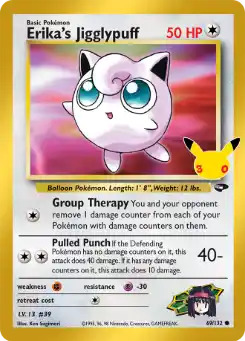
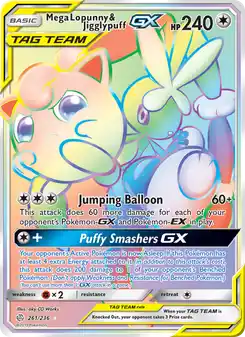
Jigglypuff can also be found in many other derivative Pokémon games: Pokémon GO, Pokémon Mystery Dungeon, puzzle games, mobile games, etc. Everywhere, it retains the same identity: a small Pokémon with big green eyes, an inflated pink body, and a voice capable of putting enemies and allies to sleep. It also appears on a multitude of Jigglypuff Pokémon cards, some of which highlight its HP, its Sing, or moves like Pound.
FAQ about Jigglypuff
What is Jigglypuff's type?
Depending on the generation, Jigglypuff's type varies slightly. In the early versions, it is Normal type. Starting from the introduction of the Fairy type, it becomes Normal/Fairy. This combination gives it an immunity to Dragon and Ghost types (thanks to Normal), a resistance to Dark and Bug types, but makes it weak to Poison and Steel types. This type evolution reinforced its place in battle, despite its modest defenses.
How do you evolve Jigglypuff into Wigglytuff?
To evolve Jigglypuff into Wigglytuff, simply use a Moon Stone. There is no minimum level required, but many Trainers wait for it to have learned certain important moves before triggering the evolution. The pre-evolution Igglybuff, for its part, must reach a sufficient happiness level and then gain a level to become a Jigglypuff. In summary, the evolutionary chain is: Igglybuff → Jigglypuff (by happiness) → Wigglytuff (by Moon Stone).
Is Jigglypuff a good Pokémon for starting an adventure?
Yes, Jigglypuff is often a good Pokémon for beginner players. Thanks to its high HP, it can take more damage than many other Pokémon encountered at the start of the adventure. Its Sing move allows it to put enemies to sleep, which greatly facilitates captures and difficult battles. Even if its offensive power is not extraordinary, simply being able to control the pace of battle with sleep makes it a valuable asset.
Why is Jigglypuff so famous in the anime?
Jigglypuff became famous in the anime thanks to a recurring gag: it sings its lullaby in front of everyone, and they all fall asleep instead of applauding. Furious, it takes out a pen and draws on the faces of the sleeping people. This scene repeats in several episodes, making the Pokémon very memorable. Its big eyes, small size, and high-pitched voice make it a comedic character, but also a symbol of the Pokémon universe for many fans.
Is Jigglypuff strong in competitive battle?
In high-level competitive battle, Jigglypuff is rarely used as a primary Pokémon. Its offensive and defensive stats are too average to compete with the most powerful Pokémon. However, in more casual formats, in Fairy or Normal-themed teams, or at restricted tiers of play, it can hold a respectable place. Its ability to put opponents to sleep, its decent HP, and access to varied moves (Ice, Psychic, Fairy, Normal) make it a fun and sometimes surprising choice.
Does Jigglypuff have a different form, like a regional form?
No, so far there is no official regional form of Jigglypuff in the main games. It also has neither a Mega Evolution nor a Gigantamax form. It retains its classic form in all versions, even though the graphic style evolves between 2D and 3D games. In certain spin-offs, it may appear with costumes or aesthetic variations, but its basic design remains constant.
What is Jigglypuff's place in the Pokédex?
Jigglypuff has a National Pokédex number located among the first Pokémon to appear in first-generation games. Its number is the same in all regional Pokédexes that include it, even if the overall order may change from region to region. This number is often used in Pokémon cards, collection tables, fan sites, and online encyclopedias to classify the information and appearances of this Pokémon.
What are Jigglypuff's main moves?
Among Jigglypuff's most iconic moves, one finds Sing (to put the target to sleep), Pound (a Normal physical move), Defense Curl (a Defense increase), as well as various moves learned via TMs depending on the version: Ice Beam, Psychic, Fairy moves, etc. It can also learn support moves that play on status conditions or team protection, which reinforces its role as a control Pokémon rather than a pure attacker.
Is Jigglypuff present in Pokémon GO?
Yes, Jigglypuff is present in Pokémon GO. It can be encountered in the wild, hatched from certain eggs, or obtained through various event mechanics. Like in the main games, it can evolve into Wigglytuff through specific Candy. Its presence in Pokémon GO reinforces its popularity among new players and nostalgic fans who have known it since Red and Blue.
Does Jigglypuff have a particular use for catching other Pokémon?
Yes, Jigglypuff is particularly useful for catching Pokémon thanks to its Sing move. Putting a target to sleep greatly increases the catch rate, which is very practical for catching rare or hard-to-catch Pokémon. Moreover, its moderate offensive power reduces the risk of accidentally KO'ing the target during weakening. This is why many Trainers keep a Jigglypuff or a Wigglytuff in their team, specifically for intensive catching sessions.
Summary
Jigglypuff is an iconic Normal/Fairy-type Pokémon, known in English as Jigglypuff and in Japanese as プリン. Small, round, all pink, with big sparkling green eyes, it stands out for its voice and Sing move capable of putting enemies and allies to sleep. With its high HP, status moves like Sing, and varied moves learned via TMs, it plays a support and control role in battle rather than that of a pure attacker. Pre-evolution of Wigglytuff and evolution of Igglybuff, it appears in many games, from Red and Blue to HeartGold and SoulSilver, as well as in the anime and many spin-offs. Whether for catching other Pokémon, completing a Pokédex, or simply enjoying its charm, Jigglypuff remains one of the most endearing and recognizable Pokémon in the entire franchise.
