


Share this Pokémon
Characteristics
- Height:
- 0.30
- Weight:
- 1.00
Base stats
Total: 210Combat strengths and weaknesses
Damage multiplier taken by Igglybuff depending on the attacking move's type. ×2 and ×4 are the attacks to avoid.


Your Pokédex, in cards
Every card of every Pokémon, what you already have and what you're missing.
Evolutions



Additional information
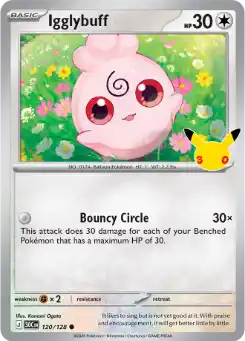
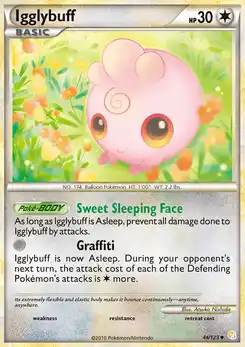
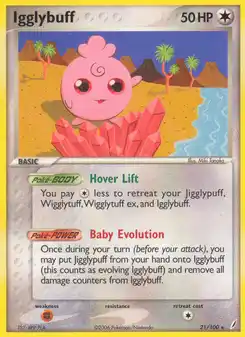
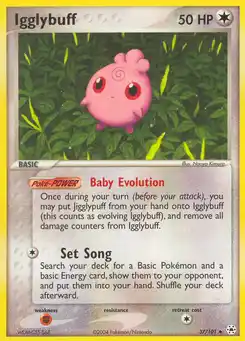
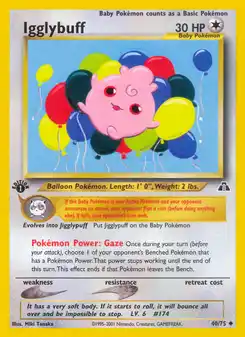
Pokémon Cards (8)






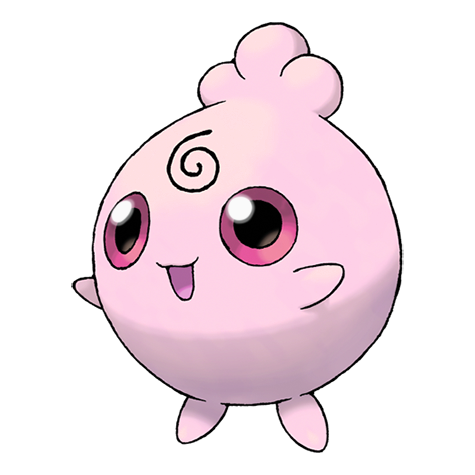
Official artwork
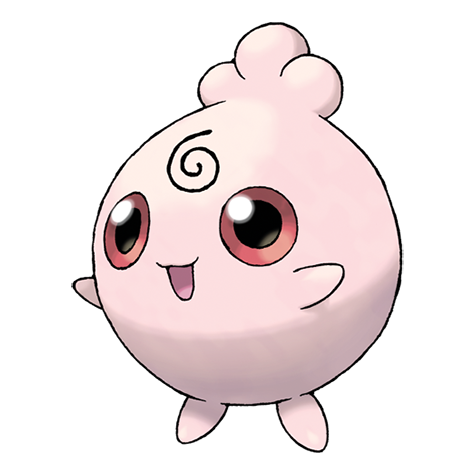
Base sprites


Pokémon Home


Dream World

Showdown


Detailed information
General Overview of Igglybuff
Igglybuff is a small Normal and Fairy-type Pokémon that serves as the baby form of the Jigglypuff and Wigglytuff family. In the Pokédex, it is often described as a round, very light Pokémon that moves by bouncing and that loves the soft light of the moon. This baby Pokémon is designed for players who enjoy cute teams, but it can also have real strategic utility early in an adventure thanks to its support moves, status attacks, and its ability to put opponents to sleep or disrupt them. Igglybuff has no impressive raw power, but it makes up for it with decent HP for a baby, access to healing moves, and numerous support moves that benefit the whole team.
Across different generations, Igglybuff gained the Fairy type, which completely changes how it is played. This type change gives it resistance to Dark and Fighting-type attacks, as well as an immunity to the Dragon type, which can catch certain opponents off guard in battle. Even though this Pokémon's base stats remain weak, it is still interesting to catch for completing the Pokédex, rounding out a fun team, or preparing an optimized egg breeding session with good moves. Thanks to the happiness mechanic, this Pokémon can quickly evolve into Jigglypuff, and then into Wigglytuff with a Moon Stone, making it an excellent starting point for a patient player.
Name, Languages, and Pokédex Description
Names in English and Japanese
In English, this Pokémon is called Igglybuff, a name that appears in many descriptions and guides. In Japanese, it is known as Pupurin, also written in katakana as ププリン. These different names all point to the same idea of a small, round, light creature closely tied to music, singing, and sleep. In some games and cards, it is classified as a baby Pokémon, which affects how it is obtained, breeding mechanics, and certain moves.
In Pokédex descriptions, Igglybuff is often presented as a Pokémon that puffs up its air-filled body to bounce, and whose skin turns slightly red when it is too excited or when it sings for too long. The Pokédex also emphasizes its large eyes, its nearly perfect ball-like shape, and its connection to the moon. Moonlight is said to strengthen its body and its song, which is why some games mention its appearances at night, or in calm areas far from busy routes. These descriptive details give useful information for better understanding Igglybuff's personality and for bringing it to life in your own Pokémon adventure.
General Information and Pokédex Number
In the National Pokédex, Igglybuff has a specific number that places it just before Jigglypuff and Wigglytuff. This order reflects its position as a pre-evolution, and allows players to visualize the progression from baby to fully evolved form. In terms of basic information, Igglybuff is an extremely light Pokémon, with a weight often expressed in just a few kilograms, which fits well with its nearly air-filled body. Its height is very small compared to many Pokémon, reinforcing its image as a fragile baby to be protected.
For players, these size and weight details do not have a direct effect on battle, but they contribute to immersion and help better imagine Igglybuff in the game world. On the other hand, its Pokédex number is useful for completing the regional Pokédex and for quickly checking whether this Pokémon has already been caught or not. Certain versions, such as Ruby, Sapphire, Diamond, Pearl, or Platinum, may adjust its position in the regional Pokédex, but its role as the baby form linked to Jigglypuff remains constant, simplifying comparisons across generations.
Igglybuff's Type, Resistances, and Weaknesses
Normal Type and Fairy Type
Igglybuff's primary type is Fairy, with a Normal-type heritage in some earlier generations. For a player, this type information is essential, as it determines damage received and dealt with each attack. The Fairy type grants Igglybuff a very valuable immunity to the Dragon type, which sometimes allows it to be used as a shield against certain powerful attacks. It also resists Fighting and Dark types, which can seem surprising for such a small Pokémon, but is very useful in strategic battle.
In return, Igglybuff remains vulnerable to certain types. Poison and Steel types pose a real danger, as they deal super-effective damage to this Pokémon. Ground-, Grass-, Water-, or Fire-type attacks hold no particular advantage over it, but players should keep in mind that its defenses remain weak, even if its base HP can seem relatively high for a baby. Managing weaknesses is therefore crucial, and it is often advisable to keep it in reserve to absorb Dragon-type attacks or to set up status conditions rather than leaving it on the front line against Poison- or Steel-type threats.
How the Type Affects Play Style
The Fairy type is also interesting because it gives Igglybuff access to moves oriented toward light, magic, and protection. Certain Fairy-type attacks can deal decent damage while benefiting from the type bonus, which helps compensate a little for its weak Attack or Special Attack stat. Players can thus create a moveset that mixes a Fairy-type attack to make use of a decent base power, and support moves that exploit status conditions or field control. Combined with a fitting ability, this type can make Igglybuff useful in battles against Dragon-, Fighting-, or Dark-type Pokémon.
In some games, Igglybuff's presence on routes or in areas near plants, grass, or water bodies highlights its peaceful side. Even though its Pokédex description rarely mentions fierce battles, this Pokémon is still a good choice for teaching new players about type matchups, damage, and resistances. Thanks to its combination of Normal and Fairy types in certain contexts, it can learn moves from several different families, which increases the flexibility of its moveset and allows its moves to be adapted to suit the chosen play style.
Base Stats and Battle Role
HP, Defense, and Endurance
Igglybuff's base stats are not impressive in terms of raw power, but they follow the logic of a baby Pokémon specialized in support. Its base HP is relatively high for a Pokémon at this stage, which allows it to take one or two hits even though its Defense and Special Defense remain low. Players who want to use Igglybuff longer in battle can invest EVs in Defense or Special Defense to compensate for this fragility. This will not turn this Pokémon into a wall, but it may be enough to hold on for an extra turn and place a status move like Sing or another support move.
Its Defense is not suited to standing up to very powerful physical attacks, especially if they are Poison or Steel type. However, in battles at a low level or in contexts where opponents do not yet have optimized stats, Igglybuff can fulfill its role without fainting immediately. Early in the game, this relative endurance allows certain strategies to be tested and highlights the importance of IVs and EVs on a Pokémon's resilience. The idea is to use it intelligently to stall rather than to leave it absorbing repeated attacks on the front line.
Attack, Special Attack, and Speed
Igglybuff's base Attack stat is low, as is its Speed. In most games, it will almost always attack after the opponent, which means the player must anticipate the damage taken. Its Special Attack rarely exceeds a threshold that allows it to compete with offensive Pokémon, but the goal is not to turn it into a sweeper. It is better to exploit status moves, healing moves, and support attacks rather than seeking raw power. Nevertheless, by investing EVs in Special Attack and giving it an appropriate nature, it can make slightly better use of a Fairy- or Psychic-type special attack.
Regarding Speed, Igglybuff does not shine. That said, low Speed can be used as an advantage in certain strategies based on Gravity or moves that benefit slow Pokémon. Advanced players can integrate Igglybuff into teams where priority is not on speed, but on controlling the pace of the game. In simpler formats, it remains preferable to accept that Igglybuff will not attack first and give it moves that remain useful even when it acts after the enemy, such as healing moves, sleep-inducing attacks, or moves that lower the opponent's Attack, Special Attack, or accuracy.
Moves, Abilities, and Recommended Movesets
Status Moves and Battle Control
One of Igglybuff's strengths lies in its status moves. It can learn moves like Sing very early, which puts the opponent to sleep, or other moves that disrupt the battle. For a player, having a move capable of putting a wild Pokémon to sleep makes catching it much easier. The catching mechanic depends partly on remaining HP and status condition, so a sleep or paralysis move greatly increases the chances of success, especially when trying to complete the Pokédex or obtain a good specimen for breeding.
Igglybuff can also access moves that lower the opponent's accuracy, Speed, or offensive power. These support moves compensate for its low Attack stat and allow it to remain useful even later in the game. In certain generations, it can also learn protection moves or moves that raise its own stats, giving it a bit more flexibility. For a balanced moveset, it is often advisable to give it two status or support moves, one Fairy- or Normal-type offensive attack, and possibly a Psychic- or Ghost-type move if the game and available TMs allow.
Offensive Moves and Type Coverage
Even if Igglybuff's Attack or Special Attack stat is not high, this Pokémon can learn several interesting moves to catch opponents off guard. Normal-type moves like Body Slam or Tackle serve as a base early in the adventure, then can be replaced by more powerful moves via TMs. Depending on the game, Igglybuff can access moves like Shadow Ball, Psychic, or Fairy-type attacks with decent power. These moves will not turn this Pokémon into a main threat, but they prevent it from being completely useless when a battle drags on.
When building a moveset, the player can seek to vary types to benefit from better offensive coverage. For example, a Fairy-type attack to handle Dragon, Fighting, and Dark types, a Normal-type attack with decent base power, a Psychic or Ghost move to handle certain Poison types, and a status move to put opponents to sleep or paralyze them. The goal is to give Igglybuff a wide enough palette of moves to support the team in different scenarios without focusing solely on damage. In general, it is advisable not to waste very rare TMs on this Pokémon if the player is aiming for competition, but for a solo adventure it can receive average TMs without issue.
TMs, PP, and Power Management
The TMs and HMs available to Igglybuff depend heavily on the generation and the game. In certain titles, this Pokémon can learn moves like Psychic, Shadow Ball, or other special attacks via TM, which increases its flexibility. Players should however keep an eye on the PP of these moves, as a Pokémon with few PP on its main attacks risks running out at the worst moment, especially on long routes or in dungeons. Good PP management, combined with a few Ether items and a balanced moveset, allows Igglybuff to remain available across multiple consecutive battles.
For players who like to optimize everything, it is also possible to think about the base power of moves and the stat used. A Fairy-type move based on Special Attack will be more effective if the player has invested EVs in that stat. Even if Igglybuff will never become a powerhouse, each small damage gain can make a difference in a close fight. With the right combination of TMs, PP, and base power, this Pokémon can fill a backup offensive role while remaining primarily support-oriented.
Catching, Encounters, and Obtaining Igglybuff
Catching in Different Generations
Igglybuff is not always directly catchable in the wild. In some generations, it appears on specific routes, often at night or in calm areas, while in others it must be obtained by breeding, hatching an egg from Jigglypuff or Wigglytuff. The player must therefore carefully check the information in the regional Pokédex or the data for the version they are using. In games like Ruby, Sapphire, or more recent remakes, Igglybuff can also be encountered in special areas, sometimes through events or specific appearances after certain conditions are met.
In more modern games, such as those from the Sun and Moon era or their follow-ups, how Igglybuff appears may change, but the principle remains similar. Sometimes it can be found in the grass on a specific route, sometimes in a more mysterious environment. In certain spin-off games, such as Pokémon GO, Igglybuff can be obtained via eggs or temporary wild appearances during events. Understanding these differences is important for players who want to complete all baby Pokémon or who are looking for a specific specimen with good IVs.
Poké Balls and Status Conditions
As with any Pokémon, the catch rate for Igglybuff depends on its remaining HP, its status condition, and the Ball used. Even if this baby Pokémon is not particularly difficult to catch, players can optimize their chances by putting it to sleep with a move like Sing. Once asleep and with its HP in the red, using a Great Ball, Ultra Ball, or a specialized Ball increases the chances of success further. In certain games, Balls specifically suited to babies or lightweight Pokémon can be very effective on it.
Players aiming for competitive or perfect Igglybufs may need to catch several or hatch many eggs to get the right IVs and the right ability. In this case, it is useful to have a Pokémon with a precise move to weaken without knocking out, and possibly an ability that helps control nature or IVs. This approach takes time, but it allows you to obtain an Igglybuff perfectly suited for breeding, which is a worthwhile investment in preparation for a future team centered on Wigglytuff or other Fairy-type Pokémon.
Evolution, Pre-Evolution, and the Igglybuff Family
From Igglybuff to Jigglypuff, Then Wigglytuff
Igglybuff is the pre-evolution of Jigglypuff and Wigglytuff. It is a baby Pokémon that evolves into Jigglypuff once its happiness reaches a certain level, generally by gaining a level when that happiness is high enough. Then, Jigglypuff evolves into Wigglytuff using a Moon Stone, giving the player a much more powerful Pokémon suited to mid- and late-game battles. Understanding this evolution chain allows you to plan training and happiness management so as not to delay obtaining stronger forms.
To optimize the evolution, it can be interesting to let Igglybuff learn certain moves as a baby before evolving it. Sometimes, certain moves are only available at a given level before evolution, or conversely, certain more powerful moves can only be learned once the evolved form is obtained. Advanced players often consult level-up move lists to decide the ideal moment to evolve their Pokémon. Once the Moon Stone is used on Jigglypuff, the new form Wigglytuff can no longer learn certain moves by leveling up, which is why planning ahead is important.
Happiness, Friendship, and Baby Management
Igglybuff's evolution into Jigglypuff is tied to happiness and level. To increase this happiness value, the player must adopt an attentive play style. Keeping Igglybuff in the party, letting it participate in battles, healing it regularly, avoiding letting it faint, giving it certain items, or walking long distances are all ways to raise its happiness. In certain games, it is even possible to check this value indirectly through NPCs who give clues about the bond between the Pokémon and its trainer.
This happiness mechanic is consistent with the baby Pokémon status, as it reinforces the idea of the relationship between the player and Igglybuff. The stronger the bond, the sooner the evolution triggers, which allows Jigglypuff to be obtained at a relatively low level. Players can thus enjoy a Jigglypuff that is more resilient and more powerful than the baby form for longer. The concept of happiness is also important for breeding, as a well-loved Pokémon is often the one you keep in the party for a long time, which increases the motivation to find good breeding partners for egg hatching.
Breeding, Eggs, and Optimization
Breeding, Egg Group, and Compatibility
Igglybuff can be obtained through breeding by having a compatible Jigglypuff or Wigglytuff lay an egg with a Pokémon from the same Egg Group. This mechanic is essential for players who want to obtain an Igglybuff with specific moves inherited from its parents. For example, moves learned through breeding can give this baby Pokémon abilities it could not learn simply by leveling up or through TMs. Breeding information is therefore very important for those preparing a strategic team, even if Igglybuff itself will not necessarily be used in the final battle.
Depending on the game, Igglybuff's Egg Group associates it with other Normal or Fairy Pokémon, which opens the door to interesting combinations. Players must choose a male parent with the desired moves and a female parent from the Igglybuff line, so that the egg hatches into this baby Pokémon. Once the egg is obtained, it must be walked a certain number of steps before it hatches. During this time, having a Pokémon with an ability that reduces hatching time, or moving through long areas, can considerably speed up the process.
IVs, EVs, and Advanced Breeding
For competitive players, Igglybuff is mainly interesting as a starting point for breeding an optimized Jigglypuff or Wigglytuff. IVs (Individual Values) determine the maximum potential of each stat. By using items like Destiny Knot and power items, trainers can pass some of the parents' IVs to the baby. The goal is to obtain an Igglybuff with perfect or near-perfect IVs in HP, Special Defense, or Special Attack, depending on the intended role for its evolved form.
EVs, in turn, are gained through battle. If the player wants the future Wigglytuff to be a good special tank, they can already have Igglybuff battle Pokémon that grant HP or Special Defense EVs. Even though Igglybuff will not remain in this form for long, each battle contributes to building a precise profile for the final form. By combining a good EV distribution, carefully chosen IVs, and an interesting ability, the player can turn a line of Igglybufs into a real asset for their competitive team.
Team Usage and Type Synergies
Support Role Early in the Game
Early in an adventure, Igglybuff is first and foremost a support Pokémon. Its main function for a player is to set up status conditions, make catching easier, and protect other team members. Thanks to moves like Sing and its reasonably high base HP for a baby, it can put wild Pokémon to sleep on a route or in tall grass, which simplifies catching rare or difficult Pokémon. Its support role is even more useful if the player does not yet have other Pokémon capable of inflicting status conditions.
In certain scenarios, Igglybuff can also serve as a temporary shield to absorb a hit intended for a more important Pokémon. Even if it is not an ideal wall, it can buy an extra turn, which is sometimes enough to use a key move or safely switch Pokémon. This calculated sacrifice remains a difficult choice, but in a solo adventure, it can help get out of a tricky situation. In general, it is better to think of Igglybuff as a support Pokémon, useful for setting up the field rather than finishing off battles.
Synergies with Other Types and Abilities
Igglybuff's Fairy type fits well into a team that lacks answers to Dragon-, Fighting-, or Dark-type Pokémon. Paired alongside Steel-, Grass-, Water-, or Ground-type Pokémon, it can form interesting defensive synergies. For example, a Steel-type Pokémon covers Igglybuff's weakness to Poison and Steel, while Igglybuff handles certain Fighting or Dragon types more effectively. By combining the abilities of each team member, the player can create effective type coverage despite this Pokémon's modest stats.
Certain possible abilities for Igglybuff can also strengthen its support profile. Abilities that improve healing, reduce damage taken, or benefit from status conditions can make this Pokémon more troublesome than expected. In Double Battles, it can protect a partner while inflicting status conditions on the opponent. The player simply needs to remember that Igglybuff remains fragile against super-effective attacks. It should therefore never be unnecessarily exposed to a faster Poison- or Steel-type, or it will leave the field before it even gets to act.
Igglybuff Across Generations and Spin-off Games
Presence in the Main Games
Across generations, Igglybuff has been obtainable in several different ways. In some it is present in the wild, in others it is found only through breeding and eggs. During the Ruby and Sapphire era, and then in remakes and games like Diamond, Pearl, and Platinum, it can be added to the team relatively early or through trades. In Sun and Moon, or in other versions set in distant regions, the methods of obtaining it may change, but the idea remains that it is a baby Pokémon designed to illustrate happiness-based evolution and breeding mechanics.
In certain versions, NPCs may offer an Igglybuff or an egg containing one, which avoids the need for breeding and catching. This type of gift is often tied to side quests or specific events, and gives the player quick access to the Jigglypuff family. For those who enjoy playing with a team themed around music, sleep, or Fairy types, such a gift is an excellent opportunity to quickly integrate Igglybuff into the team without having to farm a specific route or patch of grass.
Igglybuff in Pokémon GO and Other Games
In Pokémon GO, Igglybuff generally appears via eggs, sometimes 2 km or 5 km eggs depending on events. Its availability may vary over time, but the theme remains the same, with an emphasis on its baby status. This allows mobile players to discover egg-hatching mechanics, walking, and candy management for evolutions. Obtaining Pupurin, Igglybuff, or similar Pokémon in this context relies more on luck and event participation than on exploring a specific route.
In other spin-off games, whether dungeon-focused, card-based, or other adaptations, this Pokémon is often portrayed as a very cute character, sometimes used to illustrate sleep, singing, or healing mechanics. For a player, these appearances are more aesthetic than strategic, but they reinforce Igglybuff's overall presence in the Pokémon universe and inspire some players to use it in the main games as well, if only for the visual appeal of a team made up of babies or Fairy-type Pokémon.
Advanced Tips for Players
When to Keep Igglybuff, When to Evolve
An important strategic point for an advanced player is deciding when to evolve Igglybuff. Keeping this Pokémon in its baby stage allows it to learn certain moves at a lower level, which can be useful if the player wants to prepare a Jigglypuff or Wigglytuff with a specific moveset. However, keeping a Pokémon with low base stats for a long time makes battles harder. A balance must therefore be found between move learning and gameplay comfort.
A common approach is to let Igglybuff learn the essential status or support moves, then manage happiness to trigger the evolution into Jigglypuff at a reasonable level. Once you have the desired moves, using a Moon Stone allows the transition to Wigglytuff, which will be far more effective in battle. The choice also depends on progress in the adventure, the average level of opponents, and the overall team style. Players who want a simpler adventure often opt for a quick evolution, while those who enjoy optimizing every detail keep the baby stage longer.
Use in Double or Multi Battles
In Double or Multi Battles, Igglybuff can find an original role thanks to its support moves. Even if its base stats remain low, its type combination and status moves make it a good candidate for disrupting the opponent's strategy while its partner deals the damage. Moves that lower the opponent's Attack, Special Attack, or accuracy, combined with healing moves, can extend battles and give the partner more turns to set up.
In certain teams, Igglybuff can also benefit from moves like Gravity or other mechanics that change speed priorities. Its lack of Speed becomes secondary if the team's strategy does not rely on striking first. Even if this Pokémon is not the top choice number one in competitive formats, a player who knows how to make use of it can surprise opponents who underestimate it because of its baby appearance. The key is to remember that its role remains support, and that its true power is often revealed through its final form, Wigglytuff.
Summary
Igglybuff is a Fairy-type baby Pokémon connected to Jigglypuff and Wigglytuff, designed first and foremost as a support rather than an attacker. Its base stats are low, but its decent HP, status moves like Sing, and access to many support moves make it a useful ally early in an adventure for catching Pokémon and protecting the team. Its happiness-based evolution into Jigglypuff, and then into Wigglytuff with a Moon Stone, offers a clear progression for players who want to turn this small round Pokémon into a real asset. Used intelligently, Igglybuff is a great way to learn about type mechanics, breeding, IVs, EVs, and happiness management, all while bringing a cute and strategic touch to any Pokémon team.