



Share this Pokémon
Characteristics
- Height:
- 1.60
- Weight:
- 55.00
- Gender differences:
- Yes
Base stats
Total: 455Combat strengths and weaknesses
Damage multiplier taken by Golbat depending on the attacking move's type. ×2 and ×4 are the attacks to avoid.
Weaknesses - dangerous attacks


Resistances - weak attacks


Immunities - no damage taken


The complete Pokédex, in your pocket
Detailed pages, types, stats and your favourite Pokémon - on the app.
Evolutions

Additional information
Pokémon Cards (21)
Showing the latest 12











Official artwork
Base sprites


Pokémon Home

Dream World
Showdown


Detailed information
Introducing Golbat
Golbat is the iconic intermediate evolution of the first-generation toxic bat line. It sits between Zubat and Crobat and represents an important milestone for every trainer who catches a Zubat in a dark cave or cavern. Visually, Golbat retains the blue bat appearance of its pre-evolution but gains in wingspan, attack power, and speed. Where Zubat seems small and fragile, Golbat gives the impression of a more aggressive Pokémon, with sharp fangs, ready to pounce on its victim and drain its blood through attacks inspired by vampirism. This form is present in many games and in a large number of routes, mountains, and caves, making it a very familiar Pokémon to players.
In the Pokédex, Golbat is often described as a Pokémon that flies unnecessarily close to living creatures to feed, navigating using ultrasound and the sound of air passing through crevices in cave walls. It is Poison and Flying type, making it particularly dangerous against Grass and Fighting-type Pokémon. Thanks to its growing speed and strength, Golbat becomes a formidable ally in nighttime battles, whether in an isolated cavern, along a remote route, or atop a mysterious mountain lit by the red moon of the night sky.
General Information and Pokédex Description
Number, name and description
Golbat holds a specific number in the national Pokédex, placed just after Zubat. This number makes it easy to locate in the official list of each generation's Pokémon. Its name in English, Golbat, connects the ideas of a gold-colored bat and the act of striking or drinking blood. In other languages, it has close variants, but each name generally retains the idea of a bat and blood. This naming consistency reinforces its identity as a nocturnal, predatory, and poisonous Pokémon.
The typical Pokédex description emphasizes its tendency to cling to the ceiling of a cave, wings folded, waiting for a victim to bite on the neck and steal blood from. After feeding, its body becomes several kilograms heavier, drawing some of its HP into energy. Its fangs are particularly well-developed, capable of piercing the toughest skin. Golbat is a Pokémon that can cover long distances in the air, moving from one cavern to another, from one mountain to distant islands, searching for new prey. Cave entrances are often described as places where its blue or blue-green wings can be spotted as night falls.
Type and combat identity
Golbat's type is Poison and Flying. This dual type offers a set of resistances and weaknesses that define its battle style. It resists Grass and Fighting moves well, and thanks to its Flying side, it is immune to the Ground type, making it an excellent answer to certain enemies who rely on that type to deal massive damage. On the other hand, it is vulnerable to Ice, Rock, and Electric types, which can break through its relatively average defense. Golbat must therefore manage its entries onto the field carefully, taking advantage of its speed to target the right enemy at the right moment.
In the Pokédex across various generations, entries also highlight its ability to emit ultrasound to navigate in the dark, which is of great importance in caves and tunnels. Even without particularly prominent eyes, it can identify every crevice and obstacle in a cave or underground route, allowing it to move with impressive speed. The Poison type gives it access to many moves that inflict venom and status effects, reinforcing the image of a dangerous vampiric Pokémon for any careless enemy.
Appearance, Size, Weight and Visual Details
Size, weight and wings
Golbat is noticeably larger than Zubat. Its size increases, its wings widen, and its body takes on a more massive shape. The Pokédex lists a height of several dozen centimeters, sometimes over a meter in wingspan, making it impressive when gliding through a cavern or above a mountain route. Its weight in kilograms also increases, especially after it has drunk too much blood, as some Pokédex entries mention. This temporary weight gain sometimes affects its speed, but provides it with an energy reserve for subsequent battles.
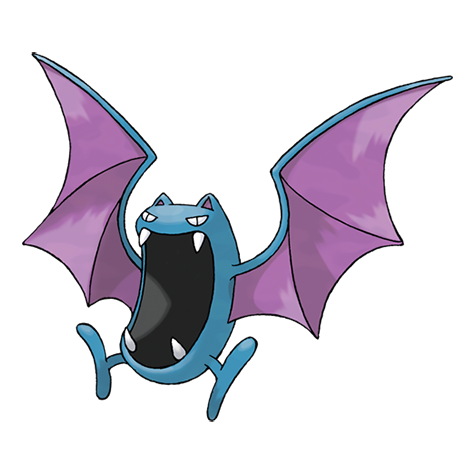
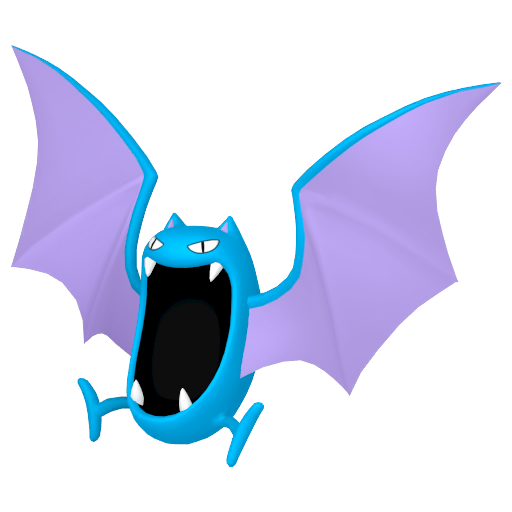
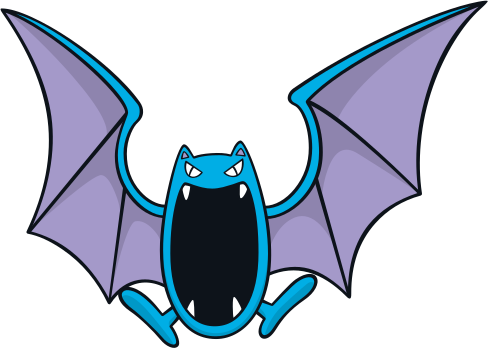
Its wings are the most striking visual element: one large wing on each side, often dark blue or blue-violet, with the inside sometimes purple or red depending on the version. When spread, Golbat can occupy a large portion of the screen, reinforcing the impression of power and threat. Its large mouth, lined with fangs, is ready to inflict bites and blood loss on any victim. Its overall silhouette remains that of a bat, but far more aggressive than the small Zubat.
Color details, male and female
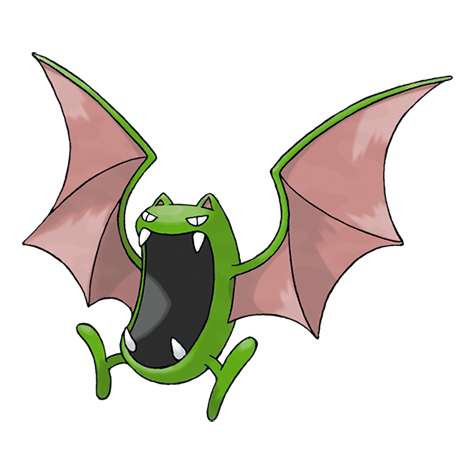
In terms of colors, Golbat retains a dominant blue, sometimes with shades of green or purple depending on the game. Its body, wings, and the interior of its mouth are distinguished by a marked contrast, making it recognizable even in dark environments. Some games introduce slight differences between male and female Golbat, but these variations remain subtle.
Whether male or female, Golbat keeps the same vampiric bat silhouette, often hanging upside down in caves. It is rarely seen resting in the blue sky in broad daylight, as it prefers the night and caves, where it can use its ultrasound undisturbed by light. When you visit a Pokémon-dedicated site or look up an appearance map, Golbat is almost always associated with caves, mountains, caverns, night, and underground routes.
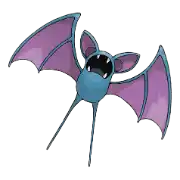
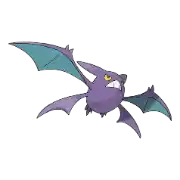
Evolution from Zubat to Golbat and then Crobat
Evolution method and key levels
Zubat evolves into Golbat at a relatively low level, usually around level 22. This evolution brings an enormous gain in stats in terms of HP, Attack, and Speed, which radically changes its combat potential. The transition to Golbat is a symbolic moment: it is often the first time the player truly feels the power of this toxic line.
Thereafter, Golbat can itself undergo a further evolution into Crobat. This evolution is not tied to a simple level, but to the friendship between the trainer and their Pokémon. Once the friendship EV is sufficiently high, Golbat evolves into Crobat upon gaining a level. This chain of evolution makes the Zubat – Golbat – Crobat line very popular among players who enjoy fast and aggressive Pokémon.
Golbat, an intermediate but essential form
Even though Crobat is often preferred in competitive strategy, Golbat holds a crucial importance in the development of this line. It is in this form that the Pokémon learns several important moves, gains enough strength to hold its own against tougher opponents, and begins to fully exploit its Poison and Flying type advantages. The Pokédex description frequently notes that it can drink its victims' blood to the point of becoming heavy and needing to rest in a cave. At this stage, the potency of its venom, the length of its fangs, and the force of its bite are clearly superior to those of Zubat.
This intermediate form is sometimes the one the player keeps for a long time before obtaining Crobat, especially in games where friendship management requires several battles, specific food, or time spent in the team. Golbat then becomes a central member of the team, present in every battle, accumulating Speed and Attack EVs, and attaining stat values solid enough to feature at the heart of the team.
Golbat's Statistics and EV Distribution
Stats overview
Golbat's stats show a very clear progression compared to its pre-evolution. Its HP increases, its Defense improves slightly, but above all its Attack and Speed explode relative to the baseline. In summary, Golbat becomes a much more threatening Pokémon, capable of dealing decent damage even before having access to the best move sets.
Its Defense remains average, however, and it cannot take too many super-effective hits. The exact values vary by generation, but the trend stays the same: a fast, offensive Pokémon specializing in physical Poison and Flying attacks, with a reasonably comfortable HP pool to survive several turns. It is not a defensive wall, but rather a predator that flies around its target, strikes quickly, and retreats if the battle turns badly.
Recommended EV distribution
Strategically, the EVs most often recommended for Golbat focus on Attack and Speed. Investing the majority of EVs in Speed ensures it strikes before most Pokémon of the same level, which is essential for a Pokémon of this type. The second priority is Attack, to boost the raw power of bites, fangs, and Flying moves.
A small portion of EVs can be placed in HP or Defense to improve survivability, but the bulk of Golbat's potential rests on its ability to move quickly through the air and hit hard. In some battle sets, investing a few EVs in Special Defense is also viable, to better absorb a Grass or Ghost-type hit, but the main axis remains Attack and Speed. This distribution gives a Golbat capable of acting multiple times in extended battles and playing the role of an effective harasser.
Types, Resistances and Weaknesses
Impact of the Poison and Flying typing
The dual Poison and Flying typing gives Golbat an interesting combination. It is immune to Ground, neutralizing a large number of commonly used attacks in battle. It also resists Grass moves, making it an excellent counter for many special or defensive Pokémon. The Poison type allows it to inflict continuous venom on the enemy, and its Flying moves hit Fighting, Grass, and sometimes Bug-type Pokémon very hard.
On the other hand, Golbat must watch out for Ice, Rock, and Electric types, which deal super-effective damage. A well-placed Ice move can knock this Pokémon out if its defense is not sufficiently boosted. Rock moves are common in caves and mountains, making certain battles particularly dangerous, especially when traversing caverns or competing in high-level tournaments.
Matchups against different types
Against Grass-type Pokémon, Golbat is almost always at an advantage. Its Flying moves have sufficient power to quickly put them out of commission, and its resistances allow it to hold firm against their counter attempts. Fighting-type Pokémon, for their part, fear Flying and Poison moves, allowing Golbat to enter the field without too much risk.
On the other hand, against Electric or Ice Pokémon, it is better to switch Golbat out as soon as possible. A Rock-type enemy present in a mountain or cave will also be dangerous. In these situations, the trainer must think about the order of entries, the management of turns, and the actual role this Pokémon occupies in the overall strategy. It is the combination of its stats, its type, and its moves that determines its place in the team.
Golbat's Moves and Attacks
Bite, fangs and Poison attacks
Golbat is famous for its fangs, used to bite its victims. Its Poison-type moves reflect its vampiric nature: it can poison an enemy with its venom, chip away at its HP turn after turn, then exploit that weakening to finish the battle. Moves such as Super Fang, Poison Fang, or other variants depending on the generation highlight its ability to deal constant damage.
Some vampirism-inspired moves even allow it to recover HP based on damage dealt. These abilities turn Golbat into a Pokémon capable of staying on the field for a long time when well protected, restoring its health turn after turn, while harassing the enemy. This dynamic is reinforced by its speed, which often lets it strike first.
Flying moves and air control
As a Flying-type Pokémon, Golbat has a range of moves to control the air and dominate the skies. Its wings, already impressive visually, serve to deliver rapid and powerful blows to the enemy. It can use various classic Flying moves depending on the game, adding an aerial dimension to its battle style.
In a battle inside a cave, a mountain, or a deep cavern, seeing Golbat surge out of the darkness with a large wing spread is an intimidating spectacle. The power of its Flying moves allows it to handle many Grass or Fighting-type Pokémon, and even certain Ghost-type Pokémon that do not hold up well against this type of pressure.
TM-learned moves and coverage
Depending on the generation, Golbat has access to a set of additional moves via TM, allowing it to adapt its move set to different situations. It can learn Fire, Ice, or Dark-type moves, or support moves like Taunt or Defog in certain games. These TMs grant it additional strategic value, and the player can tailor a custom move set for their team.
In games where routes and terrains are varied, having a Golbat capable of hitting a wide range of types is an advantage. The ability to customize its moves, combined with its Attack and Speed stats, makes it a real threat if the opponent has not prepared an adequate answer.
Habitat, Routes, Caves and Appearances
Cave, cavern, mountain and islands
Golbat is closely associated with caves and caverns. It is often encountered on underground routes, in tunnels, on mountains, and sometimes on rocky islands where hollows are abundant. Mt. Moon, for example, is a place where the Zubat – Golbat line is very prevalent. Cave entrances and deep caverns are prime locations for finding this Pokémon, especially at night.
In certain generations, it also appears in more open areas, but often connected to rocky environments or abandoned structures. The information found in Pokédexes across different versions emphasizes that it prefers the night and dim light. In sunlight, it hides in crevices in the rock, waiting for nightfall before venturing out.
Appearances by generation and catch frequency
Since the first generation, Golbat has been among the Pokémon encountered many times. The frequency of its appearances varies by game, but it remains a relatively common Pokémon in caves. Its catch rates are lower than those of Zubat, consistent with its higher level and more significant stats, but it remains simpler to catch than certain rare or legendary Pokémon.
In games such as Pearl or other versions, the presence of Golbat and Crobat in caverns reinforces the idea of a complete ecosystem of toxic bats. One can even compile a summary of appearances by route, mountain, and island to track its progression in your Pokédex and see at which level each form becomes available, which is valuable for building an effective team.
Golbat's Role in Battle
Use in solo adventure
In a solo adventure, Golbat is an extremely useful Pokémon. It brings great speed, good Attack, a versatile Poison/Flying typing, and moves capable of poisoning the enemy or draining their HP. Its stats make it an excellent harasser, perfect for weakening opposing teams over successive battle turns. On a mountain route, in an isolated cave, or in a League battle, it can be a faithful ally.
Its role is often that of a Pokémon who enters after a first enemy, takes advantage of its type advantage, and cleans up what remains of the opposing team. It also excels in nighttime battles, where its theme as a nocturnal creature makes perfect sense. When used with the right EV distribution, it becomes a true offensive pillar of the team.
Utility in strategic battles
In more advanced strategy, Golbat is sometimes overshadowed by Crobat, but it can still find a place in limited formats or in mid-level teams. Its speed remains good, its Attack power respectable, and its Poison abilities make it a threat against Grass or Fairy-type Pokémon in certain generations. A well-built set, with a good stat distribution, a judicious choice of TMs and vampirism abilities, can make it a very unpleasant Pokémon to face.
It can also serve as a transitional Pokémon, used to obtain Crobat quickly while participating in many battles to accumulate EVs. Its constant presence in the team allows it to build the friendship needed for the final evolution, while actively playing a role in battles. It is not rare for trainers to keep a Golbat until the maximum level of their adventure before triggering the final evolution.
Breeding, Eggs and Inheritance
Golbat belongs to an egg group compatible with several Flying or Poison Pokémon, allowing it to participate in breeding at Day Cares. Through this, it can pass on interesting moves and genetic values to its offspring, notably to newly hatched Zubat. Breeding makes it possible to obtain better IVs, optimized natures, and EV values better suited to the team's needs.
In certain games, breeding also allows specific moves to be inherited, reinforcing the potential of the line. Golbat is therefore not just a fighter but also an important genetic source for trainers who want to perfect their team. With a good breeding plan, you can obtain competition-ready Zubat, Golbat, or Crobat, prepared to face ever stronger opponents.
Golbat in Other Games and Media
Outside the main games, Golbat appears in many spin-offs. In Pokémon GO, it is sometimes present in specific areas, especially near parks, caves, or dark urban locations. In dungeon-style games, Golbat is often encountered on cave floors, in abandoned towers, or in deep caverns, where it attacks in groups.
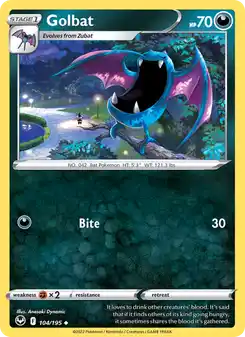
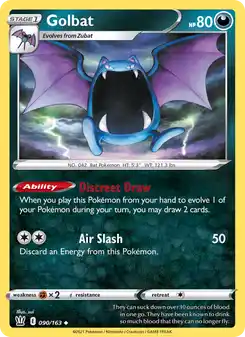
It also appears on several cards in the Trading Card Game. Each card features an illustration of its blue body, spread wings, and wide-open mouth, depicting the power of its bite and fangs. The price of these cards depends on rarity, edition, and player demand, but Golbat remains a recognizable figure for any fan of the franchise.
Summary
Golbat is the intermediate evolution of the Zubat – Golbat – Crobat line, a Poison and Flying Pokémon that dominates the caves, caverns, and mountains of many regions. Larger, heavier, and more powerful than Zubat, it stands out with its fangs, blue wings, biting and venom attacks, and its high speed. Its offensive stats make it an excellent harasser, while its central role in the evolution toward Crobat makes it indispensable for trainers who enjoy fast and nocturnal Pokémon. Easy to encounter but not to be underestimated, Golbat remains a classic of the caves and a formidable companion in any Pokémon adventure.
