


Share this Pokémon
Characteristics
- Height:
- 2.00
- Weight:
- 42.50
Base stats
Total: 510Combat strengths and weaknesses
Damage multiplier taken by Gliscor depending on the attacking move's type. ×2 and ×4 are the attacks to avoid.


Resistances - weak attacks


Immunities - no damage taken




Your Pokédex, in cards
Every card of every Pokémon, what you already have and what you're missing.
Evolutions


Additional information
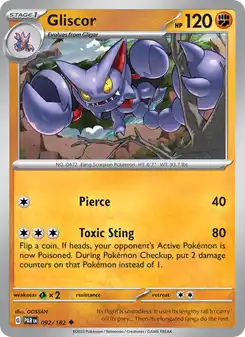
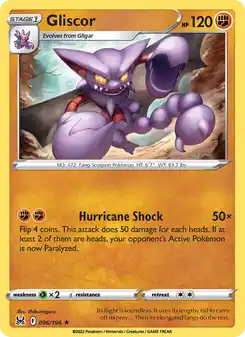
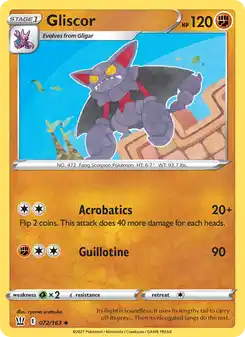
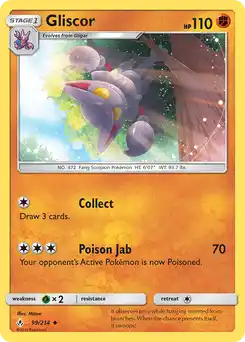
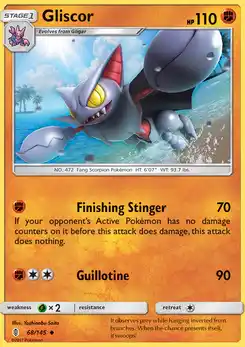
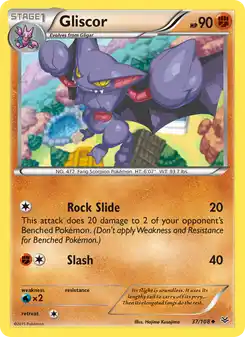
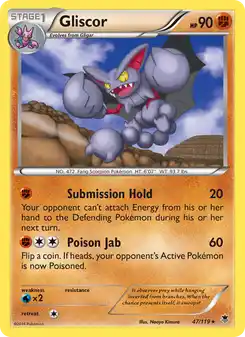
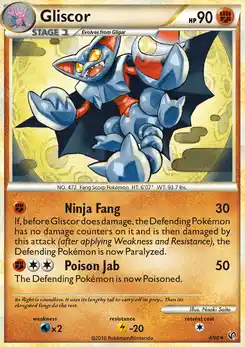
Pokémon Cards (16)
Showing the latest 12






Official artwork
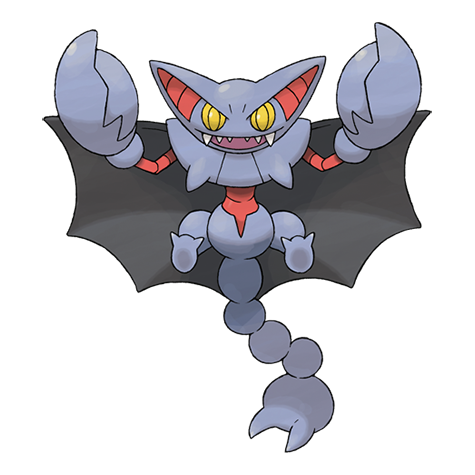
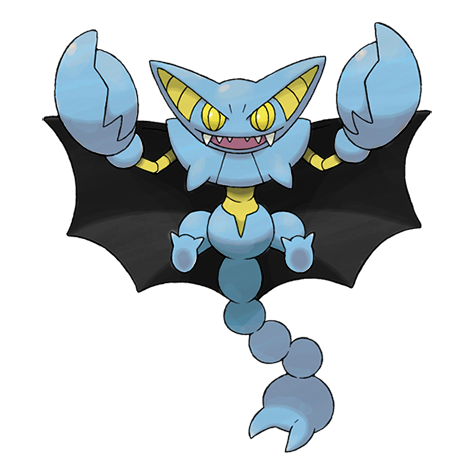
Base sprites


Pokémon Home


Dream World
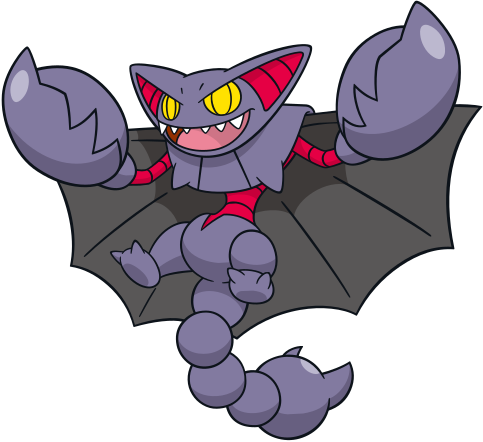
Showdown


Detailed information
General overview of Gliscor
Gliscor is a Pokémon of the Ground and Flying type introduced in the fourth generation. It is known by its Japanese name グライオン. Evolved from Gligar, Gliscor stands out for its dark appearance, its large membranous wings, and its highly strategic combat style, appreciated both in solo adventures and in competitive battles.
General information and evolution
Gliscor evolves from Gligar when it levels up at night while holding a Razor Fang. This specific evolution makes it more technical to capture and obtain than most. Gliscor retains the dual Ground and Flying type, which allows it to completely negate Ground-type attacks and resist several other common types in battle.
In the Pokédex, Gliscor is described as a nocturnal predator that glides silently to capture its prey. Its cunning and opportunistic behavior makes it a very reliable Pokémon for players looking for a good balance between defense and offensive pressure.
Type, resistances, and weaknesses
Gliscor's Ground and Flying type gives it interesting resistances against Fighting, Poison, and Bug attacks, while being completely immune to Ground attacks. On the other hand, it remains vulnerable to Ice attacks, which represent its greatest weakness, as well as to Water attacks.
This type combination strongly influences moveset and nature choices, especially in strategic battles where anticipating the opponent's moves is essential.
Base stats and combat potential
Gliscor has balanced stats, with solid Defense, good Speed, and decent HP. Its base Attack allows it to deal consistent damage without relying solely on special moves. It is often used as a physical wall or a defensive pivot capable of wearing down the opponent over time.
Thanks to its stats and well-exploited ability, Gliscor is very popular in competitive formats. Its longevity in battle makes it an excellent choice for wearing down opposing teams.
Attacks and recommended moveset
Gliscor has a wide range of physical attacks and utility moves. Ground-type attacks like Earthquake remain essential to take advantage of its raw power. Flying-type attacks help cover several opposing types and ensure good offensive pressure.
It can also learn support moves via TM or move tutor, such as Taunt or Protect, reinforcing its strategic role. Depending on the chosen set, Gliscor can be oriented toward a defensive, offensive, or tempo-control role.
In-game use and capture
Capturing Gliscor is generally done through evolving Gligar, which requires specific preparation. In adventure, it fits perfectly into a balanced team, especially for handling Steel, Rock, or Poison types.
In Pokémon GO and raids, Gliscor is appreciated for its resistance and its ability to take several hits while dealing steady damage. However, its use remains conditioned on the opponent having no Ice attacks.
Trading cards and popularity
Gliscor has several interesting Pokémon cards, often highlighted for their dark and dynamic illustration. These cards are sought after by collectors, especially in the Diamond, Pearl, and Platinum series. Its popularity is based as much on its design as on its effectiveness in battle.
Whether to complete a Pokédex entry or strengthen a competitive team, Gliscor remains a reliable, strategic, and durable Pokémon, appreciated by experienced players and collectors alike.