



N°0004 · Generation 1
Charmander
From birth, a small flame burns at the tip of its tail. If this flame were to go out, this Pokémon's life would end as well.
Share this Pokémon
Characteristics
- Height:
- 0.60
- Weight:
- 8.50
Base stats
Total: 309Combat strengths and weaknesses
Damage multiplier taken by Charmander depending on the attacking move's type. ×2 and ×4 are the attacks to avoid.



The complete Pokédex, in your pocket
Detailed pages, types, stats and your favourite Pokémon - on the app.
Evolutions



Additional information
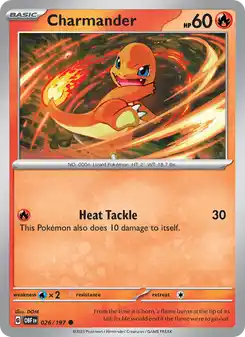
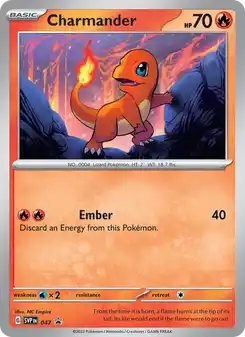
Pokémon Cards (35)
Showing the latest 12











Official artwork


Base sprites


Pokémon Home


Dream World

Showdown


Detailed information
Characteristics of Charmander
Charmander, known as Salamèche in French and ヒトカゲ (Hitokage) in Japanese, is one of the most iconic Pokémon of the first generation. It belongs to the Fire type and is one of the starter Pokémon in the Red and Blue versions. Its small size, flaming tail and lively nature have made it a beloved companion for players for decades.
The flame at the tip of its tail is one of its best-known features: according to the Pokédex, it reflects its health and emotions. A bright flame means it is in great shape, while a weak flame can signal a critical condition. Its description and design were conceived to represent a young, growing reptile that is curious, fast and slightly wary.
Physical description and temperament
Charmander is a small bipedal Pokémon with orange skin, large expressive eyes and a tail ending in a glowing flame. It is light, agile and moves quickly when on alert. Its temperament swings between caution and determination: it does not hesitate to fight when its safety, or that of its trainer, is at stake.
It is generally sociable, but it can become nervous in the presence of a more imposing enemy. The flame on its tail grows stronger when it is motivated or in the heat of action. In many versions of the games, Charmander is portrayed as an intelligent Pokémon, capable of analyzing a situation before attacking.
Special abilities of Charmander
Charmander's natural abilities are tied to its Fire type. It quickly learns moves such as Scratch or Growl at the start of its adventure, then more powerful attacks like Ember, Flamethrower or Dragon Claw as it levels up.
Here are some of its best-known moves and abilities:
- Scratch – a basic physical move, fast and reliable
- Ember – the first Fire move available in most games
- Flamethrower – an iconic Fire-type move, powerful and accurate
- Dragon Claw – a Dragon-type move, useful against several opposing types
- Growl – lowers the opponent's attack
- Burn Up (in certain versions)
Its base stats feature a solid special attack, decent speed and relatively low HP. Its weaknesses include the Water, Rock and Ground types, against which it must absolutely be protected.
Evolution of Charmander
Like many iconic Pokémon, Charmander follows a three-stage evolution whose power curve is gradual but very pronounced.
The evolution stages: Charmeleon and Charizard
Charmander evolves into Charmeleon at level 16. At this stage, it gains strength, size, aggressiveness and attack power. Its body becomes more robust and more sharply defined, and its flame burns more intensely.
Charmeleon then evolves into Charizard at level 36. This third form is one of the most popular in the entire Pokémon franchise. Charizard is Fire/Flying type and is often regarded as one of the most memorable Pokémon in the series, with numerous appearances in the anime, modern games and special cards such as Charizard ex.
How to evolve Charmander in the games
The evolution of Charmander is simply achieved by reaching the required levels in most games. However, certain versions like FireRed, LeafGreen, Sapphire, Ruby, Ultra Sun or Scarlet/Violet may offer different encounters or leveling methods depending on the area.
In Pokémon Go, Charmander can evolve using a certain number of candies, and its evolved forms also exist in shiny variants (low spawn rate).
Charmander's role in the Pokémon games
In the main games, Charmander is often the favorite starter Pokémon for players who love the Fire type. It shines especially in early and mid-game battles, then becomes an essential force once it has turned into Charizard.
Strategies and tips for using Charmander
Here are a few tips to get the most out of Charmander:
- Use its Fire-type moves against Grass, Bug and Ice Pokémon
- Avoid Water, Ground and Rock Pokémon, against which Charmander is very weak
- Optimize its EVs in Sp. Atk and Speed to increase its damage
- Take advantage of sunny areas (sun) to boost its Fire moves
- Give it a key spot on the team to benefit from its DPS and offensive coverage
Thanks to its decent speed and early moves, Charmander can win several battles on its own, especially in the first gyms. Good training makes it easy to reach a sufficient level to access Charmeleon without difficulty.
Charmander across the various game versions and editions
Charmander appears in a great many Pokémon versions, notably Red, Blue, FireRed, LeafGreen, Gold/Silver, Ruby/Sapphire, Black/White, Sword/Shield, Scarlet/Violet, as well as in several special series such as Hidden Fates and Burning Shadows through the Pokémon cards.
Fans can also find exclusive cards such as the Charmander Pokémon card in many collection sets, often at a highly variable price depending on stock or rarity. Some ultra-premium editions highlight alternative forms, sometimes in ex or shiny versions for collectors.
In recent games like Scarlet and Violet, Charmander is sometimes available through special events, limited encounters or transfers via Pokémon Home.
