



N°0024 · Generation 1
Arbok
Studies have revealed that the frightening patterns on its body can form six different designs.
Share this Pokémon
Characteristics
- Height:
- 3.50
- Weight:
- 65.00
Base stats
Total: 448Combat strengths and weaknesses
Damage multiplier taken by Arbok depending on the attacking move's type. ×2 and ×4 are the attacks to avoid.


Resistances - weak attacks


The complete Pokédex, in your pocket
Detailed pages, types, stats and your favourite Pokémon - on the app.
Evolutions


Additional information
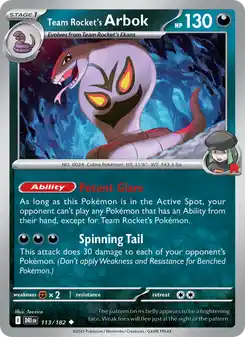
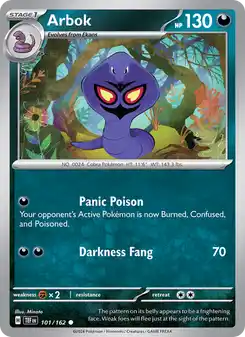
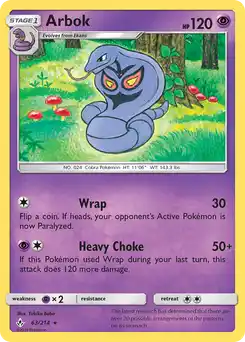
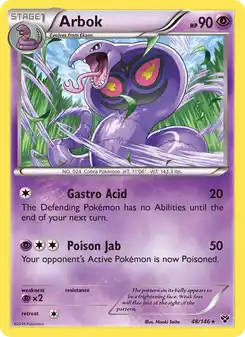
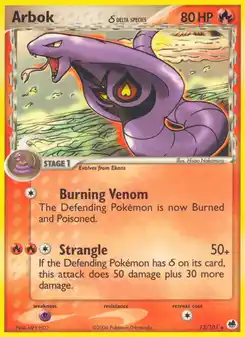
Pokémon Cards (18)
Showing the latest 12






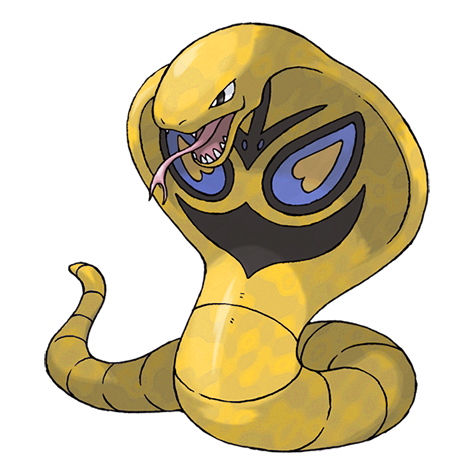
Official artwork
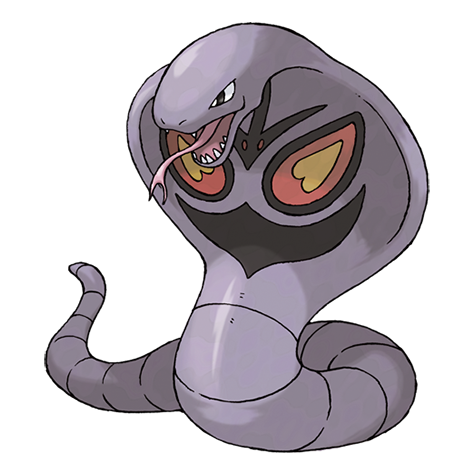
Base sprites


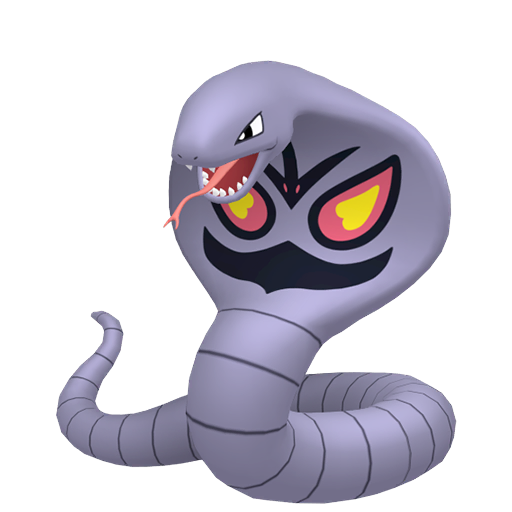
Pokémon Home

Dream World
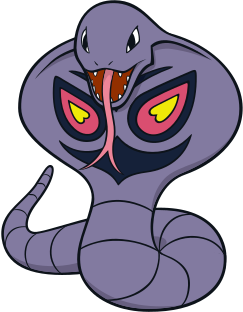
Showdown


Detailed information
Introducing Arbok
Arbok is an iconic Poison-type Pokémon from the first generation, known for its long, sinuous purple cobra body and the terrifying patterns printed on its belly. The direct evolution of Ekans, this Pokémon left a lasting mark on many players through its central role within Team Rocket in the anime, as well as its regular presence in the main games. In the Pokédex, Arbok is often described as a discreet and relentless predator that paralyzes its enemies with fear before even touching them, thanks to its gaze and its hypnotic patterns.
Arbok is an excellent example of a Pokémon specialized in the Poison type and field control: it uses its venom, its fangs, acid attacks, and its ability to coil around its target to suffocate or neutralize it. Its powerful body allows it to crush metal objects or squeeze opponents, while its venom can be concentrated enough to pose a real threat.
Whether you are discovering Arbok for the first time or looking to deepen your knowledge to optimize your team, this complete overview will guide you through its description, its strengths, its weaknesses, and its possible uses in battle. Arbok may not be the most powerful Pokémon at the highest level, but it remains a pillar for understanding the Poison type, the impact of venom in battle, and how an intimidating yet strategic Pokémon can fit into a balanced team.
Description and Origins of Arbok
General Description
Visually, Arbok is inspired by a cobra, with a long, muscular, smooth body, generally purple or dark purple depending on the game and illustrations. Its head is wide and triangular, with piercing eyes and an intense gaze that seems to track its target without letting go. The most striking characteristic of this Pokémon is the large colorful pattern that adorns its chest. This design, which sometimes varies slightly in shape between versions, is described in the Pokédex as a threatening face designed to frighten opponents.
These patterns play an important role in Arbok's description: certain Pokédex entries mention that the different designs may have various meanings or effects, ranging from simple intimidation to paralysis through fear. Arbok's body is segmented and extremely flexible, allowing it to coil around its prey and squeeze until it can no longer move. Its tail often ends in a pointed shape, adding an extra dimension to its dangerous appearance.
Arbok is therefore a Pokémon whose form perfectly translates its function: every part of its body seems designed for predation, constriction, or venom injection. Whether it is its fangs, its muscles, or its ventral patterns, everything in its description inspires dread, making it one of the most iconic Poison Pokémon in the series.
Etymology and Foreign Names
The English name Arbok is famous for being "cobra" spelled almost backwards, continuing the Ekans/snake tradition. This play on letters is an obvious nod to the snake theme and reinforces the Pokémon's identity among fans. In Japanese, Arbok carries a name that, when romanized, emphasizes a threatening sonority.
In all translations, Arbok maintains strong consistency around the idea of a venomous cobra. The English and Japanese versions highlight the reptilian and dangerous side, while retaining the short, impactful sound that suits a recurring villain in Team Rocket's rosters. In some guides and articles, one sometimes reads "Arbok Arbok" to insist on the Pokémon's identity or to distinguish it from its pre-evolution Ekans in an evolution form table.
This continuity of names across all languages contributes to the Pokémon's notoriety. Arbok is one of those Pokémon whose name is immediately associated with a specific silhouette, an obvious type, and an image of menace, whether in a video game battle, on an Arbok Pokémon card in a dedicated set, or in an anime appearance.
General Characteristics in the Pokédex
Number, Size, and Weight
In the National Pokédex, Arbok holds a relatively low position, making it an easily identifiable first-generation Poison-type Pokémon. It represents the evolved form of Ekans and appears quickly in the list of Pokémon the player can encounter or face. Its size is significant: Arbok is described as a snake that far exceeds the average human height when it rears up to its full height.
Its weight in kg, although varying between entries, is consistent with a large, muscular snake. This weight contributes to its physical strength: it can crush objects, break environmental elements, or immobilize opponents by coiling around them. The size/weight combination thus underlines the fact that Arbok is not merely a simple Poison-type Pokémon, but also a close-combat fighter capable of using its body as a weapon.
This basic information, visible on any Pokédex entry or in a stats summary table, helps players better situate Arbok's place in the Pokémon world. It is neither a small, discreet snake nor a gigantic creature comparable to certain legendaries, but a medium-sized predator that is very dangerous for any Pokémon of comparable level.
Pokédex Description and Natural Environment
Arbok's Pokédex entries emphasize its danger and its ability to terrify its enemies. Players learn that it can suffocate its prey with its body, that its ventral patterns are unique or vary by region, and that its venom can be powerful enough to paralyze or seriously weaken opponents. Some versions mention that Arbok can break barrels or stones simply by squeezing around them, further emphasizing its physical power.
In its natural environment, Arbok is often associated with grassy areas, dark forests, swamps, or remote routes far from large cities. It likes to hide in tall grass, under loose soil, or near rocks, ready to spring out to surprise an enemy or prey. Its purple or dark skin sometimes blends into shadow, reinforcing its image as an ambushing Pokémon, difficult to spot before it is too late.
Type, Strengths, and Weaknesses
Poison Type and Interactions with Other Types
Arbok is a pure Poison-type Pokémon. This type grants it several important resistances and weaknesses to know in order to use it well in battle. As a Poison Pokémon, it resists Grass, Fighting, Bug, and — in more recent generations — Fairy-type attacks. These resistances allow it to come in against a number of Pokémon and limit the damage received, particularly when facing early-game Pokémon centered on these types.
However, Arbok is vulnerable to Ground and Psychic-type attacks, which can be problematic in games where these types are very common. Ground-type moves like Earthquake or Dig can inflict massive damage, potentially taking Arbok out of battle in a single turn if its HP are not at their max. Similarly, Psychic-type attacks exploit its weakness and can quickly put it in difficulty if the trainer does not anticipate these threats.
Arbok's Poison-type attacks are super effective against Grass and Fairy-type Pokémon, making it a very good counter for these categories. Players who take the time to understand these interactions can easily incorporate Arbok into a strategy aimed at neutralizing certain recurring threats on routes or in Gyms centered on these types.
Strategic Strengths of the Poison Type
The Poison type is not defined solely by raw damage: it is also linked to the poisoned status, which drains the enemy's HP each turn. Arbok fully benefits from this mechanic by combining its Poison attacks with its ability to hold the field for several turns. Once the opponent is poisoned, Arbok can choose to continue the confrontation by harassing the enemy or retreat to let another Pokémon finish the job.
Poison-type attacks like Acid, Sludge Bomb, or other similar moves deal decent damage while having a chance to poison the target. Combined with support moves or moves that reduce the opponent's Defense or Special Attack, these abilities make Arbok a controller and disruptor rather than a pure attacker. This distinguishes it from other Pokémon that rely exclusively on raw power.
In summary, Arbok's strategic form rests on a mix of venom, constant pressure, and psychological threats symbolized by its ventral patterns. Well used, it can force the opponent to waste potions or frequently switch Pokémon, providing a considerable tactical advantage over the course of a battle.
Base Stats, EVs, and Nature
Base Stat Profile
Arbok's base stats reflect its role as a solid and threatening Poison Pokémon without reaching the heights of rarer creatures. Its Attack stat is decent to good, allowing it to effectively exploit its physical moves such as Bite, Poison Fang, or Poison Sting. Its Defense and Special Defense are average, but sufficient to take a few hits if the matchup is not too unfavorable.
Its HP falls in an intermediate range: Arbok can withstand several attacks, but it is not a pure tank. Its Speed is moderate, often sufficient to outrun certain Grass or Bug-type Pokémon, but insufficient to compete with the fastest Pokémon at higher levels. Overall, its base stat profile makes it a versatile Pokémon oriented toward control and attrition rather than systematic one-shots.
When compared to other Poison Pokémon in a values table, Arbok sits in a middle range, but its combination of moves, its field presence, and its ability to intimidate make it more threatening than a simple stat reading might suggest.
EV Distribution and Optimization
In terms of EVs, Arbok generally yields points in Attack or Defense, depending on the game, when it is knocked out. For trainers looking to optimize their teams, fighting Arbok can be a way to adjust the EV distribution on their own Pokémon. As for training Arbok itself, several options are available depending on the desired role.
A classic approach consists of investing EVs in Attack and HP to make it a Pokémon capable of taking a few hits while hitting hard enough for its venom and physical attacks to be genuinely threatening. Another option is to distribute some EVs in Defense or Special Defense to make it more resistant to certain specific types. Everything depends on the game context and team style.
Recommended Natures
The nature of Arbok directly influences its statistics and determines in part its role on the battlefield. Natures that increase Attack at the expense of Special Attack, or that boost Special Defense at the expense of a less useful stat, are often preferred. For example, a nature that increases Attack while decreasing Special Attack improves its physical moves without penalizing its core gameplay.
For players who want a more resilient Arbok, a nature increasing HP or Special Defense can be interesting, even if that comes at the cost of some offensive power. The important thing is to adapt the nature to the desired role: Arbok can be a resilient poisoner that holds the field for several turns, or a more aggressive Poison attacker that seeks to deal quick damage before giving way.
Moves, TMs, HMs, and Move Tutors
Moves Learned by Level-Up
Through level-up, Arbok learns a variety of moves centered on the Poison type, but also a few moves from other types. Among its iconic attacks are moves like Poison Sting, Acid, Poison Fang, Bite, and moves that reduce opponent stats. These attacks reflect its nature as a toxic snake that harasses its target while wearing it down.
As it progresses to higher levels, Arbok can acquire more powerful moves, sometimes with a higher poisoning rate or interesting secondary effects. Raising Arbok to level 50 and beyond unlocks a broad enough range of attacks to handle most standard in-game battle situations.
In some games, managing the PP of its Poison attacks can become a strategic factor: repeated poisoning and constant pressure on the opposing team can drain their resources if the trainer does not properly manage the pace of battles.
TMs, HMs, and Move Tutors
In addition to naturally learned moves, Arbok can access various moves via TMs, HMs, or move tutors depending on the generation. These additional moves allow it to fill certain gaps — for example, giving it a Ground, Dark, or Normal-type attack to surprise Pokémon that resist Poison too well. TMs can include support moves, power-boosting techniques, or defensive options.
In some games, move tutors offer specific moves that Arbok cannot learn otherwise. These moves are sometimes rare and valuable, giving motivated players the opportunity to build a truly original set for their Arbok. The choice of a balanced move card between Poison attacks, coverage attacks, and support moves is crucial to getting the most out of this Pokémon.
Evolution from Ekans and Role in Progression
From Ekans to Arbok
Arbok is the direct evolution of Ekans, which generally occurs at a relatively low level in most first-generation games and their remakes. This evolution marks a significant leap in terms of stats, power, and visual presence. The small, discreet snake transforms into an imposing cobra with intimidating ventral patterns and a longer, more muscular body.
From a gameplay standpoint, this evolution transforms an early-game Pokémon into a more solid companion for the mid-game. Players who invest time in leveling up Ekans can quickly benefit from an Arbok capable of holding its own against tougher opponents, particularly in areas where Grass, Bug, and Fairy-type Pokémon are common.
Why Evolve Ekans Rather Than Keep It
For the vast majority of players, evolving Ekans into Arbok is a natural choice. The gains in Attack, Defense, HP, and versatility more than justify the transition. Keeping an unevolved Ekans generally only makes sense in specific challenges, such as runs where one voluntarily limits themselves to basic forms or tests original team compositions.
Arbok also benefits from better access to certain moves and stat values that make it more viable in the long run. As a result, it fits more easily into a team aimed at progressing to the final Elite Four, rather than being confined to the role of a simple route Pokémon.
Arbok Across Game Generations
Arbok in Red, Blue, Yellow, and FireRed
In the first Red, Blue, and Yellow versions, Arbok appears as a recurring enemy, particularly in Team Rocket rosters. Players especially remember Jessie's Arbok from the anime, but also the grunts who use this Pokémon to block the hero's path in various areas. In FireRed and LeafGreen, Arbok retains this role as an important opponent in certain key passages, while also being available for capture on certain routes.
For trainers, catching an Ekans and evolving it into Arbok in these games provides a Poison-type Pokémon faithful to the first-generation atmosphere. It can participate in mid-game battles, counter Grass or Fairy-type Pokémon in more recent remakes, and embody the spirit of a Team Rocket-inspired team.
Arbok in Ruby, Sapphire, White, and Other Versions
In Ruby, Sapphire, and Emerald, as well as their remakes, Arbok can be obtained via transfers or in certain specific areas depending on the version. It is not always as central as it is in Kanto, but it remains an important representative of the Poison type. In Pokémon White, Black, and their sequels, it can also be made available via transfer or event methods, allowing fans of this Pokémon to keep it across multiple game generations.
Over the generations, Arbok has often been included in the list of catchable Pokémon in various regions, even if its star role has faded somewhat with the appearance of newer Poison-type species. Nevertheless, its purple cobra silhouette and intimidating patterns remain immediately recognizable.
Arbok in Pokémon GO, Raids, and CP
Arbok as an Evolved Pokémon
In Pokémon GO, Arbok is the evolution of Ekans and fills a similar role to the one it has in the main games: a solid Poison Pokémon but not necessarily at the top of the competitive rankings. Its CP level depends on its level, its IVs, and the quality of its training. Players can use it in certain lower-level raids or in Gym battles, especially when they do not yet have rarer, more powerful Pokémon.
The attacks available to Arbok in Pokémon GO reflect its main types and abilities: it has Poison-type attacks and sometimes coverage moves from other types. Managing its moves, their importance against raid bosses or Gym opponents is essential to making the most of it.
For some trainers, Arbok is primarily a Pokémon of the heart, chosen for its design, its history, and its references to Team Rocket, rather than for its raw abilities in the most competitive formats.
Capture, Rate, and Use
Catching Ekans and then evolving it into Arbok in Pokémon GO requires accumulating a certain amount of Candy and XP, but this remains relatively accessible for an active player. The catch rate of Ekans in certain areas makes it possible to gather enough Candy without too much difficulty if one is in an environment where this Pokémon appears frequently.
Once Arbok is obtained, it can be used as an intermediate Poison Pokémon to fill out a team or to participate in certain specific events, particularly those that feature Poison-type Pokémon or classic Kanto Pokémon.
Arbok, Team Rocket, and Its Image in the Franchise
Arbok as a Symbol of Team Rocket
One of the main reasons for Arbok's popularity comes from its role in the Pokémon anime, where it is Jessie's faithful companion for many seasons. This Arbok appears on numerous occasions, attacking the heroes, rearing up with its chest adorned with frightening patterns, and participating in Team Rocket's more or less credible schemes. This repeated presence has firmly anchored its image as a villainous yet endearing Pokémon in fan popular culture.
Seeing Arbok alongside other Pokémon like Koffing, Weezing, or Meowth in iconic episodes helped create a strong connection between this Pokémon and the idea of a criminal team or a crew of bumbling villains. Even in the games, encountering Arbok in Rocket headquarters immediately recalls the anime and the overblown ambitions of that organization.
Arbok in the Pokémon TCG and Merchandise
Arbok has also been featured on several Pokémon cards across various sets. An Arbok Pokémon card is often illustrated with an image of the cobra rearing up, fully revealing its ventral patterns and threatening gaze. The attacks depicted on these cards highlight venom, acid, constriction, and sometimes special abilities related to fear or the reduction of opponent stats.
These cards complement Arbok's image as a classic but iconic Poison Pokémon, and allow fans to incorporate it into themed decks centered on Team Rocket, the Poison type, or Kanto Pokémon. Beyond cards, Arbok also appears in figures, plush toys, and various merchandise, consolidating its status as a recognizable Pokémon with an immediately identifiable design.
Strategic Tips for Using Arbok
Arbok in the Solo Campaign
In the solo campaign, Arbok is particularly useful in the mid-game, when opponents start using more varied Pokémon but the player's options are still somewhat limited. Its Poison type allows it to effectively counter Grass Pokémon, certain Bug Pokémon, and Fairy Pokémon in more recent versions. Its venom and acid attacks can quickly reduce opponent HP, especially when they trigger poisoning.
To make the most of Arbok in a campaign, it is advisable to give it a balanced set including at least one heavy Poison attack, a coverage move of another type, and possibly a support or stat-reduction move. Used at the right moment, it can neutralize threats that would otherwise have caused serious problems for your team, while remaining resilient enough to take a few hits.
Arbok in Advanced Strategy
In more competitive formats, Arbok does not always appear at the top of the standings, partly due to limited base stats compared to Pokémon introduced in later generations. However, in restricted formats or themed leagues, it can still find its place. Its access to certain moves via TMs, move tutors, and breeding, combined with its ability to intimidate and poison, opens up some interesting niches.
Players who love to experiment can build a set tailored to low or mid-level battles, or to internal competitions where only Kanto or first-generation Pokémon are allowed. In these environments, Arbok can be surprising, benefiting from its decent power, well-distributed EVs, and an optimized nature to hold its own against opponents in the same category.
More than just a route Pokémon, Arbok becomes a style choice, a nod to Team Rocket and the history of the franchise, while offering real tactical possibilities when played thoughtfully.
Summary
Arbok is a first-generation Poison-type Pokémon, the evolution of Ekans, whose purple cobra silhouette, intimidating ventral patterns, and piercing gaze have made it one of the most iconic Pokémon in Kanto. Its place in the Pokédex, its base stats, its size, its weight, and the detailed description of its venom and strength make it an ideal representative of the Poison type for players discovering or rediscovering the first games.
This page has presented a complete overview of the key information on Arbok: type, strengths and weaknesses, base stats, EVs, best nature, level-up moves, TMs and move tutors, solo campaign role, Pokémon GO presence, appearances across different generations, and its image within Team Rocket. From simply catching an Ekans on a remote route to using an optimized Arbok at level 50, each step of this Pokémon's journey illustrates the progression from a discreet snake to a formidable cobra.
Whether you are looking for a reliable Poison Pokémon for your campaign teams, a Team Rocket symbol to integrate into a themed squad, or an Arbok Pokémon card to add to your collection, this Pokémon remains a personality-packed choice. Well trained, with good stat management and a solid move set, Arbok can still today surprise opponents who underestimate it and remind them that even the "classic" Pokémon of the first generation still have a great deal to offer in the Pokémon world.
