



N°0037 · Generation 1
Vulpix
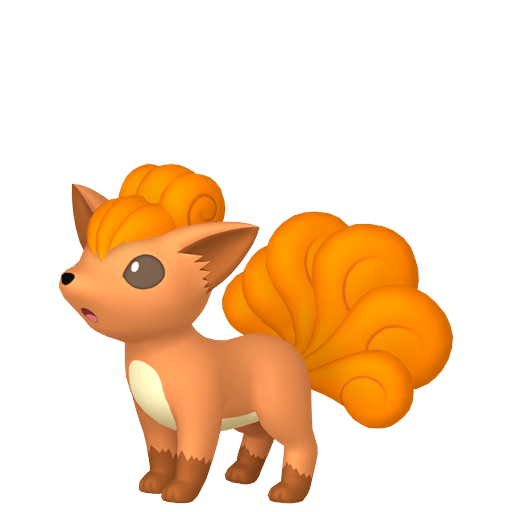
As it ages, the fur of its six tails grows increasingly beautiful and silky. It is warm to the touch.
Share this Pokémon
Characteristics
- Height:
- 0.60
- Weight:
- 9.90
Base stats
Total: 299Combat strengths and weaknesses
Damage multiplier taken by Vulpix depending on the attacking move's type. ×2 and ×4 are the attacks to avoid.


Your Pokédex, in cards
Every card of every Pokémon, what you already have and what you're missing.
Evolutions


Forms
Forms available in your language are clickable. The others show their stats below.
Additional information
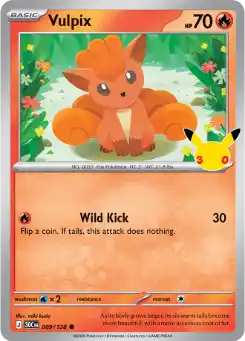
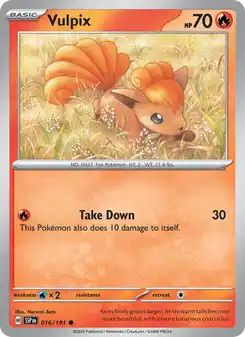
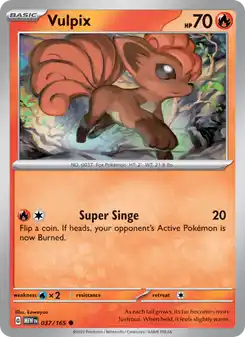
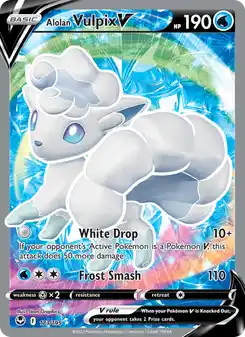
Pokémon Cards (41)
Showing the latest 12








Official artwork
Base sprites


Pokémon Home

Dream World

Showdown


Detailed information
Overview of Vulpix
Vulpix is an iconic Fire-type Pokémon from the first generation, well known for its elegant silhouette, blazing fur, and multiple curled tails. Appearing for the first time in Red and Blue, Vulpix quickly established itself as one of the most appreciated Pokémon among players thanks to its unique design and its future evolution: Ninetales. Vulpix's grace, gentle gaze, and personality — both mischievous and calm — contributed to making it an essential character in the Pokémon universe, across all generations.
In the Pokédex, Vulpix is often described as a Pokémon with an inner fire of great purity, capable of burning intensely without ever losing control. Its six initial tails can multiply as it grows, reflecting its development, elegance, and the evolution of its form. Its majestic appearance has inspired countless illustrations, cards, figurines, and merchandise over the years. Several Pokédex entries emphasize the idea that Vulpix can manipulate flames as if they were living beings, allowing it to create illusions, warm its allies, or frighten its enemies.
Vulpix is a Pokémon that can appear in volcanic environments, warm plains, rocky mountains, or even dry forests depending on the region. Its alternative version, Vulpix of Alola, completely transforms this Pokémon into an Ice-type form, but this page focuses on Fire-type Vulpix while touching on its appearances across different games. Thanks to its many depictions, its iconic moves like Ember and Flame Charge, and its connection to the moon or snow in its Alolan form, Vulpix is today one of the most versatile Pokémon in terms of design and lore.
Description and Origins of Vulpix
General Appearance and Morphology
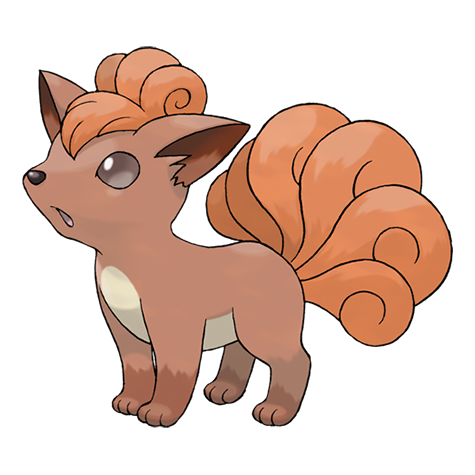
Vulpix is a small, lightweight Pokémon, rarely exceeding a few kilograms. Its modest size makes it an agile Pokémon, capable of slipping into small crevices, running quickly, and leaping with elegance. Its rust-colored, almost red fur represents its association with the Fire type. The most remarkable part of its body remains its six tails, curled like tongues of flame. When a Vulpix grows, or in certain versions, its tails split or lengthen, symbolizing the importance of maturity in this Pokémon's biology.
Its fine snout, gentle eyes, and posture — always ready to flee or defend itself — show a cautious yet confident Pokémon. In several illustrations, Vulpix is shown in warm environments, sometimes surrounded by embers or burning rocks. The Pokédex mentions that the heat it gives off can warm a lost Trainer in the mountains or serve to drive away predators. This association with pure fire makes it a Pokémon respected and admired by the inhabitants of certain regions.
Etymology and Name Meanings
The English name "Vulpix" comes from the Latin "vulpes" meaning fox. In Japanese, its name ロコン (Rokon) refers to a spirit or creature with six tails in Asian legends.
These links to myths and legends are numerous. In several cultures, multi-tailed foxes are considered magical creatures capable of manipulating fire or ice. This symbolism is directly reflected in Vulpix and in its Alolan form, a perfect adaptation of the same concept to two different climates. Whether a Fire-type or Ice-type Pokémon, Vulpix always retains its elegance, finesse, and mythological heritage.
Habitat, Behavior, and In-Game Appearances
Natural Habitat and Wild Behavior
Vulpix can be found in volcanic areas, sun-scorched plains, dry environments, or tall grass near mountains. It dislikes overly humid areas, which justifies its rarity in swampy regions. Its Alolan form, on the other hand, prefers snow, but this guide remains focused on the Fire version.
In its natural state, Vulpix lives in packs, each individual learning from its elders how to control its flames. Its character is generally gentle, but it can become fierce when it must protect its eggs, challenge a rival, or defend its territory. The management of its flames makes it a mature Pokémon despite its small size, and some Pokédex entries indicate that the older a Vulpix gets, the more its tails multiply or become elegant.
Appearances Across Main Generations
In Kanto, Vulpix appears mainly in Red, LeafGreen, and Yellow, often in secondary areas or on routes where the player must be patient to capture this rare Pokémon. Its appearances are sometimes limited to certain versions (for example, exclusive to Red in the early generations).
In Ruby and Sapphire, Vulpix reappears in specific volcanic areas, often near Route 112 or Mt. Chimney. In Black, White, and their sequels, it appears more in controlled environments or via transfers. In Sun and Moon, Vulpix exists in two forms: the Fire version, rare, and the Alolan form, much more prevalent and greatly appreciated by collectors.
Type, Strengths, and Weaknesses of Vulpix
Analysis of the Fire Type
Vulpix is a pure Fire-type Pokémon, which gives it a number of advantages. It is effective against Grass, Bug, Steel, and Ice types, making it an excellent choice in the early or mid-game. Fire-type attacks such as Ember, Flamethrower, and Flame Charge are among its most common natural moves. This type allows it to burn its enemies, thereby reducing their physical Attack and weakening their direct strikes.
On the other hand, Vulpix is vulnerable to Water, Rock, and Ground types, which can be a problem in certain game areas. Water-type damage can be formidable, especially if the opponent is faster or benefits from a power-boosted attack. Rock-type attacks inflict heavy damage and must be anticipated.
Interactions Across Generations
In the early generations, Vulpix had decent but limited offensive coverage. Modern games give it access to more moves such as Will-O-Wisp, Flame Charge, Overheat, Dazzling Gleam (depending on the platform), and certain support moves via TMs. This allows it to become far more strategic in recent versions.
Against Ice or Grass-type Pokémon, Vulpix remains an excellent counter. Against Water and Rock types, it absolutely must be protected or switched out quickly to avoid an immediate KO.
Stats, EVs, and Strategic Potential
Base Stats
Vulpix's stats are balanced around Speed and Special Attack. It does not have a very high HP count, making it fragile against physical attacks or direct hits. Its Defense is low, which requires a playstyle based on evasion, Speed, or support. On the other hand, its ability to burn opponents allows it to reduce the striking power of its enemies, which partially compensates for its natural weaknesses.
Its Special Attack is its main resource, as it allows it to effectively use powerful Fire moves such as Flamethrower or Fire Blast. In certain game versions, Vulpix can learn complementary moves like Mystical Fire or certain coverage moves via TMs, which further increases its versatility.
EV Allocation and Possible Roles
To optimize Vulpix, it is often recommended to invest EVs in Speed and Special Attack, to make it an offensive Pokémon capable of attacking first. In certain Sun-based teams, Vulpix (or Alolan Vulpix in other contexts) is sometimes used as a weather setter, allowing certain abilities or chain moves to be activated.
It is nevertheless a fragile Pokémon: its low weight and lack of physical resilience require good anticipation from the Trainer. It can play an interesting secondary role before becoming Ninetales, where its potential increases dramatically.
Vulpix's Moves and Abilities
Moves Learned by Level-Up
Vulpix naturally learns several Fire-type moves, including:
– Ember – Fire Fang – Flame Charge – Will-O-Wisp – Fire Spin – Swift (depending on versions) – Quick Attack (certain games)
These moves allow stable early-game progression. Flame Charge, for example, increases its Speed, making it easier to face faster opponents.
Moves via TMs and Breeding
In terms of breeding, Vulpix can obtain rare moves such as Dazzling Gleam, Sacred Fire (special cases), Confuse Ray, and more. The TMs available depending on the game give it access to support or coverage moves, such as Protect, Will-O-Wisp, or Toxic.
Strategically, one of its most well-known roles involves burning the enemy to reduce its physical damage, or setting up a move like Will-O-Wisp or Thunder Wave before switching out.
Evolutionary Mechanics
From Vulpix to Ninetales
Vulpix evolves into Ninetales via the use of a Fire Stone. This evolution drastically changes its stats: Ninetales becomes much faster, gains a significantly higher Special Attack, and takes on a more majestic appearance. Ninetales has a secondary form, Alolan Ninetales, but this page remains focused on the classic Fire version.
The timing of evolution often depends on the Trainer. Some prefer to wait for Vulpix to learn more moves before evolving it, while others make the transition quickly to benefit from Ninetales's power as soon as possible.
Vulpix in Pokémon GO
CP, Catch Rate, and Raid Role
In Pokémon GO, Vulpix has a relatively low CP, but its evolution Ninetales can reach a respectable max CP. Its catch rate is average, and it appears regularly during themed Fire-type, summer, or Kanto Pokémon events. Players collect Candy to evolve Vulpix and power up Ninetales.
In raids, Vulpix is rarely a boss, but it can be a secondary Pokémon when players are seeking rare creatures. Its Alolan form is also very popular in this game.
Summary
Vulpix is a Fire-type Pokémon from Kanto, appreciated for its charm, its six elegant tails, and its ability to manipulate flames with precision. Fragile but fast, it learns many useful moves such as Ember, Flame Charge, and Will-O-Wisp. Its evolution into Ninetales dramatically increases its power and versatility. Present in every generation and in Pokémon GO, Vulpix remains one of the most beloved Pokémon thanks to its mythological design and versatile strategic role.
