


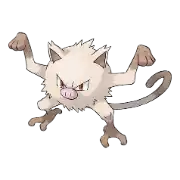
N°0056 · Generation 1
Mankey
Agile and quick, this Pokémon lives in trees. It gets angry easily and attacks anything that moves when it is in a rage.
Share this Pokémon
Characteristics
- Height:
- 0.50
- Weight:
- 28.00
Base stats
Total: 305Combat strengths and weaknesses
Damage multiplier taken by Mankey depending on the attacking move's type. ×2 and ×4 are the attacks to avoid.


The complete Pokédex, in your pocket
Detailed pages, types, stats and your favourite Pokémon - on the app.
Evolutions
Additional information
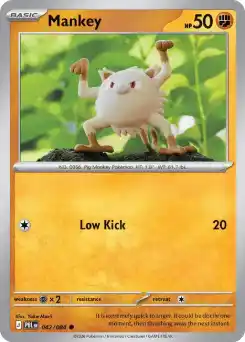
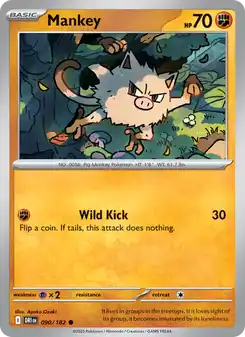
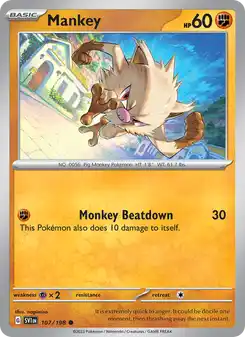
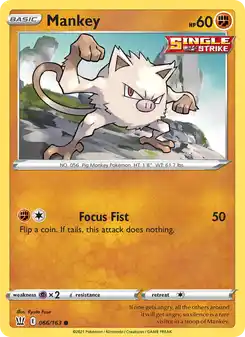
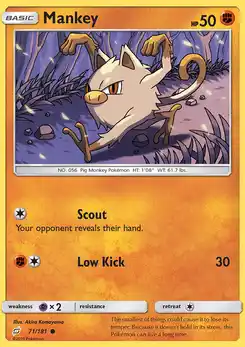
Pokémon Cards (22)
Showing the latest 12








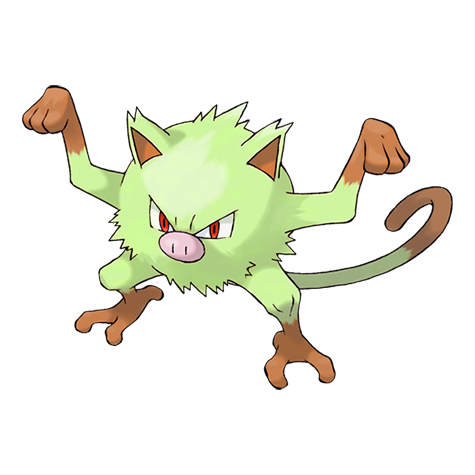
Official artwork
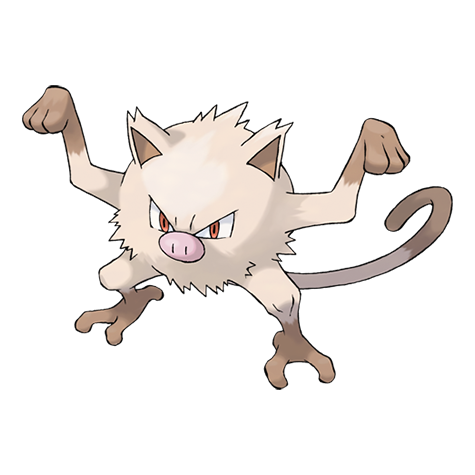
Base sprites


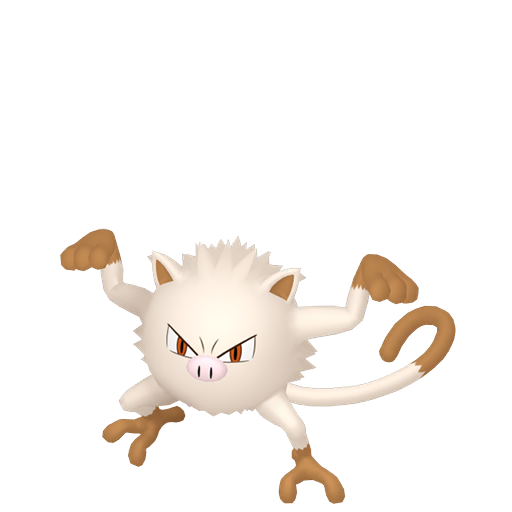
Pokémon Home

Dream World
Showdown


Detailed information
General Overview of Mankey
Mankey is a Fighting-type Pokémon that has been around since the very first generation, in Red and Blue. Known in English as Mankey and in Japanese as マンキー, this hot-tempered little monkey has become a classic on early-game offensive teams. In the Pokédex, Mankey is described as an extremely impulsive Pokémon that flies into a rage at the slightest provocation and strikes everything around it with rapid, repeated punches. Its aggressive nature, combined with a solid Attack stat and decent Speed, makes it an excellent physical attacker for players who enjoy an offensive playstyle.
Visually, Mankey is a small beige monkey with a round body, a short tail, slender but wiry limbs, and a permanently furrowed face. It looks both small and constantly ready to fight, which fits perfectly with its Fighting-type role. In many games, it can be caught fairly early, often in areas where players are still lacking a real solution against Rock or Normal types. Its early availability and powerful moves make it a popular choice among trainers who want to strengthen their team quickly.
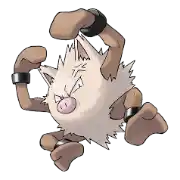
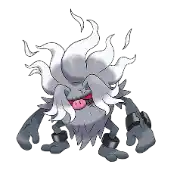
Throughout the generations, Mankey has kept the same core concept – a small, fast, aggressive Fighting-type monkey specialized in physical hits. It evolves into Primeape, an even larger and more dangerous Pokémon, giving the evolutionary line a focus on raw power. In modern versions, particularly with the arrival of new games, Primeape even gains a new evolution, which further increases the interest in catching and training a Mankey for players who want to exploit the entire line.
Type, Role, and Strategic Profile of Mankey
Mankey is a pure Fighting-type Pokémon. This means it benefits from STAB on all its Fighting-type moves and naturally fills the role of physical attacker in a team. Its type gives it significant advantages against Normal, Rock, and even Steel types depending on the game, making it very useful early in the adventure when these types are common among opposing trainers.
Strengths and Weaknesses of the Fighting Type
As a Fighting-type, Mankey is particularly effective offensively. Fighting moves hit super-effectively against Normal, Rock, Ice, Steel, and Dark types in most games, giving Mankey a good number of favorable match-ups once it learns moves like Karate Chop, Low Kick, or Close Combat in more recent generations. This lets it fit easily into an offensive set based on powerful physical hits.
On the other hand, it also inherits the typical weaknesses of Fighting-type Pokémon. Mankey is vulnerable to Flying, Psychic, and Fairy-type attacks. In certain versions, it can also struggle against Ghost Pokémon if it lacks sufficient coverage moves, even though Ghost types are immune to Fighting attacks. Players must therefore think about giving it complementary moves or supporting it with partners capable of handling those types.
Team Role and Playstyle
In practice, Mankey is an offensive Pokémon generally played as a lightweight physical attacker. Its Attack stat is solid for a basic Pokémon, and its decent Speed lets it outrun many wild Pokémon or low-level trainers early in the game. It is not built to absorb much damage, but to hit hard and fast, then optionally be switched out for a more resistant ally.
For players, Mankey is particularly useful during progression phases where Normal or Rock Pokémon encountered on the route need to be quickly eliminated. Thanks to its punches and Fighting moves, it can take care of a large portion of random battles. Later, once evolved into Primeape, it retains this attacker role with improved stats and more powerful moves.
Mankey's Stats and Build Orientation
Mankey's stats are typical of an early-game offensive Pokémon. It has a solid Attack stat, decent Speed, but modest defenses and HP. This means players must protect it from heavy hits and avoid leaving it on the field against special attackers or very fast opponents.
Stat Overview
Without going into exact numbers, Mankey's base values can be summarized as follows:
Attack – its best stat, ideal for maximizing physical damage
Speed – decent, lets it outrun many wild Pokémon and low-level ones
HP – average, sufficient to take a few hits but not to tank
Defense – rather low, making it fragile against powerful physical attacks
Special Attack – generally useless on most sets
Special Defense – average or slightly below, watch out for special attacks
This stat distribution shows that Mankey is built to attack first and hard, not to tank. For players, the primary goal is to exploit its punches and Fighting-type techniques before the opponent can retaliate.
Recommended Natures and EVs
For players interested in optimization via EVs and natures, Mankey particularly benefits from natures that boost Attack or Speed. Among the most suitable natures:
Adamant – boosts Attack while reducing Special Attack
Jolly – boosts Speed while reducing Special Attack
Since Mankey's Special Attack is rarely used in most sets, reducing it is not a problem. An Adamant nature turns Mankey into a damage machine, while a Jolly nature lets it outspeed more targets and strike first more often.
For the EV distribution, a classic set would be:
252 EVs Attack
252 EVs Speed
4 EVs HP
This distribution maximizes Mankey's offensive potential, which is perfectly consistent with its role. Even if, in practice, players often use it for story mode without worrying too much about EVs, this model is a solid foundation for those who want to play it seriously or who are preparing a well-optimized Primeape.
Key Moves and Important Abilities
A large part of Mankey's appeal for players lies in its access to many Fighting-type moves as well as useful coverage attacks. Its punches, its rage-based moves, and certain more technical moves make it a flexible Pokémon offensively.
Main Fighting Moves
Fighting-type moves are the core of Mankey's set. Depending on the generation and available TMs, it can learn:
Karate Chop – an early-game move with an increased critical hit rate, very useful in Red and other classic versions
Low Kick – deals damage proportional to the target's weight, effective against heavy Pokémon
Close Combat – in more recent generations, enormous power but lowers defenses
High Jump Kick or Superpower – depending on the game, for even more raw power
These Fighting moves allow Mankey to overcome many opponents, particularly Normal and Rock types that starters or early Flying-type Pokémon can sometimes struggle with.
Rage- and Power-Based Moves
In several games, Mankey has access to moves that reflect its hot-tempered personality. For example:
Outrage – a move that hits for several turns but locks the user in
Fury Swipes (or variants of multi-hit moves depending on the generation)
Thrash – a very powerful attack, but with confusion drawbacks in some games
These moves can deal enormous damage in a short time, but they require careful management from the player, as they sometimes force you to stay on the field longer than desired. Using these hits on a well-positioned Mankey, for example when the enemy is weakened or cannot respond effectively, can decide a battle.
Coverage Moves and TMs
In addition to its Fighting moves, Mankey can learn various TM moves, giving it coverage options against types that are normally problematic. Among the common moves depending on the generation:
Stone Edge – for hitting Flying or Bug Pokémon
Earthquake – an enormous Ground move, very useful against Electric, Fire, Rock, and Steel types
Knock Off – in more recent generations, lets it remove the opponent's item
Cross Chop or Fire Punch / Ice Punch / Thunder Punch in certain versions via breeding or move tutors
These TMs and moves greatly expand Mankey's possible set, allowing players to adapt it to their team and playstyle. A well-planned set lets you exploit its Attack stat without leaving too many type gaps.
Evolution into Primeape and the Rest of the Line
Mankey evolves into Primeape, a larger, more powerful, and even more aggressive Fighting-type Pokémon. The evolution occurs by leveling up. This evolution is crucial for players, as Primeape gains considerably higher stats, making it far better suited for mid- and late-game battles.
Transition from Mankey to Primeape
Once it reaches the required level, Mankey evolves into Primeape. This transition noticeably improves its HP, Attack, and sometimes Speed, reinforcing its role as a physical attacker. The Pokédex presents Primeape as an even more hot-tempered Pokémon than Mankey, which justifies its even more brutal combat style.
For players, it is often advised to evolve Mankey without waiting too long, once the essential moves have been acquired. However, depending on the game, Mankey can learn certain moves slightly earlier than Primeape, which may push some trainers to delay evolution slightly to optimize the final set.
Value of the Complete Line
In recent games, Primeape can even access an additional evolution in certain regions, giving Mankey's line even greater long-term interest. Even without this third form, the Mankey–Primeape duo alone is sufficient to cover a large portion of the offensive needs of a team focused on physical attacks.
Location, Catching, and Appearances in the Games
Mankey appears in several generations, often in areas accessible relatively early. In Red, it can be encountered near the first towns, allowing a player to quickly strengthen their team with a Fighting Pokémon. In other versions, it can be found on various routes, near mountainous zones, or in wild Pokémon colonies.
Wild Encounters and Catch Rate
Mankey's catch rate is generally reasonable. With a simple Poké Ball and some prior damage, it is easy to catch, making it accessible from the very first hours of the game. For players, this means they do not need to spend costly Ultra Balls or spend hours hunting for it. Its frequent appearances in certain areas make it an almost guaranteed Pokémon if you properly explore the routes.
In Pokémon GO, Mankey appears in the wild in various areas, sometimes with more frequent appearances during thematic events related to the Fighting type or Kanto. It can also be found in eggs or as a reward for certain special research tasks, making it easy to complete the line up to Primeape.
Notable Appearances and Role in the Franchise
The Pokédex lists Mankey in many main series games – Red, Blue, Yellow, and then in remakes and later games. It may also appear in spin-offs, in dedicated Pokémon trading cards, and in various merchandise. Its simple silhouette, furious expression, and battle-ready stance make it a frequent subject for Mankey Pokémon cards and official artwork.
Breeding, Eggs, and Move Inheritance
Mankey belongs to an egg group that lets it breed with various compatible partners. Breeding allows hatching new Mankeys with better base stats, an optimized nature, and even certain inherited moves (egg moves) that are not learned naturally by leveling up.
Inherited Moves and Advanced Sets
By breeding Mankey, players can pass it specific moves to build more powerful sets. For example, depending on the generation, it can inherit moves like:
Cross Chop or other improved Fighting-type moves
Coverage moves like Fire Punch, Ice Punch, or Thunder Punch via the line
Certain hits that are only available via breeding or move tutors
For players who enjoy optimizing, breeding is an excellent way to turn a simple wild Mankey into a spearhead for an offensive team, especially if the goal is then to evolve it into Primeape and use it in advanced formats or post-game challenges.
Mankey in a Game Team
Integrating Mankey into a team is relatively straightforward thanks to its Fighting type and offensive stats. It can fill several roles, but its main role is that of a physical "breaker," meaning a Pokémon designed to punch holes in the opposing team through powerful hits.
Synergies with Other Types
To compensate for its weaknesses, it is advisable to pair it with Pokémon capable of handling the types that most threaten it. For example:
An Electric or Rock Pokémon to handle Flying Pokémon that threaten Mankey
A Dark or Bug Pokémon to deal with Psychic Pokémon
A Steel or Poison Pokémon to offer extra resistance to Fairy attacks in generations where that type exists
In return, Mankey provides excellent support against Normal and Rock Pokémon, which can sometimes hinder other team members. It fits particularly well in aggressive teams looking to apply pressure quickly rather than play defensively for many turns.
Example Sets for Story Mode
For story mode, there is no need to aim for an ultra-competitive set, but a coherent move selection helps get the best out of Mankey. For example, a typical set might be:
A main Fighting move (Karate Chop, Close Combat, Superpower depending on the generation)
A Rock coverage move (Stone Edge) for Flying and Bug types
A Ground move (Earthquake) if available, to handle Fire, Steel, and Electric types
A fourth support move or a second, more powerful Fighting STAB
This type of set allows facing the majority of wild encounters and trainers without too much difficulty, especially if Mankey's level is properly maintained.
Using Mankey in Pokémon GO
In Pokémon GO, Mankey is less dominant than in the main series games, but it remains interesting for certain players, particularly those who appreciate Kanto Pokémon and want to complete their Pokédex. It can also be useful in certain league formats with a reduced maximum level, where its relative power is more in line with other Pokémon.
Sets centered on Fighting moves with good energy can allow it to shine in certain contexts, even if, in the global meta, it is often replaced by more powerful Fighting Pokémon. For collectors, Mankey Pokémon cards and event appearances remain an additional interest for this combative little monkey.
Practical Tips for Playing Mankey Well
To summarize the useful points for trainers who want to use Mankey in their team, here are some practical recommendations:
Catching it early in the adventure allows you to immediately benefit from its Fighting moves against the first trainers.
Investing in its Attack and Speed is the priority, via EVs and nature if you play in optimized mode.
Avoid exposing it to Flying and Psychic types without appropriate coverage; it will often be knocked out in one or two hits.
Take advantage of its evolution into Primeape to keep it relevant even late in the game.
Use the TMs available in your version to give it at least one coverage move (Rock, Ground, or other) to avoid being blocked by certain types.
With these simple rules, Mankey can become one of the offensive pillars of your team, particularly in first- and second-generation games, but also in remakes and more recent versions where the line has been reintroduced.
Summary
Mankey is a small but very aggressive Fighting Pokémon, known for its solid Attack stat, decent Speed, and powerful punches. Present in the Pokédex since Red and Blue, this monkey called Mankey in English and マンキー in Japanese evolves into Primeape, an even more formidable physical attacker. Easy to catch, valued for its offensive early-game role, and capable of learning many Fighting and coverage moves via TM, Mankey is an excellent choice for players who want a team oriented around raw power. Well trained, with an appropriate nature and a coherent set, it can accompany the trainer throughout the game and remain a reliable option for dealing heavy physical damage to opponents.
