

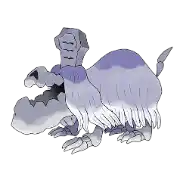
N°0972 · Generation 9
Houndstone
Houndstone is a pure Ghost-type Pokémon and the final evolution of Greavard, known for its high HP, solid defensive presence, and devastating late-game power that scales with the number of foes it has defeated.
Share this Pokémon
Characteristics
- Height:
- 2.00
- Weight:
- 15.00
Base stats
Total: 488Combat strengths and weaknesses
Damage multiplier taken by Houndstone depending on the attacking move's type. ×2 and ×4 are the attacks to avoid.


Resistances - weak attacks


Immunities - no damage taken




The real price of your cards
Prices by language and condition, a card scanner, your collection's value and alerts when a price moves.
Evolutions

Additional information
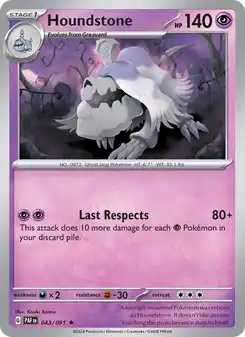
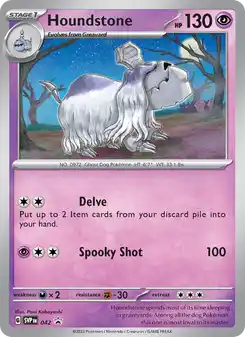
Pokémon Cards (9)









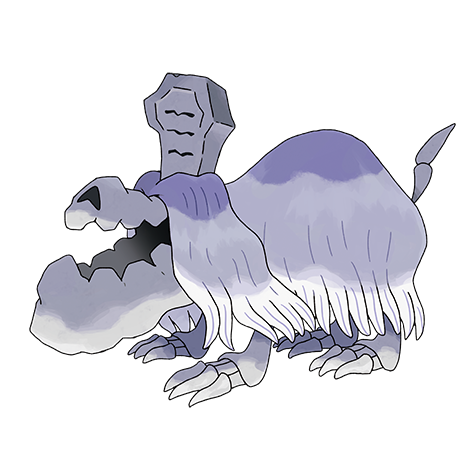
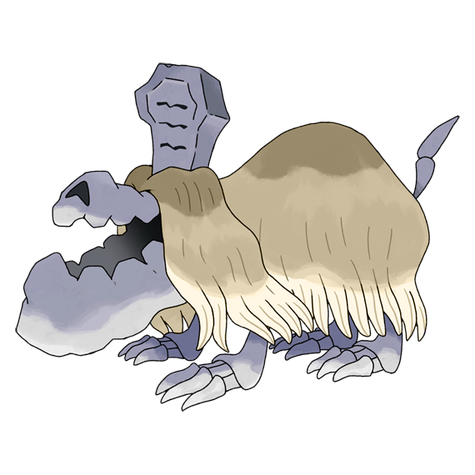
Official artwork
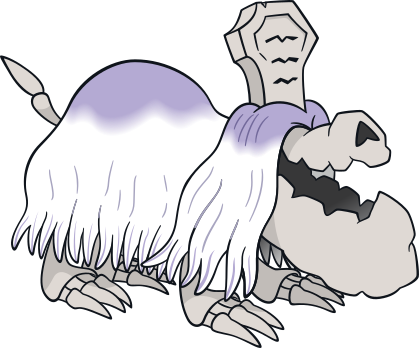
Base sprites


Pokémon Home


Dream World
Showdown


Detailed information
General Overview of Houndstone
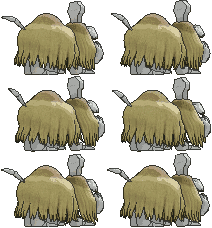
Houndstone is a Ghost-type Pokémon introduced in the ninth generation, appearing alongside Pokémon Violet and Pokémon Scarlet. It is known in Japanese as ハカドッグ. Houndstone represents the final evolution of Greavard, a canine Pokémon with a deep connection to loyalty and protection beyond death.
In the Pokédex, Houndstone is presented as a faithful Pokémon that watches over forever the humans or places it was attached to in life. Its design evokes a dog covered in sand and stone, reinforcing its ties to ruins, the earth, and desert areas. For players, Houndstone is particularly interesting thanks to its Defense-oriented stats and its access to very powerful Ghost-type attacks.
Type and Characteristics of Houndstone
Houndstone is a pure Ghost-type Pokémon. This type grants it strategic immunities, particularly against Normal- and Fighting-type attacks. In return, it remains susceptible to Ghost and Dark attacks, requiring good anticipation in battle.
Its HP are high, making it an excellent defensive wall. Its physical Defense is decent, while its Special Defense is more average. Its Speed is moderate, which often leads players to use it in strategies based on endurance, progressive damage, or priority moves.
Evolution and How to Obtain It
Houndstone is the direct evolution of Greavard. The evolution is triggered when Greavard levels up after having walked a certain distance in free exploration mode with its Trainer. This original mechanic requires the player to genuinely interact with the Pokémon in the open world.
This evolution is generally reached at an intermediate level, allowing Houndstone to be integrated fairly early into a team during the main adventure of Pokémon Violet. There is no known alternate form or Mega Evolution for Houndstone.
Stats, EVs, and Strategic Potential
Houndstone has a high HP base, making it very durable over time. Its Attack is decent and allows it to deal notable damage, especially with Ghost-type attacks that benefit from the STAB bonus. As its Speed is limited, it is often optimized with EVs invested in HP and Defense.
Strategically, Houndstone is often used as a defensive pivot or as a slow sweeper under certain conditions. It can take advantage of moves that boost its power based on the number of opposing Pokémon it has knocked out, making it fearsome in the late game.
Notable Moves and Abilities
Houndstone has a wide range of Ghost-type attacks, including moves that deal heavy direct damage. It can also learn support moves to hinder the opponent or increase its own power. Certain moves learned via TM or HM further enhance its versatility.
Its passive abilities are particularly appreciated, as they can increase its resistance or power depending on the battle situation. This makes it a solid choice for both solo play and strategic battles.
Pokémon Cards and TCG Presence
Houndstone also appears in the Pokémon Trading Card Game. Cards featuring its image often highlight its Ghost type and its damage output that scales with cumulative knockouts. Certain promotional cards or those from recent Pokémon Violet sets offer interesting effects for control- or attrition-oriented decks.
Houndstone cards are sought after by collectors for their dark aesthetic and their direct link to Greavard and the Houndstone line. They fit perfectly into Ghost-type strategies built around progressive pressure on the opponent.