


Share this Pokémon
Characteristics
- Height:
- 0.50
- Weight:
- 12.00
Base stats
Total: 330Combat strengths and weaknesses
Damage multiplier taken by Chinchou depending on the attacking move's type. ×2 and ×4 are the attacks to avoid.


Resistances - weak attacks


Your Pokédex, in cards
Every card of every Pokémon, what you already have and what you're missing.
Evolutions


Additional information
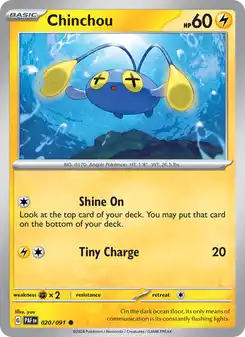
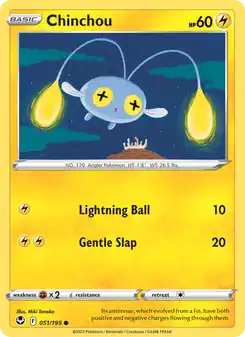
Pokémon Cards (26)
Showing the latest 12






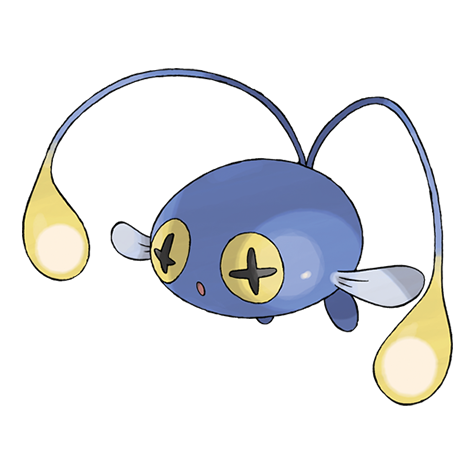
Official artwork

Base sprites


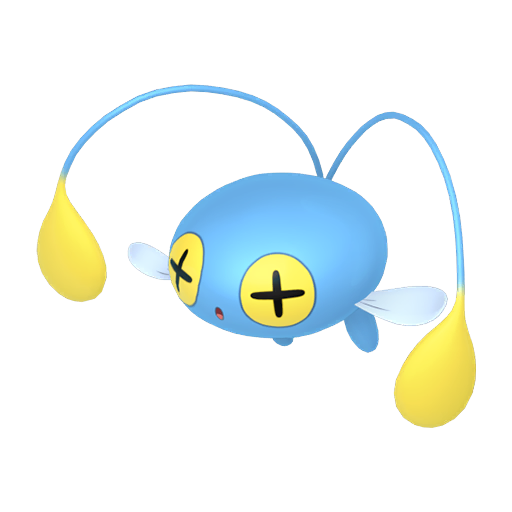
Pokémon Home

Dream World
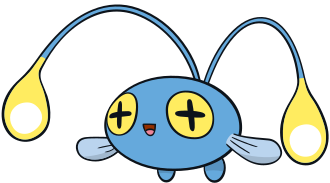
Showdown


Detailed information
General overview of Chinchou
Chinchou is a Water- and Electric-type Pokémon introduced in the second generation. Its Japanese name is チョンチー. This aquatic Pokémon is easily recognizable thanks to its two long luminous antennae, which serve both to attract prey and to generate electricity in battle.
In Pokémon adventures, Chinchou is often encountered in the ocean depths or near coastlines, where it swims slowly in groups. Small in size but full of resources, it surprises many trainers on their first encounter thanks to its rare dual typing at that stage of the game. It can quickly become a reliable ally for progressing through the story and navigating maritime routes.
Stats and combat potential
Chinchou has balanced stats oriented toward endurance. Its HP is decent for a basic Pokémon, allowing it to stay on the field for a long time. Its Special Attack is more interesting than its physical Attack, encouraging a playstyle centered on Electric- and Water-type ranged moves.
Its Defense and Special Defense are average, but sufficient to absorb several hits during the early hours of the game. Its Speed remains modest, which sometimes requires anticipating opponent attacks. In terms of EVs, Chinchou is often used to train HP or Special Attack depending on the chosen strategy.
Type, weaknesses, and resistances
The Water and Electric typing gives Chinchou an interesting defensive profile. It resists Water, Flying, Steel, and Fire attacks well. However, it has a significant weakness against Ground, which completely nullifies its Electric moves. This weakness must be taken into account during encounters against Ground-type Pokémon.
This type combination makes Chinchou particularly useful against many aquatic opponents encountered early in the game. It can thus secure difficult battles for young players or beginners, while remaining relevant in more advanced teams.
Evolution and progression
Chinchou evolves into Lanturn starting at level 27. This evolution greatly improves its overall stats, particularly HP and Special Attack. Lanturn then becomes a defensive cornerstone capable of enduring long battles while dealing consistent damage.
Before evolving, Chinchou can already learn useful moves such as Thunderbolt, Confuse Ray, and Bubble Beam. These moves facilitate progression through the Pokédex entries and allow various enemy types to be handled without difficulty.
Notable moves and abilities
Chinchou naturally learns Electric and Water moves suited to its role. Thunder, Thunder Wave, and Surf are often prioritized once the evolution is reached. It can also use support moves to hinder the opponent and help allies in double battles.
Through TMs, it is possible to optimize its set to cover more situations. This makes it a versatile choice for players who enjoy exploring different strategies without constantly switching Pokémon.
Chinchou in the collectible card game
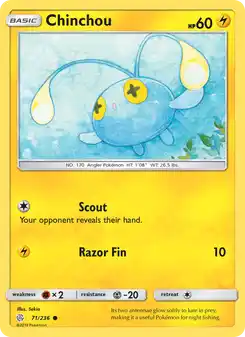
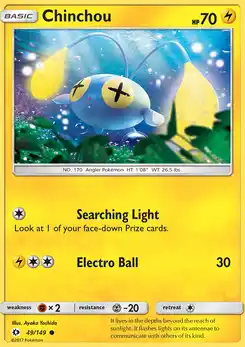
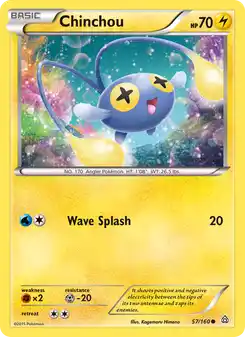
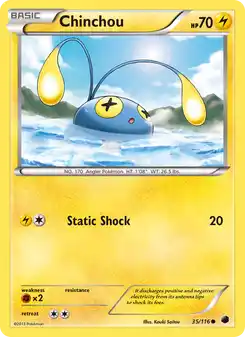
In the Pokémon Trading Card Game, Chinchou regularly appears as an easy-to-include basic card in an Electric or Water deck. Its cards often highlight its support role, with low-energy attacks or paralysis effects.
Some editions feature illustrations showing Chinchou resting peacefully in the ocean depths, reinforcing its image as a quiet but full of potential little Pokémon. These cards are appreciated by collectors and children discovering the game alike.
Interest for players
Chinchou is a solid choice for starting an aquatic adventure while maintaining an Electric advantage. Its ease of use, natural progression, and reliable evolution make it a Pokémon appreciated across generations. It can accompany trainers on long journeys and remain useful well beyond its first encounters.